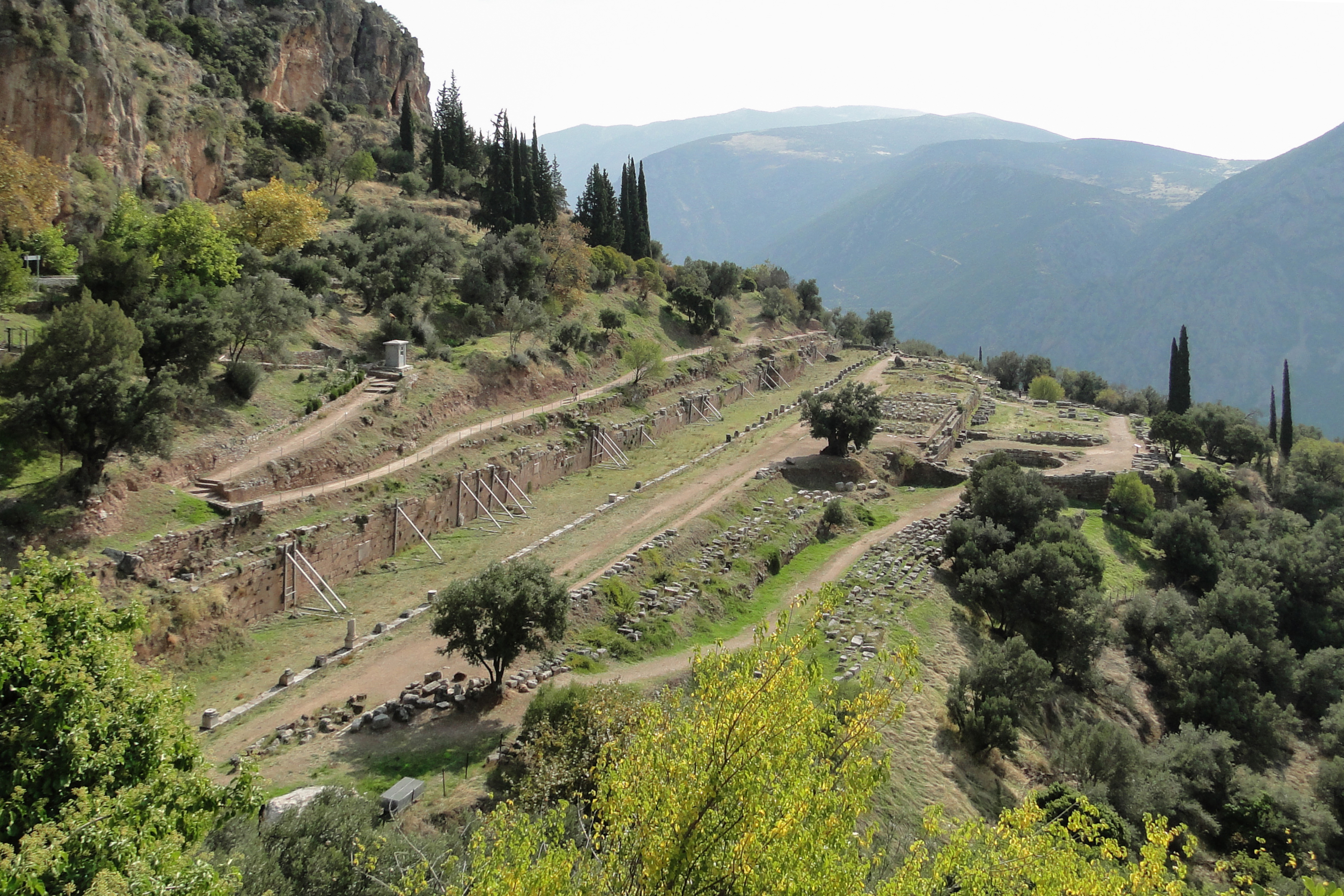
Gymnasium at Delphi
Lord Byron carved his name into a fallen column here, and you can still see it today. He was not the first traveler to leave a mark on the Gymnasium at Delphi, and he was far from the last. For centuries during the Ottoman period, visitors lodged at the small monastery of Panagia, which had been built directly on top of the ancient ruins, and many of them scratched signatures into the marble drums of the colonnade lying scattered around them. When archaeologists finally excavated the site and re-erected the columns, the graffiti came up with them. The marks remain - a strange, accidental record of three thousand years of people drawn to this terrace on the slopes of Mount Parnassus.
A Terrace for Runners
The Gymnasium occupies two long terraces between the Sanctuary of Athena Pronaia and the Castalian Spring, the sacred fountain where athletes and pilgrims came to purify themselves before approaching the oracle. Built around 330 BC, the complex housed everything an ancient athlete needed: a covered running track, an open-air practice corridor, changing rooms, a wrestling court, and baths. The track itself - the xystos - was a roofed portico stretching the length of a stadion so runners could train through summer heat or winter rain. Eighty-three Doric columns of poros stone supported its roof. Centuries later, when Rome ruled the Greek world, the Doric colonnade was replaced with a marble Ionic one, but the column count stayed the same. Continuity through change. The floor was laid with sand to cushion the athletes' feet.
The Round Pool
Step down to the lower terrace and you find the palaestra, a square courtyard ringed by porticoes and small chambers. Inscriptions tell us how each room was used: a pool room here, a changing room there, a fighting room for wrestlers and pankratiasts. To the west, a circular pool ten meters across and nearly two meters deep still holds its shape in the soil. Water from the Castalian Spring fed this basin and then flowed into ten stone bathing tubs lined up alongside it - cold water, the only kind on offer, until the Romans arrived and added a heated bath nearby. Athletes preparing for the Pythian Games, the second-greatest games in the Greek world after Olympia, would have lined up at these basins. Sweat, oil, sand, and the cold shock of mountain spring water - the same ritual, day after day, for centuries.
Beneath the Monastery
What you see today was buried for most of recorded history. Sometime after antiquity, a small Byzantine monastery dedicated to the Dormition of the Virgin - the locals called it Panagia - rose on top of the ruined gymnasium. Travelers staying at the monastery slept and prayed atop the foundations of the wrestling school without knowing it. When French archaeologists arrived at the end of the nineteenth century to excavate Delphi, the monastery had to come down. Its frescoed walls were carefully detached and moved to the Byzantine and Christian Museum in Athens, where they still hang. Beneath the church floor, the diggers found something older still: traces of an archaic sanctuary, possibly dedicated to Demeter, suggesting the terrace had been sacred long before any athletes trained here.
Pythian Games and Apollo's Mountain
Every four years, athletes traveled to Delphi from across the Greek world to compete in the Pythian Games, held in honor of Apollo. The contests included foot races, wrestling, boxing, the brutal pankration, chariot racing, and - uniquely at Delphi - musical and poetic competitions, since Apollo was patron of both athletic and artistic excellence. The gymnasium's training track ran roughly the length of the stadion above, where the actual races took place. You can see the stadion higher up the slope, carved into the mountainside above the temple of Apollo. The geography is exhausting and theatrical: every step at Delphi is an ascent toward the oracle, and the whole landscape is staged like a series of altars rising toward the cave where the Pythia delivered her enigmatic prophecies.
Closed for Visitors
As of 2024, the Gymnasium area is closed to visitors. Concerns about the stability of the terraces and the columns have kept the gates locked while restoration work continues. From the path above, you can still look down on the round pool, the long line of the xystos foundations, and the columns Byron once leaned against. Most tourists hurry past, focused on the temple of Apollo and the dramatic Tholos at the Sanctuary of Athena. But the gymnasium is where Delphi reveals something quieter - the daily routine that filled the four years between each celebration of the games. The training, the bathing, the conversations on stone benches in the shade. The ordinary life that kept the sacred site running.
From the Air
Located at 38.4816°N, 22.5060°E on the southern slopes of Mount Parnassus in Phocis, central Greece. Cruising altitude 8,000-12,000 ft offers views of the dramatic Pleistos River gorge below the sanctuary. Nearest airports: Athens International (LGAV) about 180 km southeast, Nafplio Hellinikon (LGNF) southwest. Mountain weather can be turbulent; afternoon thermals build over Parnassus.