Gyokusen-ji: The Temple That Became America's First Embassy in Japan
A monument near the entrance reads: "This monument, erected in 1931 by the butchers of Tokyo, marks the spot where the first cow in Japan was slaughtered for human consumption." The parenthetical clarification -- "Eaten by Harris and Heusken" -- makes it sound almost like a crime report. This is Gyokusen-ji, a Soto Zen temple in the port town of Shimoda on the tip of the Izu Peninsula, where centuries of Japanese isolation collapsed in a rush of treaties, tsunamis, and bewildered diplomacy. A place of meditation became a consulate. A graveyard of Buddhist monks accepted the bones of American sailors and Russian seamen. And in the middle of all of it, one stubborn New Yorker demanded beef.
A Hermitage Pressed into Service
Gyokusen-ji began quietly. Temple records trace its origins to a Shingon Buddhist hermitage that converted to Soto Zen sometime during the Tensho period, between 1573 and 1592. For more than two centuries, the temple lived the unhurried rhythms of a small coastal settlement. Its current main hall, the Hondo, was completed in 1848 -- just in time to be commandeered. When Commodore Matthew Perry's Black Ships arrived to force open Japan's doors, the Tokugawa shogunate needed somewhere to house the foreigners who came in their wake. Gyokusen-ji, overlooking the harbor in the village of Kakizaki, was conscripted. Its monks made room for American naval officers, and its cemetery accepted the body of Robert Williams, a twenty-one-year-old Marine private from Hebron, Connecticut, who died of fever aboard the USS Mississippi in March 1854. He was the first, but not the last, foreigner buried in this Buddhist ground.
The Admiral Stranded by an Earthquake
In November 1854, Russian Admiral Yevfimiy Putyatin sailed into Shimoda harbor aboard the frigate Diana, hoping to negotiate a treaty similar to what the Americans had won through the Convention of Kanagawa. The shogunate directed Putyatin and his officers to Gyokusen-ji. Then an earthquake struck. The Ansei Tokai earthquake of December 1854 sent a devastating tsunami crashing through Shimoda, destroying the Diana. Stranded without a ship, Putyatin stayed on, negotiating from the temple grounds while his crew built a replacement vessel at nearby Heda. The result was the Treaty of Shimoda, signed on February 7, 1855, which opened the ports of Hakodate, Nagasaki, and Shimoda to Russian vessels and drew a boundary through the Kurile Islands between Urup and Iturup. Four Russian sailors who died during the long stay -- three from the Diana, one from the Askold -- were buried alongside the Americans in the temple cemetery.
Townsend Harris and the Reluctant Consulate
The Russians departed, but Gyokusen-ji's diplomatic career was just beginning. In 1856, Townsend Harris arrived as the first American Consul General to Japan, accompanied by his Dutch-born secretary-interpreter Henry Heusken. The temple was pressed into service once more -- this time as the official United States consulate, a role it would fill for two years and ten months. Harris was not an easy guest. He demanded milk and beef from his Japanese hosts, extraordinary requests in a country where Buddhist tradition discouraged the slaughter of cattle. The cow monument outside the temple today memorializes the result. Harris worked from the temple to negotiate what became the Treaty of Amity and Commerce of 1858, fundamentally reshaping Japan's relationship with the Western world. His personal effects, along with ukiyo-e prints and dioramas of the temple during the Bakumatsu period, fill the Townsend Harris Museum that the temple now maintains.
Eight Graves on Foreign Soil
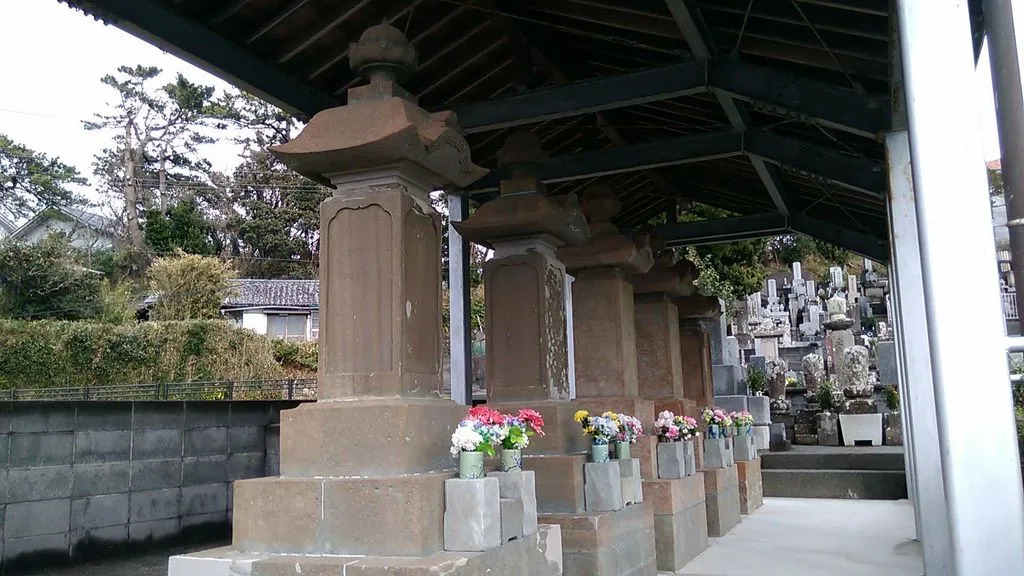
The small cemetery at Gyokusen-ji holds five Americans and three Russians -- eight men who died far from home during the chaotic 1850s. The names of the Americans survive in careful naval records: Robert Williams, the young Marine; G.W. Parish, a twenty-four-year-old sailor who died in a fall from the rigging of the USS Powhatan; Jas. Hamilton, an assistant surgeon on the USS Susquehanna; John D. Storm, a fireman from Schoharie County, New York; and Alexander Doonan, a Marine aboard the USS Mississippi who died in 1858. Their graves, tended by Buddhist monks, sit beneath pine trees in a temple that predates the United States itself. A National Historic Site since 1951, the cemetery is among the earliest physical evidence of American presence on Japanese soil.
Cows, Presidents, and Living Memory
Gyokusen-ji today is a working Soto Zen temple that doubles as a museum and memorial park. The cow monument, erected in 1931 by the butchers' guild of Tokyo, stands as perhaps the strangest diplomatic memorial in Japan -- a tribute to the first bovine sacrificed for Western appetites. Nearby, another marker commemorates the temple as the birthplace of Japanese milk production. President Jimmy Carter visited in 1979, adding his own plaque to the collection. The Townsend Harris Museum draws visitors who come to see the diary of Hamada Yoheiji, the headman of Kakizaki village who recorded the daily bewilderments of hosting the foreigners. From the temple grounds, the harbor at Shimoda stretches below, looking much as it did when Black Ships and Russian frigates crowded its waters. The monks still tend the graves of the eight foreign sailors, sweeping pine needles from headstones inscribed in English and Russian.
From the Air
Located at 34.676N, 138.962E on the southern coast of the Izu Peninsula, overlooking Shimoda harbor. From altitude, the temple sits in the village of Kakizaki on a hillside above the port. The Izu Peninsula's distinctive hook shape is unmistakable from the air. Shimoda harbor is visible as a small indentation on the southeastern coast. Best viewed at 2,000-4,000 feet AGL approaching from the south over Suruga Bay. The nearest airport is RJTO (Oshima Airport) on Izu Oshima island approximately 35 nautical miles southeast across Sagami Bay.