Halsingland
A golden goat rears up on a black field - the coat of arms granted to Halsingland in 1560, when King Gustav Vasa recognized this province's famous goat breeding. The symbol captures something essential about this stretch of central Sweden: prosperity carved from unlikely ground, wealth accumulated through determination rather than easy geography. Eighty-five percent of the land here is covered in forest, the soil mostly rocks and bogs, yet Halsingland's farmers became so wealthy they built two- and three-story mansions decorated with hand-painted interiors rivaling aristocratic estates.
The Helsings of Old
The people of Halsingland may appear in one of the oldest surviving works of Old English literature. In the poem Widsith, composed sometime in the 9th or 10th century, a people called the Haelsings are mentioned. Adam of Bremen wrote definitively of them around 1070, noting their contribution to the leidang - the Viking-age naval levy that could mobilize entire populations for war and trade. The Helsings were Swedish-speakers who inhabited the entire coastal region north of Uppland, a vast and somewhat imprecise territory. One persistent theory suggests that 13th-century settlers from Halsingland named the river Helsingfor in Finland - giving rise to the modern capital Helsinki - though linguists note that Finland Swedish dialects show more connection to Uppland than to Halsingland.
A Landscape Written in Impact Craters
The terrain of Halsingland rolls and folds toward the Gulf of Bothnia, hilly and rocky, descending from 671 meters in the western highlands to the coastal plains. The River Ljusnan threads through, providing the province's most fertile agricultural corridors in an otherwise challenging landscape of forest, rock, and bog. But the most remarkable geological feature lies in the north: the Dellen lake system, twin bodies of water filling ancient meteoric impact craters. The collision created something found nowhere else in Sweden - a type of volcanic rock called dellenite, named for this very place. When flying over Halsingland, these paired crater lakes appear as dark eyes staring skyward, a visible reminder of cataclysmic forces from beyond Earth.
Timber Kings and Painted Rooms
The wealth that built Halsingland came from its endless forests. The timber industry made fortunes for farmers who transformed their earnings into architectural statements. The Halsingegårdar - the decorated farmhouses of Halsingland - now hold UNESCO World Heritage status. These are not modest rural dwellings but towering two- and three-story mansions, some used only for celebrations while others served as 'bed-cottages' for extended families. Inside, the walls blaze with color: biblical scenes adapted to Swedish settings, wandering painters from Dalarna bringing their distinctive style of ribbons and oversized flowers, cautionary tales mixed with humorous vignettes. Expensive imported wallpaper was combined with folk painting into something entirely new. Around a thousand of these extraordinary farmhouses still stand across the province.
Where Bandy Is King
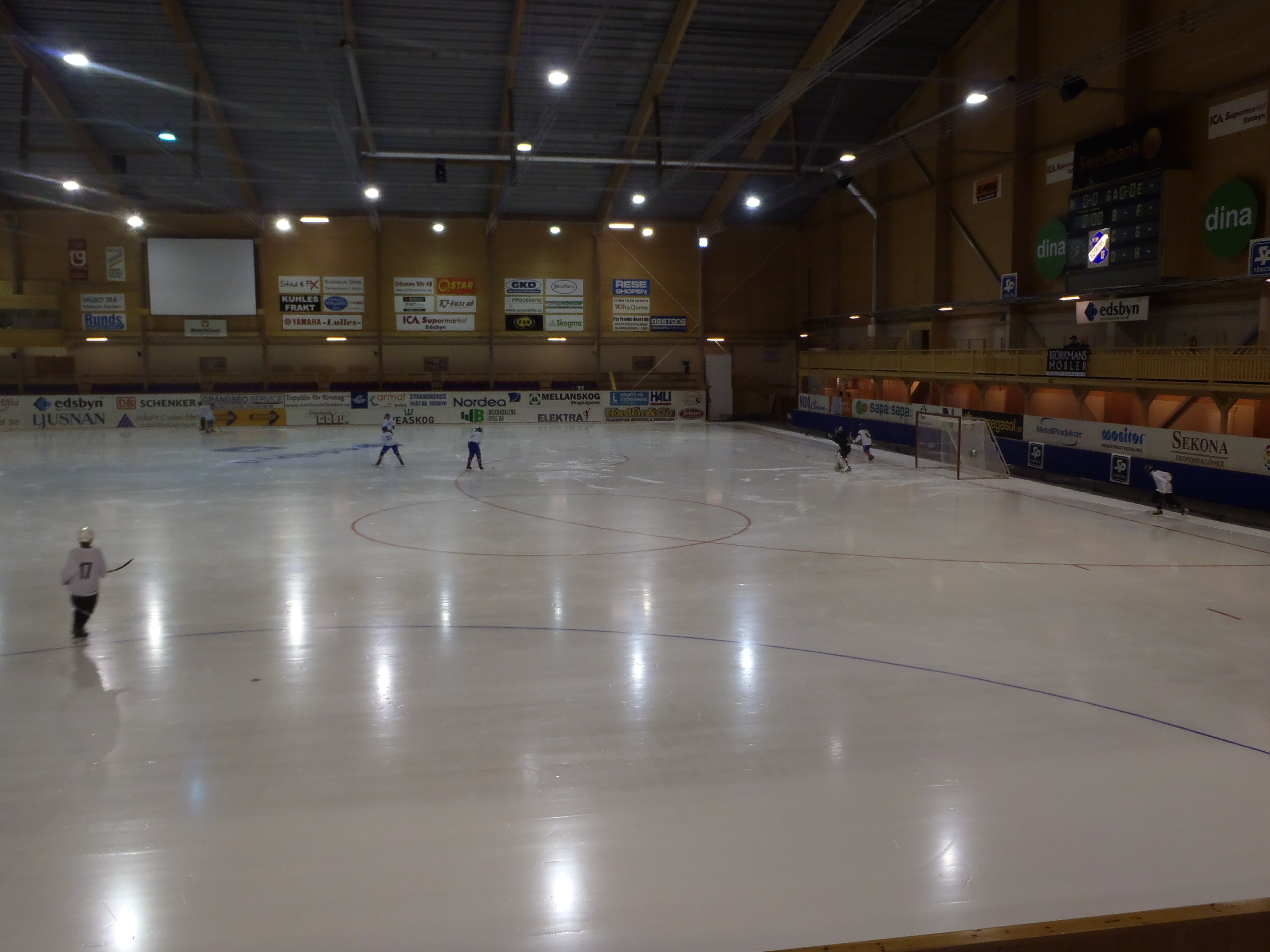
In most of Sweden, ice hockey dominates winter sports. Halsingland is different. Here, bandy - a fast-paced game played on ice with a ball rather than a puck, on fields the size of a soccer pitch - reigns supreme. It is the only Swedish district where bandy outdraws hockey. The Svenska Fonster Arena in Edsbyn claims the distinction of being Sweden's first indoor bandy venue. Four Halsingland clubs compete in Elitserien, the top tier of Swedish bandy. The province has also produced international stars: Hans Johansson from Edsbyn won multiple Swedish and world championships. Other notable natives include football star Tomas Brolin (1994 World Cup All-Star Team), actress Noomi Rapace of the Millennium series films, and Archbishop Nathan Soderblom, the 1930 Nobel Peace Prize laureate born in Trono in 1866.
A Province in Time
Halsingland's oldest city, Hudiksvall, received its charter in 1582. Soderhamn followed in 1620. Bollnas became the province's third and final city in 1942 - the last to receive such status before Sweden abolished city designations entirely in 1971. Today, Halsingland forms the northern part of Gavleborg County, with Princess Madeleine holding the ceremonial title of Duchess of Halsingland and Gastrikland. The province retains its identity as a historical and cultural entity, even as its population has declined relative to Sweden's growth. What remains constant is the landscape: the dark forests, the crater lakes, the painted farmhouses standing like folk art museums in the countryside, and the echoes of medieval Helsings who once gathered their longships at the king's command.
From the Air
Halsingland lies at approximately 61.51N, 16.51E in central Sweden along the Gulf of Bothnia coast. The province covers a large area with elevations reaching 671 meters in the western highlands. Key visual landmarks include the distinctive Dellen crater lake system in the north and the extensive forest coverage (85% of the land). The River Ljusnan provides a navigable reference through the terrain. Nearest major airport is Hudiksvall Airport (ESNH). Soderhamn Airport (ESNY) provides additional access. The terrain is generally hilly, descending toward the Baltic coast. Best viewed at 5,000-8,000 feet to appreciate the forest coverage and the remarkable crater lake formations.