H. P. Lovecraft
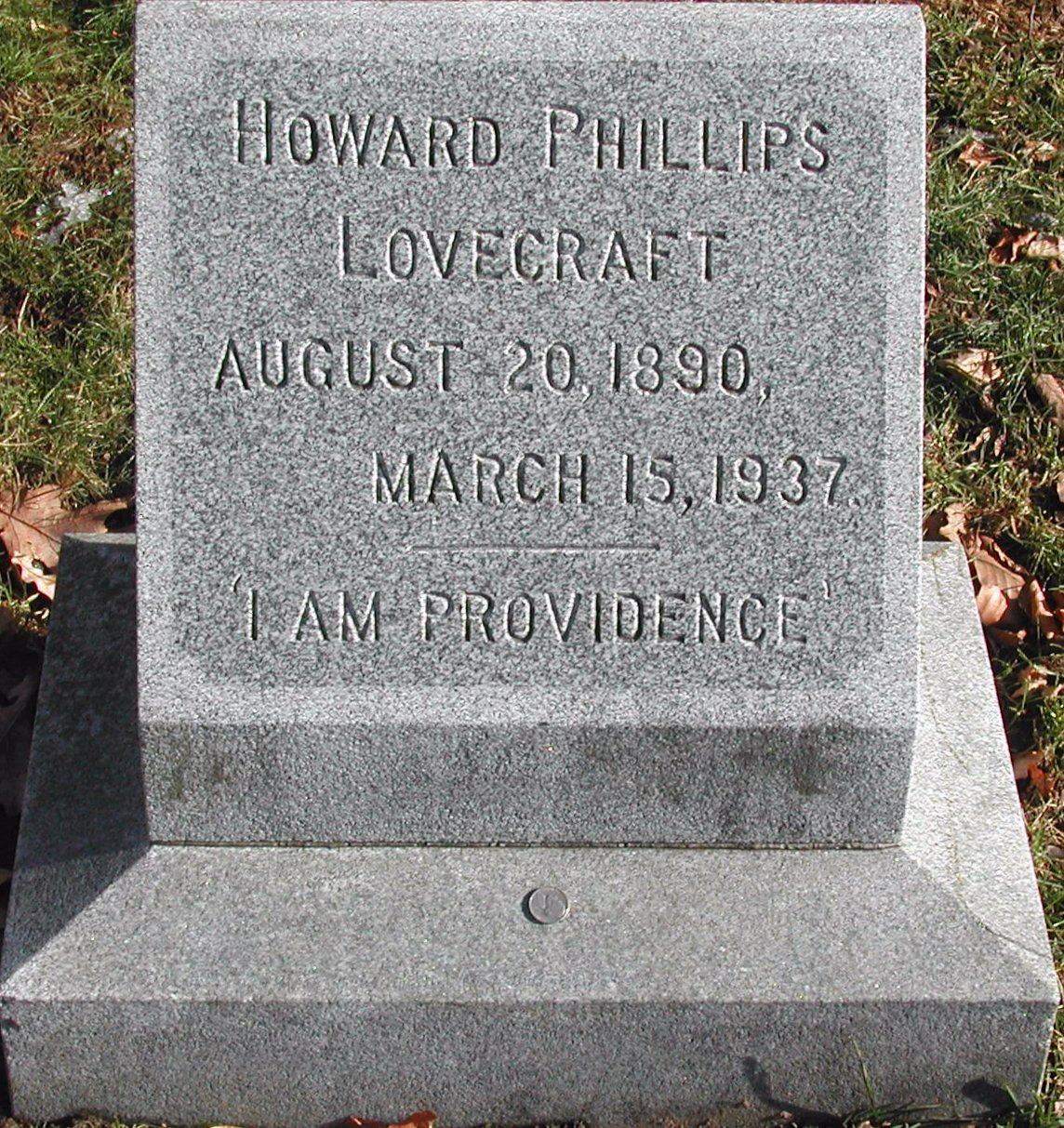
His headstone reads simply: I AM PROVIDENCE. Howard Phillips Lovecraft meant it literally. Born in 1890 at 194 Angell Street, he spent nearly his entire 46 years in Rhode Island's capital, and the city repaid the devotion by seeping into everything he wrote. The gambrel roofs of College Hill, the crooked lanes of the East Side, the spire of the First Baptist Church - these became the architecture of dread in stories that would reshape horror fiction long after Lovecraft died in poverty and obscurity in 1937. He invented cosmic horror, the idea that the universe is not malevolent but simply indifferent to human existence, and that true terror lies in glimpsing just how small we are. Today, the word 'Lovecraftian' appears in dictionaries. The Cthulhu Mythos spans books, games, films, and an entire subgenre of fiction. It all started on these quiet Providence streets.
A Grandfather's Gothic Tales
Lovecraft's childhood was shaped by loss and literature in roughly equal measure. His father, Winfield Scott Lovecraft, was institutionalized at Butler Hospital in 1893 after a psychotic episode and died there five years later. Young Howard was raised by his mother Susie and his maternal grandfather, Whipple Van Buren Phillips, in the family home on Angell Street. Whipple became the center of the boy's universe, introducing him to classical literature, English poetry, and - most fatefully - original weird tales of 'winged horrors' and 'deep, low, moaning sounds.' By age three, Lovecraft was reading. By seven, he was writing poems restyling the Odyssey. By eight, he had discovered astronomy and chemistry. When Whipple died in 1904 and the family's wealth evaporated, forcing Susie and Howard into a small duplex, Lovecraft considered ending his life. His scientific curiosity, he later wrote, was what kept him alive.
The Dreamer on College Hill
Lovecraft never graduated high school, never attended Brown University despite living in its shadow, and never held a steady job. What he did was write - obsessively, voluminously, for almost no money. He joined the United Amateur Press Association in 1914, published his first short story ('The Alchemist') in 1916, and by the early 1920s was producing the works that defined cosmic horror. 'Nyarlathotep' arrived in 1920, followed by 'The Nameless City' in 1921 with its immortal couplet: 'That is not dead which can eternal lie; And with strange aeons even death may die.' A brief, unhappy marriage took him to Brooklyn from 1924 to 1926, where he lost weight, lost his apartment to burglars, and wrote in despair. He fled back to Providence and never left again, composing 'The Call of Cthulhu' in the summer of 1926 shortly after his return. The final decade was his most productive: The Case of Charles Dexter Ward, At the Mountains of Madness, The Shadow over Innsmouth, and The Shadow Out of Time all poured out of his rooms at 10 Barnes Street and later 66 Prospect Street.
Providence as Nightmare
Lovecraft did not merely set his stories in New England; he transformed the region into something scholars call 'Lovecraft Country.' The real places of Rhode Island and Massachusetts became the raw material for his fictional geography. Arkham was based on Oakham, Massachusetts. Innsmouth drew from Newburyport. The Case of Charles Dexter Ward is, in part, a novel about Providence itself, its colonial houses and hidden cellars concealing horrors older than the republic. Lovecraft walked these streets on long nocturnal rambles, absorbing their atmosphere, and his fiction is saturated with the specifics of New England architecture, weather, and history. The gambrel roofs he described are still visible on Benefit Street. The Athenaeum library where he read and corresponded is still open. The Ladd Observatory where he peered at the stars as a boy still stands on Hope Street. Providence was not just his home; it was his primary literary instrument.
Cosmic Indifference
What made Lovecraft's horror different from everything that came before was its philosophical core. Earlier horror writers - Poe, Machen, Blackwood - traded in ghosts, curses, and the supernatural. Lovecraft traded in scale. His monsters are not evil; they are simply vast and unconcerned with humanity. Cthulhu sleeps in a sunken city. The Elder Things built civilizations before multicellular life existed on land. The Mi-Go mine minerals from distant hills. Humans who encounter these beings do not face judgment or punishment - they face irrelevance. Lovecraft called this philosophy cosmicism, and it emerged from his lifelong study of astronomy, his materialist worldview, and his reading of then-new developments in physics and biology. He saw humanity as a temporary accident in an indifferent universe, and he made that vision terrifying.
I Am Providence
Lovecraft died on March 15, 1937, of intestinal cancer, diagnosed only a month before his death because he feared doctors. He was 46, virtually unknown, published almost exclusively in pulp magazines, and unable to support himself from his writing. He was buried in the Phillips family plot at Swan Point Cemetery. For decades, he had no individual marker. In 1977, fans collected money for a headstone inscribed with the line from his letters: 'I AM PROVIDENCE.' The scholarly revival began in the 1970s, and today Lovecraft is regarded as one of the most significant American horror writers of the 20th century. Providence has embraced him in return. Walking tours trace his haunts on College Hill. The Providence Athenaeum displays his correspondence. The John Hay Library at Brown University holds his manuscripts. The city that shaped his nightmares has become a pilgrimage site for readers who find, in his strange and troubled vision, something that resonates far beyond the quiet streets of the East Side.
From the Air
Lovecraft's Providence is centered around College Hill on the East Side, roughly 41.854°N, 71.381°W. From altitude, the Rhode Island State House dome (white marble, fourth-largest self-supporting marble dome in the world) is the dominant landmark. College Hill rises east of the Providence River, with Brown University's campus visible as a cluster of Georgian and Victorian buildings. Swan Point Cemetery, where Lovecraft is buried, lies along the Seekonk River to the northeast. T.F. Green Airport (KPVD) is 8 nautical miles south in Warwick. Providence is best viewed at 2,000-4,000 feet AGL, where the colonial grid of the East Side contrasts with the modern downtown west of the river.