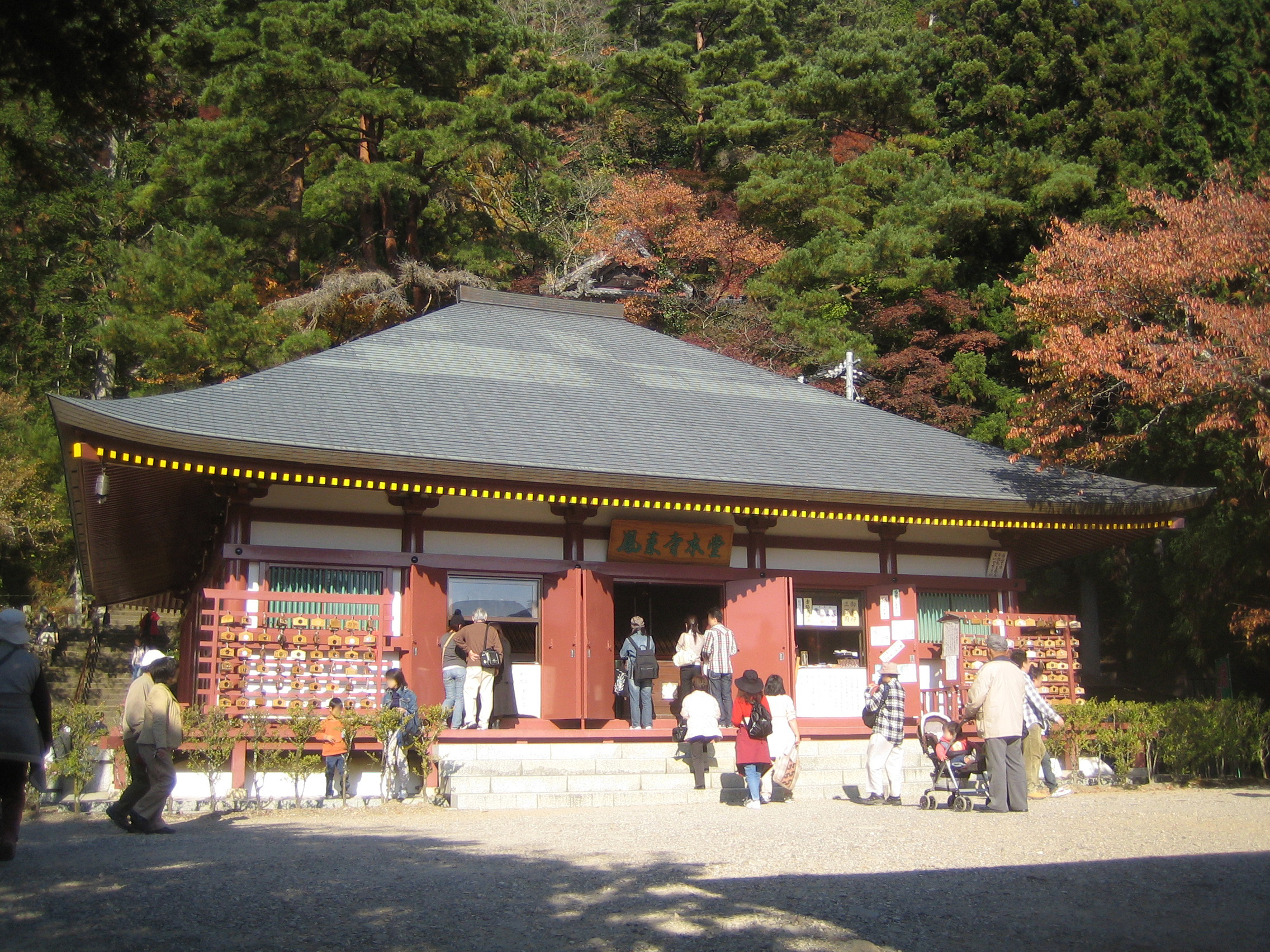
Hōrai-ji
There are 1,425 stone steps between the world below and Horai-ji. Each one was supposedly laid by Minamoto no Yoritomo, the first shogun of Japan, in gratitude for the mountain temple that sheltered him during rebellion. Whether or not Yoritomo personally placed every stone, the climb remains the same -- a winding ascent through dense forest on Mount Horai in what is now Shinshiro, Aichi Prefecture, rising toward a Shingon Buddhist temple that has burned, been stripped of its lands, lost its pilgrims, and still survived for over thirteen centuries. The grounds have held their designation as a Place of Scenic Beauty and Natural Monument since 1931, and the forest canopy overhead is home to the Eurasian scops owl, the official bird of Aichi Prefecture.
Gods Carved from Living Wood
The temple's founding story belongs to the realm of legend. In 702 AD, a holy ascetic named Ryushu Sennin is said to have climbed Mount Horai and carved statues of Yakushi Nyorai, the Buddha of healing, along with Nikko Bosatsu, Gakko Bosatsu, the Twelve Heavenly Generals, and the Four Heavenly Kings -- all from the living trunks of trees on the mountainside. When prayers at this remote shrine cured Emperor Mommu of an illness, the temple received imperial recognition and its place in the religious landscape was secured. The main image remains a statue of Yakushi Nyorai, the Medicine Buddha, tying the temple's identity to healing across its entire history.
Shoguns, Fire, and Confiscation
Horai-ji's history is a cycle of patronage and devastation. Minamoto no Yoritomo rebuilt the temple during the Kamakura period, and Adachi Morinaga added a chapel. But repeated fires during the Kamakura and Muromachi periods destroyed most written records. Archaeological evidence -- pottery shards and sutra mounds scattered across the site -- confirms the temple served as a center of both Buddhism and folk religion well into the Sengoku period. Then came Toyotomi Hideyoshi, who proved openly hostile to the temple. He confiscated most of its estates, leaving it with a revenue of just 300 koku. The blow was devastating. A temple that had survived centuries of warfare and fire nearly collapsed under the weight of a single warlord's displeasure.
Revival Under the Tokugawa
Recovery came through an unlikely patron: Odai no Kata, mother of Tokugawa Ieyasu. Her favor brought renewed attention to Horai-ji, and under Tokugawa Iemitsu, the third shogun, the temple's revenues were restored to 1,350 koku. Iemitsu also donated the construction of the Horaisan Tosho-gu shrine on the grounds in 1651, along with the Sanmon gate that still stands today. The temple straddled both Shingon and Tendai Buddhist sects, and its mountain location made it a popular side-trip for travelers walking the Tokaido road. For the first time in generations, Horai-ji thrived -- a mountain sanctuary enriched by shogunal patronage and the steady traffic of pilgrims.
When the Modern World Arrived
The Meiji Restoration of 1868 hit Horai-ji like a third catastrophe. The new government's forced separation of Buddhism from Shinto tore the Horaisan Tosho-gu away from the Buddhist temple. Much of Mount Horai was seized as national forest. Worse, the opening of the Tokaido Main Line railway rerouted travelers away from the old road, and the stream of pilgrims that had sustained the temple for centuries dried up. In 1905, Horai-ji was made a subsidiary of Horin-ji in Kyoto, which merged the remaining Tendai elements back into the Shingon tradition. The Main Hall burned down in 1915 and could not be rebuilt until 1974 -- nearly six decades of absence at the temple's heart.
The Vermillion Gate That Survived It All
One structure endured every upheaval: the Sanmon gate. This two-story Niomon gate, built in 1651 from zelkova wood and painted a deep vermillion, is one of the few surviving Edo-period structures on the grounds. Its copper-shingled roof rises in the elegant irimoya-zukuri style. Each face of the gate tells a different story in carved relief: bamboo and tigers on the front, peonies and lions on the back, waves and rhinoceros on the east, clouds and kirin on the west. The gate was designated an Important Cultural Property of Japan in 1953 and underwent major restoration in 1988. It stands at the foot of those 1,425 steps as both gatekeeper and promise -- proof that something here has always survived the climb.
From the Air
Horai-ji sits at 34.979N, 137.586E on Mount Horai near Shinshiro, Aichi Prefecture. The temple complex is nestled in dense mountain forest and is not easily visible from high altitude, but the mountain itself is a prominent feature in the landscape east of the Toyo River valley. Best viewed at 3,000-5,000 feet AGL. The nearest significant airport is RJNN (Nagoya Chubu Centrair International), approximately 50 nm to the southwest. Closer options include RJTY (Komaki) to the west. The mountainous terrain in this area requires caution at lower altitudes.