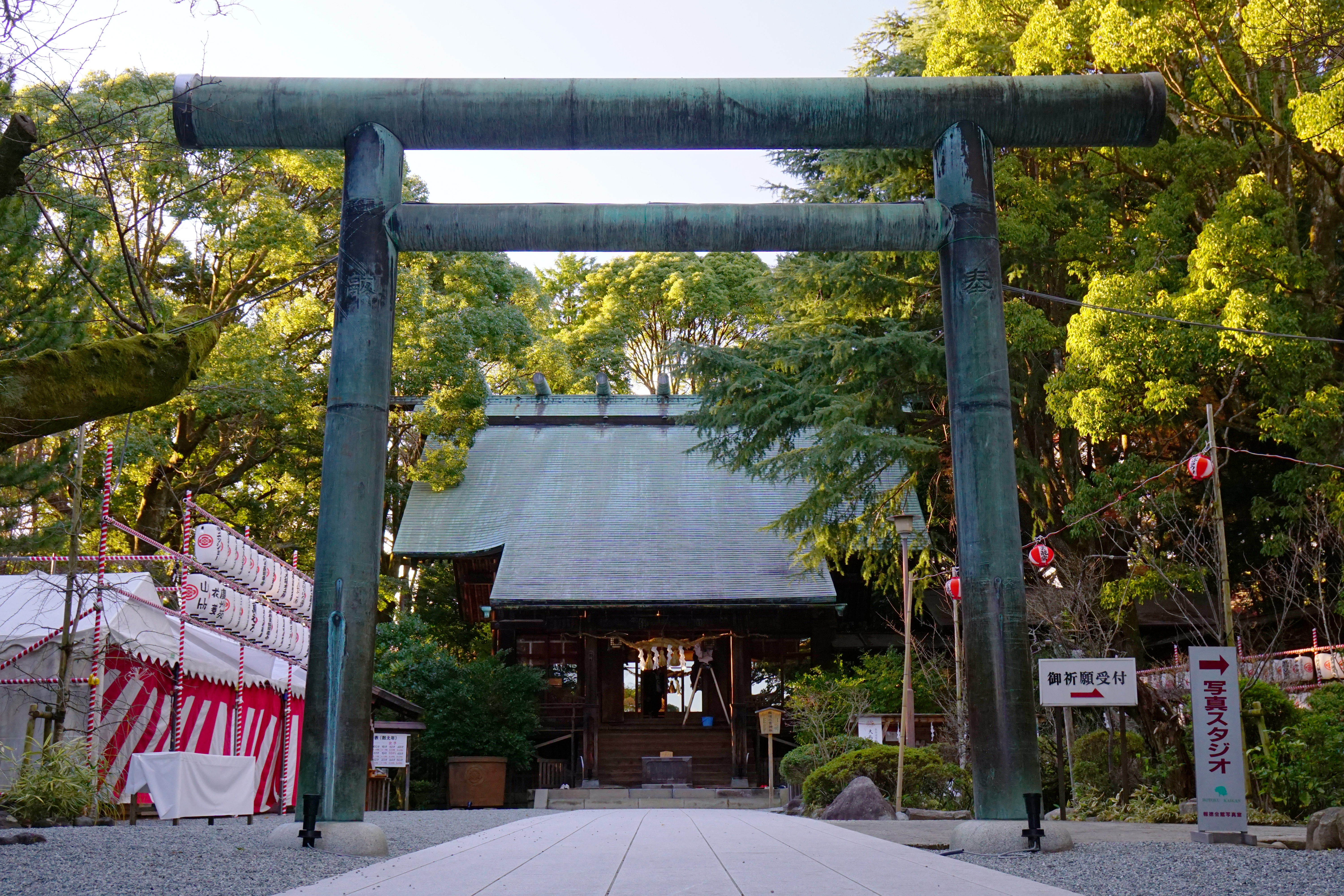
Hotoku Ninomiya Shrine
If you attended elementary school in Japan before the 1990s, you walked past him every morning: a bronze boy hunched under a bundle of firewood, reading a book as he walked. That boy was Ninomiya Kinjiro, and the statue was so ubiquitous that at one point practically every school in the country displayed one. The real Kinjiro grew up to become Ninomiya Sontoku, an orphaned peasant who taught himself economics by candlelight and revolutionized agriculture across entire feudal domains. His shrine stands on the grounds of Odawara Castle, in the city where he was born, a quiet place where the philosophy of repaying virtue still shapes the community around it.
The Boy with the Firewood
Ninomiya Kinjiro was born in 1787 to a farming family in the village of Kayama, just outside Odawara. Catastrophic flooding destroyed most of the family's fields in 1791, and by the time Kinjiro was fourteen, his father was dead. His mother followed two years later. Sent to live with relatives who viewed him as a burden, the boy spent his days laboring in the fields and his nights studying by the light of homemade candles, reading everything he could find about farming techniques and rural economics. The image that became iconic, a child carrying firewood on his back while reading, was not artistic invention but biography. That relentless self-education carried him from destitution to becoming one of the most influential agricultural reformers of the late Edo period, a man who rebuilt entire villages by applying his philosophy of hard work, thrift, and community obligation.
The Doctrine of Repaying Virtue
Sontoku's philosophy, which he called Hotoku, meaning the repayment of virtue, held that individuals must balance self-interest with collective good. He believed farmers and merchants should work hard to improve their own circumstances, then reinvest their surplus into the communities that sustained them. It was a radical idea in feudal Japan, where rigid class structures dictated that peasants simply produced and lords consumed. Sontoku put his theory into practice across multiple domains, reviving impoverished villages through a combination of agricultural innovation, communal savings programs, and moral education. By the time of his death in 1856, his methods had transformed the economic life of the Odawara fiefdom and beyond, earning him a legacy that the Meiji government would later elevate into a national model of civic virtue.
A Shrine Born of Gratitude
In April 1894, during the 27th year of the Meiji era, the Hotoku Association founded a Shinto shrine on the grounds of Odawara Castle to honor Sontoku's memory. The location was deliberate: Odawara was his birthplace, and the castle grounds placed his spirit at the heart of the city he had helped prosper. The main hall, the Honden, enshrines his spiritual presence. Beside it stands the Gokitouden, a secondary hall used for ceremonies when the main space is occupied. Between the second and third torii gates, the shrine has woven itself into daily life through two cafes, Cafe Kinjiro and Cafe Kankitsu Club, where visitors can buy original shrine goods and locally produced food. Across from the cafes, the Hotoku Kaikan hall hosts weddings, cultural events, and community projects, including an initiative called Kankitsu Club that supports local citrus farmers, keeping Sontoku's agricultural legacy alive in tangible form.
The Statues That Shaped a Nation
Beginning in the Showa period, which started in 1926, bronze statues of the young Kinjiro began appearing outside elementary schools across Japan. The image, a studious child carrying his burden without complaint, became the national symbol of self-discipline and perseverance. Generations of Japanese children grew up under his gaze, absorbing the implicit lesson: education and hard work could lift anyone out of poverty. In recent decades, many of the statues have been removed or controversially updated, with some schools replacing the walking figure with a seated one, citing concerns about reading while walking. But at the shrine in Odawara, the original story endures. A bronze statue of Sontoku stands along the approach, firewood on his back, book in hand, still embodying the idea that knowledge and labor are not opposites but partners.
From the Air
Hotoku Ninomiya Shrine sits at 35.250N, 139.153E on the grounds of Odawara Castle in Kanagawa Prefecture. From the air, look for the distinctive white castle keep and surrounding moat in central Odawara; the shrine grounds are located just south of the main castle tower, within the broader castle park. Odawara sits along the coast where the Tokaido corridor passes between Sagami Bay and the Hakone Mountains. Nearest airport is RJTT (Tokyo Haneda), approximately 75 km northeast. The Shinkansen line runs through Odawara Station, visible as a major rail junction just north of the castle. Recommend viewing at 3,000-5,000 feet. The castle keep and surrounding greenery provide a clear landmark even from moderate altitude.