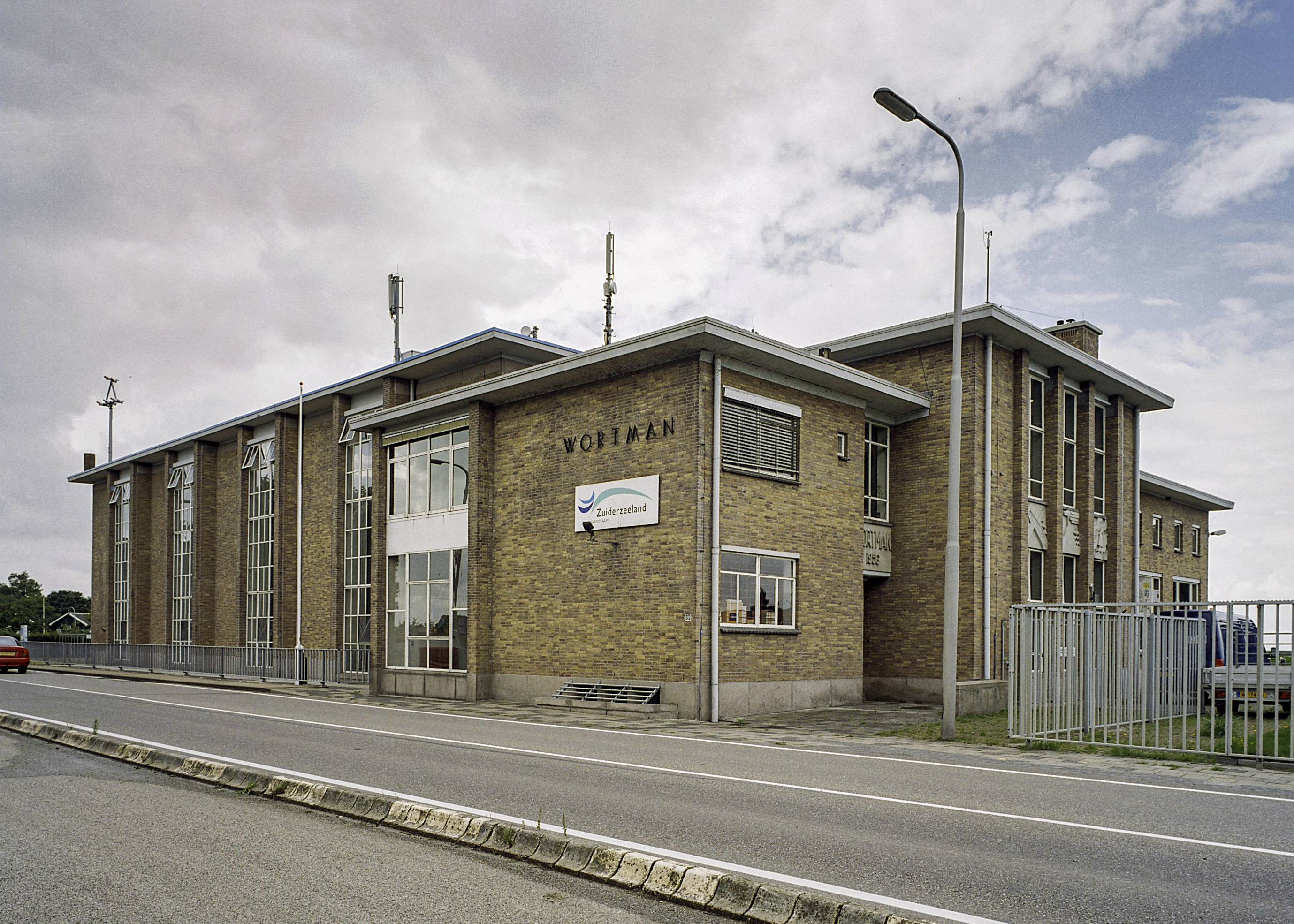
H. Wortman Pumping Station
On 13 September 1956, the last gap in the Lelystad dyke was closed and Queen Juliana stepped up to declare a pumping station operational. The water on the inside of that dyke had been part of the Zuiderzee since the thirteenth century, when a North Sea storm punched through the dunes and drowned an entire region. Now, on a stretch of dyke that did not yet have a city behind it, four American-made centrifugal pumps - paid for through the Marshall Plan - began the slow, deliberate work of moving the sea aside. The H. Wortman Pumping Station was about to drain East Flevoland. Three years later, where this building's outfall poured into what is now the Markermeer, there would be farms.
The Man on the Sign
The station is named for Hendrik Wortman, born 1859 and trained as a civil engineer at a time when the idea of damming and draining the Zuiderzee was still a national daydream. When Queen Wilhelmina gave royal assent to the Zuiderzee Works in 1918, the project needed someone to actually lead it. In 1919, Wortman was appointed director-general of the Zuiderzee Works Service. He shepherded the early construction of the Afsluitdijk, the thirty-two-kilometre barrier dam that would seal the Zuiderzee from the North Sea entirely. He died in 1939, two years after that dam was closed, never seeing the polders his organization had been designed to create. Naming the second great drainage pump after him was an act of remembrance - and a quiet acknowledgment that the men who imagined this landscape did not always live to walk on it.
Architecture for Machines
Dirk Roosenburg designed the building - the same Roosenburg whose architectural firm became LIAG Architecten, and whose grandson Rem Koolhaas would go on to found the modernist powerhouse OMA. His Wortman station is a study in honest industrial form. A long, single-storey machine hall sits on a concrete substructure that hides the real action: the suction and pressure shafts running down into the polder. The superstructure rises in alternating panels of brick and glass, originally framed in steel, later replaced with aluminium. On the southwest facade a stone relief depicts three figures - a woman who stands for the sea, a child who stands for the new land, and a man who will inhabit it - surrounded by fish, shells, and a beaver. It is an old, almost mythic story, carved in 1956: water surrendering ground to people. Inside, the engine room holds four centrifugal pumps mounted on concrete volutes, each driven by a seven-cylinder diesel and each capable of moving 500,000 litres per minute.
Eighteen Hours, Then Twenty-Four
Excavation of the construction pit began in 1951; the first pile was driven in September 1952. On 13 September 1956 the Lelystad dyke closed, the queen spoke, and operations were officially declared open - though the building was not actually finished. Pumping paused for completion work. On 17 November 1956, two of the initial three pumps began running eighteen hours a day. Soon a third pump joined, and drainage went to round-the-clock. The fourth pump - foreseen in the original design - was installed several years later. Together with the Smeenge pumping station to the north and the H. J. Lovink station near Biddinghuizen to the south, the Wortman ran water out of the polder until 27 June 1957, the day East Flevoland was officially declared dry. The land directly around the station, having been the deepest part of the former seabed, stayed swampy for years afterward. Agriculture had to wait.
After the Reclamation
These three stations did not stop work in 1957. They were called back into service through the 1960s to drain the much larger South Flevoland polder, completed in 1968 - the project that produced the land beneath Almere and the Oostvaardersplassen. In May 1987, a fire blamed on engine failure tore through the Wortman engine hall; damages ran into the millions of guilders and the station was offline for weeks. After repair, life settled into a quieter rhythm. The pumps now run only in exceptional circumstances - heavy rainfall, storm surges, the rare crisis the automated drainage cannot handle alone. In 2017 the city of Lelystad designated the building a municipal monument as part of the Werkeiland, the working island where Lelystad's construction crews first lived. Tour buses now stop on the dyke. Visitors stand where Juliana stood. Below the lock called the Noordersluis - sixty-five metres long, eight metres wide - shipping still moves between the polder canals and the Markermeer beyond.
From the Air
The H. Wortman Pumping Station sits at 52.50N, 5.42E, on the Oostvaardersdijk along the southwest edge of Lelystad, where the polder meets the Markermeer. Look for a long, low building with alternating brick-and-glass facades immediately beside the dyke, with the Noordersluis lock and a small cluster of staff houses to one side. The Oostvaardersplassen nature reserve lies just southeast - a vast, marshy expanse that is itself an accidental product of the reclamation. From altitude, the Wortman's outfall channel cuts a visible scar through the dyke. Nearby airports: Lelystad (EHLE) 6 NM east-southeast, Schiphol (EHAM) 22 NM southwest.