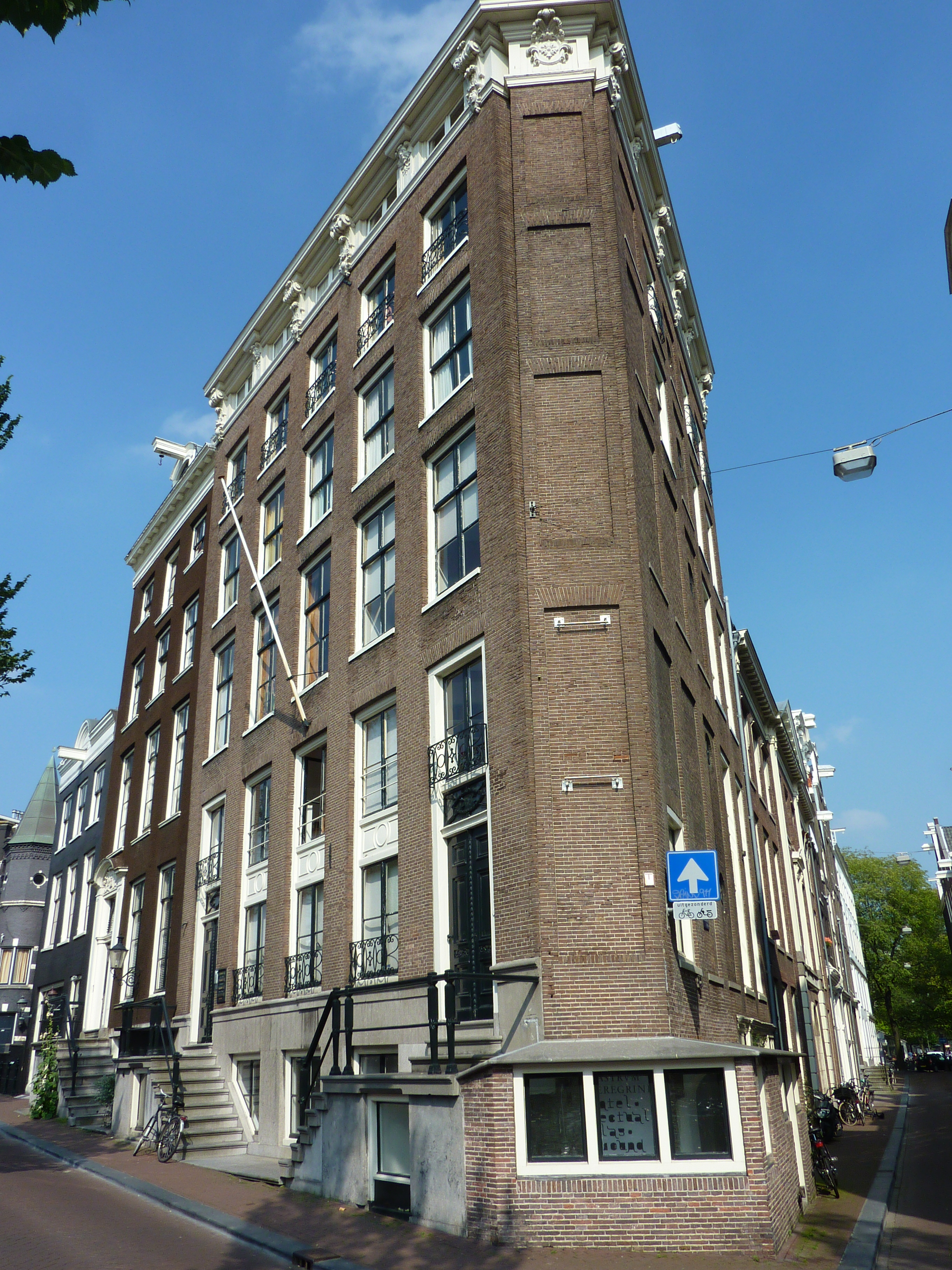
H401
Three young men climbed the narrow stairs at Herengracht 401 in 1942 and did not come back down again for almost three years. Below them, the Amsterdam canal froze and thawed and froze again. German soldiers walked the bridges. The woman whose flat now hid them, the Dutch-Austrian artist Gisele van Waterschoot van der Gracht, had moved into the upper floors only the year before. She was thirty when the occupation began. She would be ninety when she died in this same building in 2013, having lived through the war, the postwar publishing of a secretive German literary circle around the poet Wolfgang Frommel, the 1997 Yad Vashem recognition as Righteous Among the Nations, and finally the reckoning that came after her death. The building, now called H401, holds all of it at once.
A Hiding Place in Plain Sight
Gisele was born in The Hague in 1912 to a Dutch geologist father and an Austrian baroness mother. Her childhood swung between Europe and the United States, between Sacred Heart boarding school and her grandmother's castle at Hainfeld. She studied etching and engraving in Paris at the Academie Julian, won an honorable mention at the 1931 Salon, and by 1939 had her own studio and her first commission for stained glass windows in a Limburg church. Through the painter Adriaan Roland Holst she met Frommel, a German poet who had fled his country shaken by its politics. When the deportations of Dutch Jews began in 1942, Frommel and Gisele began hiding young Jewish men, including the artists Buri Wongtschowski and Claus Bock, in the flat at Herengracht 401. The men survived. Liberation came on May 5, 1945.
The Circle, the Press, the House
After the war the hiding place became a press. Frommel kept a circle around him at Herengracht 401, modeled on the literary brotherhood of the German poet Stefan George whom he revered. They published, they held reading sessions, they lived a life of intentional secrecy. Gisele financed much of it. In 1957, with money inherited after her mother's death, she finally bought the entire building. The publishing went on for decades. In 2008 the activities shifted again: the press closed, and the foundation reopened as a public cultural center under the name Castrum Peregrini, devoted to vrijheid, vriendschap, en cultuur, the three watchwords of freedom, friendship, and culture that Frommel had used since the war.
A Reckoning After Death
Gisele died in May 2013. Four years later, in 2017, Frank Ligtvoet, a man close to the circle, used the word misbruik in public: abuse. The foundation hired an independent commission under Frans Bauduin to investigate Castrum Peregrini's history from 1942 to 1986. The commission's findings, published in Dutch and German, concluded that Frommel had abused young men and women drawn into his circle over many decades. Gisele, the report acknowledged, had been excluded from the circle's inner activities and was often abroad, but the commissioners accepted that she must have been aware of certain behaviors. In 2019 the foundation changed its name to H401 and remade its mission. It now runs thematic programs on traumatic heritage, on contested colonial pasts, on collective memory and group fanaticism. Many of the European projects, including SPEME and the Heritage Contact Zone, take this house and its history as a starting point.
What the House Holds Now
From the canal outside, Herengracht 401 looks like any of the seventeenth-century merchant houses lining this stretch of Amsterdam's grachtengordel: tall narrow windows, a step gable, the soft brick faded by centuries of weather. Inside, the rooms still hold Gisele's paintings, the press archives, the staircase that the hidden youths climbed. The foundation has chosen not to scrub its complicated history but to use it. Artists in residence work here on questions of memory and silence. The 2024-2026 Contested Desires project brings nineteen partners from around the world to ask how colonial pasts shape present cultural identities. The house that hid three young Jewish men in 1942 has become a slow public conversation about what it means to remember accurately: the rescues and the harms, the courage and the complicity, held in one set of rooms.
From the Air
Located at 52.3678N, 4.8872E along the Herengracht canal in central Amsterdam, between the Singel and Keizersgracht in the UNESCO-listed canal ring. The individual building is difficult to distinguish from cruising altitude but sits within the distinctive horseshoe pattern of canals that defines central Amsterdam. Nearest airport: Amsterdam Schiphol (EHAM), approximately 9 km southwest. Useful visual references are the spire of the Westerkerk to the west and the Royal Palace on Dam Square to the east.