Habitat 67
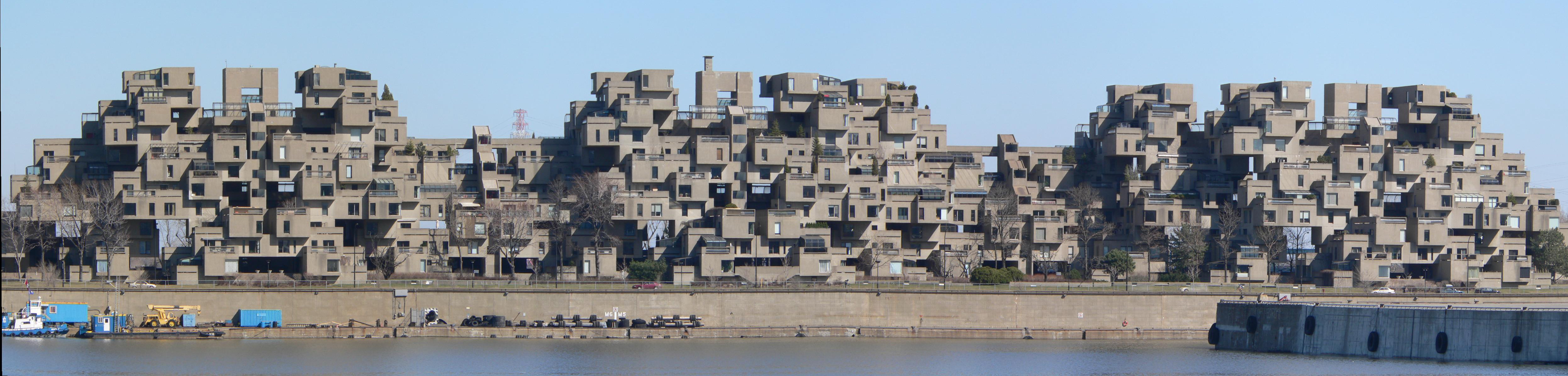
The first models were built out of Lego bricks. That detail alone captures something essential about Habitat 67: it began as a young architect's audacious game of stacking blocks, and it never quite stopped being one. Moshe Safdie was just 23 years old when he proposed his McGill University undergraduate thesis as a real pavilion for Expo 67, Montreal's World's Fair. The concept was deceptively simple -- mass-produce identical concrete boxes, crane them into place, and let each resident's rooftop become the neighbor below's private garden terrace. The result, rising from Cite du Havre on the Saint Lawrence River, looked like nothing the world had ever seen: a cascading mountain of 354 interlocking modules that somehow managed to feel both monumental and intimate at the same time.
A Fairy Tale in Concrete
Safdie's path from student sketch to built reality reads like an improbable screenplay. After graduating from McGill, he left Montreal to work under the legendary Louis Kahn in Philadelphia. Then his former thesis advisor, Sandy van Ginkel, pulled him back with an irresistible offer: help develop the master plan for Expo 67. Safdie seized the moment and pitched his thesis as a living pavilion. Despite his youth and inexperience, he won the commission -- an opportunity he later called "a fairy tale, an amazing fairy tale." The fairy tale came with hard constraints. His original vision called for 1,200 apartments. Budget reality slashed that to 158 units, funded at roughly CA$22.4 million by the federal government. The structural engineer August Eduard Komendant, a pioneer of prestressed concrete, figured out how to make the stacked geometry actually stand. Each apartment received a moulded plastic bathroom and a modular kitchen, prefabricated components that could be installed before the boxes were even lifted into position.
A Village in the Sky
Walk through Habitat 67 today and the original ambition still registers in your bones. Semi-covered walkways thread between clusters of units like streets in a Mediterranean hill town. Rooftop gardens cascade overhead. Every apartment has at least one private outdoor terrace, and many have two or three, each one the roof of the unit below. The complex was designed so that no resident looks into a neighbor's window -- a feat of privacy engineering that most conventional apartment towers never achieve. Safdie wanted to prove that high-density living did not have to mean dark corridors, identical boxes, and zero connection to the sky. In that sense, Habitat 67 succeeded brilliantly. What it did not achieve was affordability. The very novelty that made the building famous also made it desirable, and desirability drove prices far beyond what Safdie had envisioned for working families. Today, units sell for well over a million dollars.
Expo's Living Pavilion
Expo 67 ran from April to October 1967, attracting over 50 million visitors under the theme "Man and His World," borrowed from Antoine de Saint-Exupery's memoir. Housing was one of the fair's central preoccupations, and Habitat 67 became its most visible statement -- a thematic pavilion you could actually live inside. Dignitaries from around the world stayed in its units during the exposition. Visitors walked its elevated streets and peered into furnished model apartments, encountering a vision of communal urban life that felt simultaneously futuristic and ancient. The global press christened it a "fantastic experiment" and an "architectural wonder." Not everyone agreed. The Guardian later quoted The Walrus's assessment of the complex as a "failed dream," pointing to the gap between Safdie's egalitarian ideals and the luxury reality. That tension -- between utopian intention and market outcome -- remains one of Habitat 67's most compelling stories.
From Controversy to Icon
The building's journey after Expo has been one of slow vindication. In 1985, the tenants formed a limited partnership and purchased the complex from the Canada Mortgage and Housing Corporation, transforming it into what observers have called "a very successful co-op." Canada Post honored the structure with a commemorative stamp for Expo's 50th anniversary in 2017. Leonard Cohen filmed his music video for "In My Secret Life" among its concrete terraces, and the complex has graced album covers from Sweet Trip to Stars. In 2012, Habitat 67 won a Lego Architecture online poll, closing a circle that began with Safdie's original Lego-brick models. Safdie Architects and Epic Games later recreated the full, unrealized 1,200-unit vision in Unreal Engine 5, allowing people to finally walk through the complex as Safdie first imagined it. The building that began as a student thesis has become one of Montreal's most recognized landmarks -- brutalist, controversial, and utterly irreplaceable.
From the Air
Habitat 67 sits at 45.50N, 73.54W on Cite du Havre, a narrow peninsula jutting into the Saint Lawrence River south of Old Montreal. From the air, the complex is unmistakable: a terraced cluster of stacked concrete cubes that contrasts sharply with the surrounding port infrastructure. Best viewed from 2,000-3,000 feet AGL on approach from the south or east. The nearby Montreal/Pierre Elliott Trudeau International Airport (CYUL) lies 12 nm to the west. Montreal/Saint-Hubert Airport (CYHU) is 8 nm to the southeast. The Jacques Cartier Bridge and Parc Jean-Drapeau on Saint Helen's Island provide excellent visual reference points.