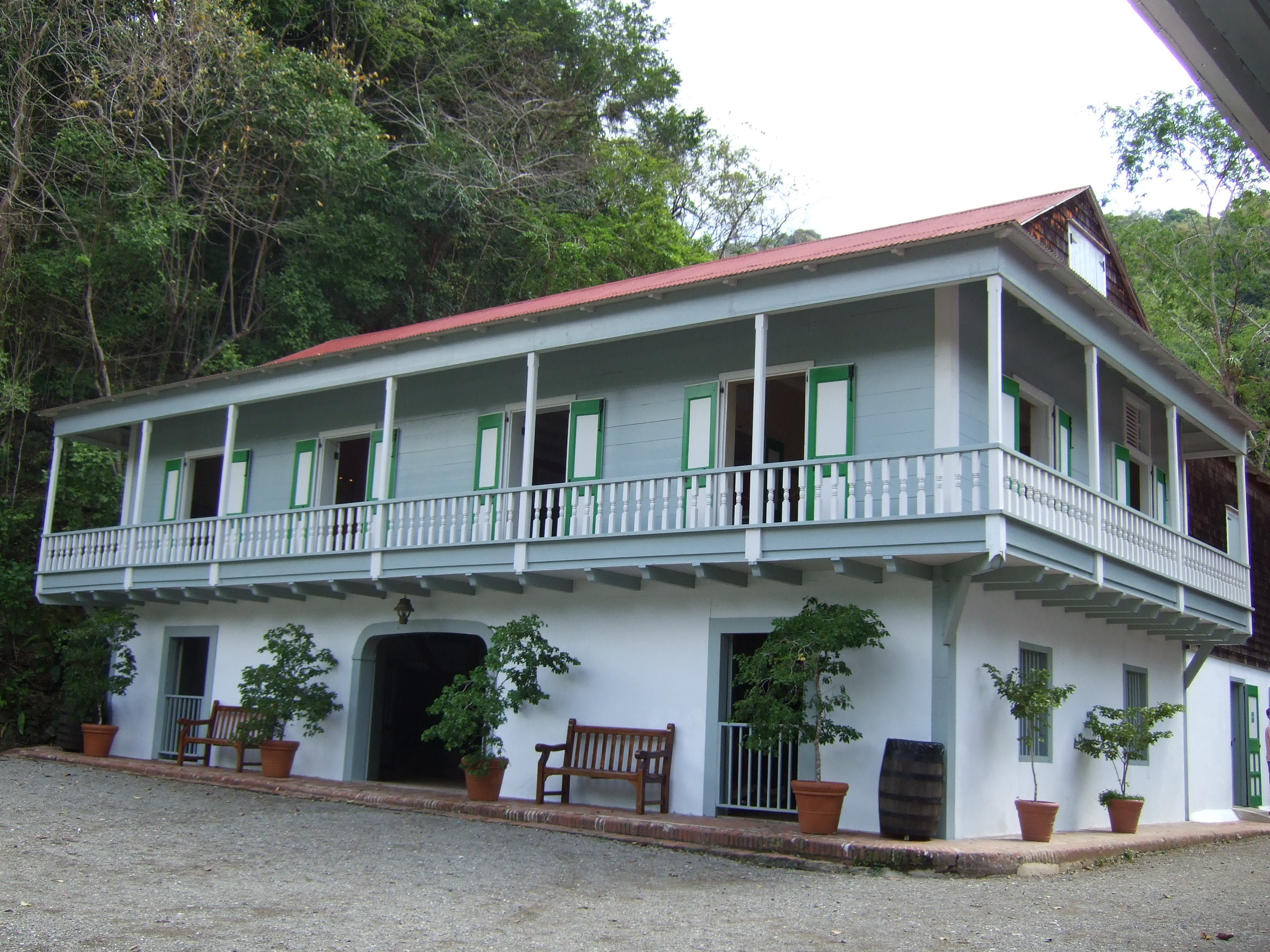
Hacienda Buena Vista
Hidden in a fold of Puerto Rico's Cordillera Central, seven miles north of Ponce, a sixteen-foot wooden waterwheel still turns. The Canas River drops through a 2,600-foot canal built by hand in the 1840s, and the water drives machinery that once ground corn and husked coffee for export to Europe. Hacienda Buena Vista is the only farm museum in Puerto Rico, but its significance runs deeper than heritage tourism. Beneath the corn mill floor sits a hydraulic turbine so rare that the American Society of Mechanical Engineers declared it a National Historic Monument of Mechanical Engineering -- the sole surviving example of a pre-Scotch type turbine, a missing link in the evolution of water-powered machinery.
A Soldier's Second Life
Salvador de Vives was a Catalan career officer who had spent twelve years in the Spanish Army when the Battle of Carabobo in 1821 shattered Spain's hold on Venezuela. Fleeing with his wife Isabel Diaz, his son Carlos, and two enslaved people, Vives arrived in Ponce on June 27, 1821, and found a city booming with sugar money. He could not afford the fertile coastal flatlands where sugarcane thrived, so he worked as a public notary for nearly two decades, saving enough by 1838 to purchase 482 acres of steep, forested terrain in Barrio Magueyes. The land was cheap precisely because it was remote and mountainous -- worthless for sugar. Vives saw possibility where others saw only difficulty, and by 1837 he had installed a corn mill, a coffee depulper, a cotton gin, and a rice husking machine, all powered by animals. These humble machines marked the beginning of what would become one of Puerto Rico's most successful mountain plantations.
Water, Gears, and Ambition
When Salvador died in 1845, his son Carlos inherited both the hacienda and an idea. Puerto Rico's coastal sugar plantations needed vast quantities of corn meal to feed the enslaved people who worked them, and Carlos realized this demand could finance something ambitious: a water-powered corn mill to replace his father's animal-driven equipment. Between 1845 and 1847, Carlos built a mill with a sixteen-foot wooden waterwheel, fed by a canal that channeled the Canas River's waterfall through 2,600 feet of carefully graded channel. He completed the canal in 1851, along with most of the structures visitors see today -- the manor house, the warehouse, the carriage house with its stables, and the quarters where enslaved people lived and labored until abolition came to Puerto Rico in 1873. After emancipation, the former slave quarters were converted into a coffee bean drying building, one of many reinventions that kept the hacienda alive.
The Golden Bean and Its Collapse
Carlos died in 1872, just as corn meal demand was fading and Puerto Rican coffee was rising to global prominence. His eldest son, a third-generation Salvador, pivoted the operation. In 1892 he installed coffee depulping and husking machinery in the old corn mill, running everything from the same waterwheel his father had built decades earlier. The timing was right: coffee from Puerto Rico's central mountains -- around Yauco, Ponce, Lares, Maricao, and Utuado -- was considered among the finest in the world, reportedly even favored at the Vatican. At its peak, Hacienda Buena Vista produced and processed over five tons of coffee annually for European export alone. Then came catastrophe. A series of hurricanes and politico-economic disasters at the turn of the twentieth century devastated the island's coffee industry. Production across all of Puerto Rico plummeted from 338 tons to just eight tons per year. By 1900 the hacienda had ground to a halt, and by 1937 it was little more than a weekend retreat for the Vives heirs.
A Machine No One Expected
The hacienda might have crumbled entirely if not for the Puerto Rico Conservation Trust, which purchased 86 of the original 500 acres in 1984. What the restorers found beneath the deteriorating mill floor astonished engineers: a hydraulic turbine that did not match any known design. It resembled a Scotch turbine but incorporated elements of the much older Barker reaction wheel, invented in the late seventeenth century. No other surviving example of a pre-Scotch turbine exists anywhere. Industrial archaeologist R.L. Johnson called it "a missing link in the evolution of mechanical artifacts." On July 16, 1994, the American Society of Mechanical Engineers formally designated the turbine a National Historic Monument, recognizing both its rarity and the Conservation Trust's painstaking restoration. The museum opened in 1987, and by 1988 the Trust had rebuilt the coffee mill to its 1892 appearance.
Alive Again
Today the hacienda's 87-acre complex contains eleven original buildings clustered around a three-acre central area. The waterwheel turns, the canal system still flows, and farm animals wander grounds where the scent of freshly roasted coffee fills the humid mountain air. Visitors walk through the manor house with its donated period furnishings, past the solid brick hurricane shelter built to survive the tropical storms that ultimately ended the plantation's commercial life. The surrounding landscape is protected as the Hacienda Buena Vista Protected Natural Area, spanning the municipalities of Ponce and Adjuntas along the Canas River from its origins in the Cordillera Central down toward the Caribbean coast. The river that once powered an unlikely engineering marvel now sustains a riparian ecosystem preserved in its name.
From the Air
Located at 18.08N, 66.65W in the mountains north of Ponce, Puerto Rico. The hacienda sits at roughly 800-1,000 feet elevation in the foothills of the Cordillera Central, along the Canas River valley. Look for the forested river corridor running north from Ponce along PR-123. Nearest airport is Mercedita Airport (TJPS/PSE) approximately 7 miles south. The coastal city of Ponce is clearly visible from altitude, with the green mountain terrain rising sharply to the north.