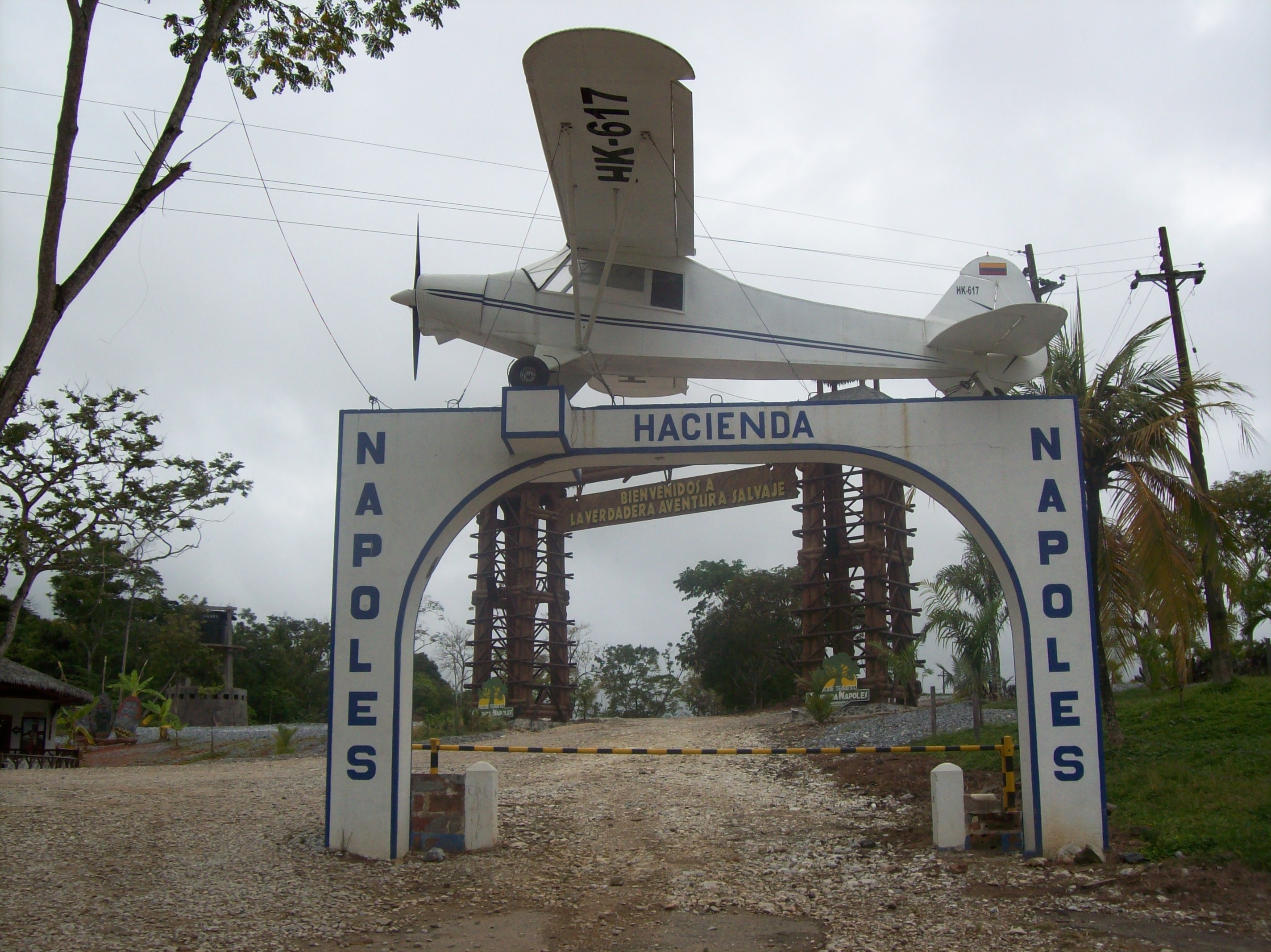
Hacienda Napoles
For years, a replica Piper PA-18 Super Cub sat mounted on the entrance arch, tail number HK-617-P still legible -- the type of plane that carried Pablo Escobar's first cocaine shipments, bolted above his front gate the way another landowner might hang a family crest. The plane was removed in 2019, replaced by a larger arch, but the legend it represented remains. Hacienda Napoles, spread across 20 square kilometers of the Magdalena River valley in Puerto Triunfo, Antioquia, was never subtle. At its peak in the 1980s, it contained a private zoo, a Formula 1 racing track, a sculpture park, a bullring, a private airport, and a collection of luxury cars. Today it is a public theme park managed by the local municipality. But the estate's strangest legacy is not what Escobar built -- it is what he imported and could not contain.
A Drug Lord's Playground
Escobar built Hacienda Napoles approximately 150 kilometers east of Medellin and 249 kilometers northwest of Bogota, in the lowland heat of the Magdalena valley. The estate included a Spanish colonial house and the extravagances that narcotics money could buy without limit: elephants, giraffes, antelopes, ostriches, and exotic birds shipped in from multiple continents to stock a private zoo. There was a collection of vintage and luxury automobiles, motorcycles, and the airstrip that kept Escobar connected to his operations. Life-sized dinosaur statues dotted the grounds, a peculiar decorative choice that has somehow survived better than most of the original buildings. After Colombian police shot and killed Escobar on December 2, 1993, in Medellin, his family fought the government over the property. The government won. Most of the exotic animals were donated to zoos across South America, the mansion eventually collapsed, and the estate fell into neglect.
Four Hippos, Then a Hundred
Escobar kept four hippopotamuses in his private menagerie. Unlike the elephants or giraffes, the hippos were deemed too large, too dangerous, and too expensive to seize and relocate after his death. So they were left on the abandoned estate. It was a decision whose consequences no one fully anticipated. By 2007, the four had become sixteen and had begun roaming beyond the property, foraging along the Magdalena River. By 2011, at least thirty were living wild in the countryside. The National Geographic Channel produced a documentary about them called "Cocaine Hippos." By 2023, Colombia's environment minister Susana Muhamad announced there were 166 hippos descended from Escobar's original herd. Scientists estimate the population could reach 1,000 by 2035 if left unchecked.
An Invasive Species Debate
The hippos have divided environmentalists, conservationists, and local communities. Some researchers argue the animals are filling an ecological niche left vacant since the extinction of South America's large herbivores thousands of years ago, potentially benefiting river ecosystems. Others warn that hippopotamuses, native to sub-Saharan Africa, pose genuine threats to native wildlife and to the fishermen who share the Magdalena's waterways. In February 2022, the Colombian government officially declared hippos an invasive species. In November 2023, Minister Muhamad outlined a three-pronged plan: sterilize twenty animals, transfer others abroad, and euthanize some. The tourism industry, however, has embraced the hippos. A female named Vanessa, who responds to her name, became the park's mascot. The tension between ecological responsibility and economic opportunity has no easy resolution.
Theme Park Over Ruins
The Municipality of Puerto Triunfo has transformed what remains of Hacienda Napoles into a family-oriented theme park. Waterslides, a Jurassic Adventure attraction, an African Museum, a Butterfly Vivarium, and a wildlife sanctuary now occupy the grounds. The sanctuary houses bison, zebras, ostriches, and other animals. Escobar's original mansion collapsed in 2015, but the dinosaur statues remain, standing guard over swimming pools where cartel associates once lounged. The original entrance arch with its mounted airplane was removed in 2019 and replaced with a larger structure, but photos of the famous arch remain a touchstone of Escobar mythology. A memorial museum on the grounds addresses the violence of the Escobar era. The park charges modest admission and draws visitors from across Colombia and beyond, offering the strange experience of spending a family day at a water park built on the ruins of a cocaine empire.
From the Air
Located at 5.9255N, 74.7222W in the Magdalena River valley, approximately 150 km east of Medellin. The 20 km2 estate is visible from altitude as a large cleared area along the river with waterpark features, scattered structures, and the distinctive entrance archway. Nearest major airport: Jose Maria Cordova International Airport (SKRG, Medellin). The former Hacienda Napoles Airstrip is on the property grounds. Best viewed at 3,000-6,000 feet AGL. The Magdalena River valley provides a natural navigation corridor.