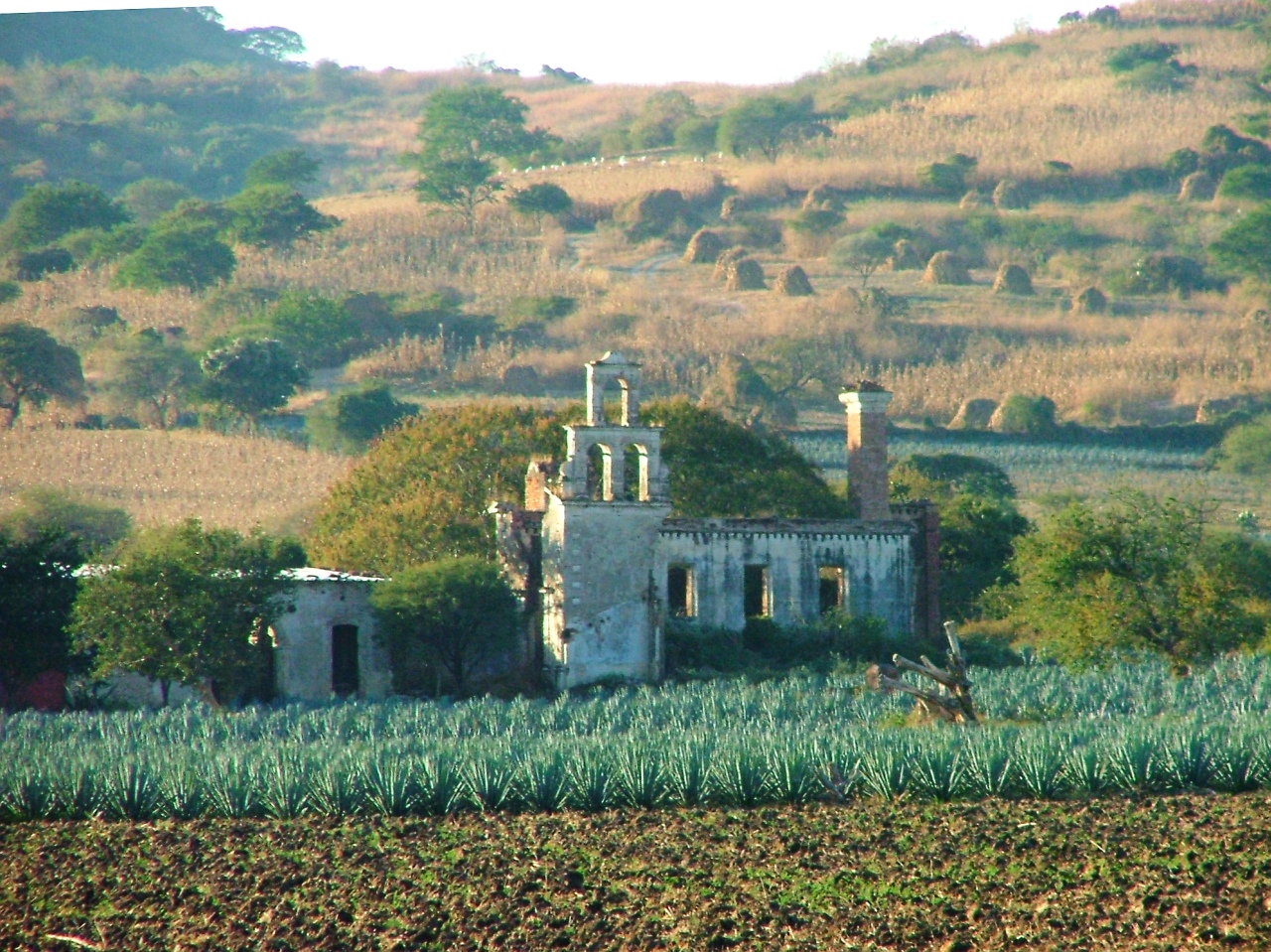
Hacienda San Jose de Miravalle
It took four days by ox cart to haul tequila from Hacienda San Jose de Miravalle to Guadalajara, and fifteen full days to reach Mexico City. Wooden carts pulled by six or eight bulls crept across the Jalisco countryside carrying small quantities of what the aristocratic 'Dones' of Mexican high society considered the finest vino mezcal-tequila in the country. The hacienda never produced much. Its legend was built on quality, not volume, on the exclusivity of a spirit served only at the most special occasions by the wealthiest families. That legend began in 1870 in the valley of Ameca, and it ended with the Mexican Revolution, which dismantled the hacienda system across the country with a simple, devastating demand: land and freedom.
Don Felipe's Valley
Don Felipe, born in 1834, was an aristocrat and the political leader of the municipality of San Martin de Hidalgo in central Jalisco. He founded the hacienda in 1870, choosing a site in the valley of Ameca where rich water springs flowed from the adjacent western mountains. An acequia channeled that water downhill to irrigate orchards of arrayan, mango, and granada trees. The location was already partially settled by the Barbosa family, who had their own chapels, barns, and lands on the mountain slope to the west. Don Felipe served as mayor for four terms, alternating with his son-in-law, and his political influence helped the hacienda grow. By 1899, it was officially listed as a mezcal factory, with Antonia Mijares de Arce recorded as its owner. A census in 1900 counted 147 inhabitants: 73 men and 74 women, a community of peones, hacendados, and peasants whose lives revolved around the agave fields and distillery.
Maria Dolores Takes the Reins
The hacienda's transformation from a modest estate into a renowned tequila producer began with Don Felipe's only child, Maria Dolores. Described as restless and enterprising, she convinced her father to expand one of his many commercial operations into agave cultivation. Under her direction, the artisanal tequila of Hacienda San Jose de Miravalle became famous not for the quantities it produced, which were always small, but for its exceptional quality. The spirit entered the exclusive circles of the Dones, the hacienda owners and gentlemen of Mexican high society who served it as a rare treat to honored guests. Residents of the nearby town of San Jeronimo visited the hacienda's chapel on Sundays, passing through arcaded portales lined with food stands serving pozole, enchiladas, and menudo. The hacienda was both a working estate and the social center of its valley.
The Brightest Years and the Revolution's Shadow
By 1907, Don Alfredo, the eldest son of Maria Dolores, had taken charge. Under his leadership the estate reached its peak, supporting more than 1,300 economic dependents in the valley. The hacienda was a self-contained world: fields, distillery, chapel, arcaded buildings, and a community that relied entirely on its productivity. But the Mexican Revolution, which erupted in 1910 and burned through the country for a decade, targeted precisely this kind of concentrated wealth. The revolutionary demand for agrarian reform, the redistribution of land to the workers who farmed it, led to the expropriation of haciendas across Mexico. Hacienda San Jose de Miravalle was among them. The productive activities that had sustained the valley came to an abrupt end. What had taken three generations to build was dismantled by a political upheaval that saw the hacienda system as the embodiment of inequality.
Ruins, Plans, and a Family's Return
Today the hacienda is officially still classified as a community, though it is inactive. The buildings that once housed a thriving tequila operation and hundreds of residents stand largely in ruin. In the 1990s, a municipal plan proposed relocating the population of San Jeronimo to the hacienda site, envisioning a rebuilt community on the old estate's footprint, but the plan never fully materialized. Then in 2008, nearly a century after the Revolution stripped the family of its holdings, descendants of Don Felipe returned to their roots. The restart was modest compared to the glory days when one could see farther than sight allowed from atop the hacienda's chapel bell tower, but it marked a reconnection with a heritage that the Revolution could expropriate but not erase. The valley of Ameca still has its springs, its mountain slopes, and the memory of a tequila that was once hauled by oxen across the Mexican countryside to reach the tables of the powerful.
From the Air
Hacienda San Jose de Miravalle is located at 20.408N, 103.977W in the valley of Ameca, central Jalisco. From 3,000-5,000 feet AGL, the valley floor is visible between mountain ridges, with the town of San Martin de Hidalgo nearby. The area is agricultural, with agave fields visible in the surrounding lowlands. Guadalajara International Airport (MMGL) is approximately 60 km to the east. The terrain is relatively flat in the valley but rises steeply to the west. Expect clear conditions in dry season and convective weather during summer months.