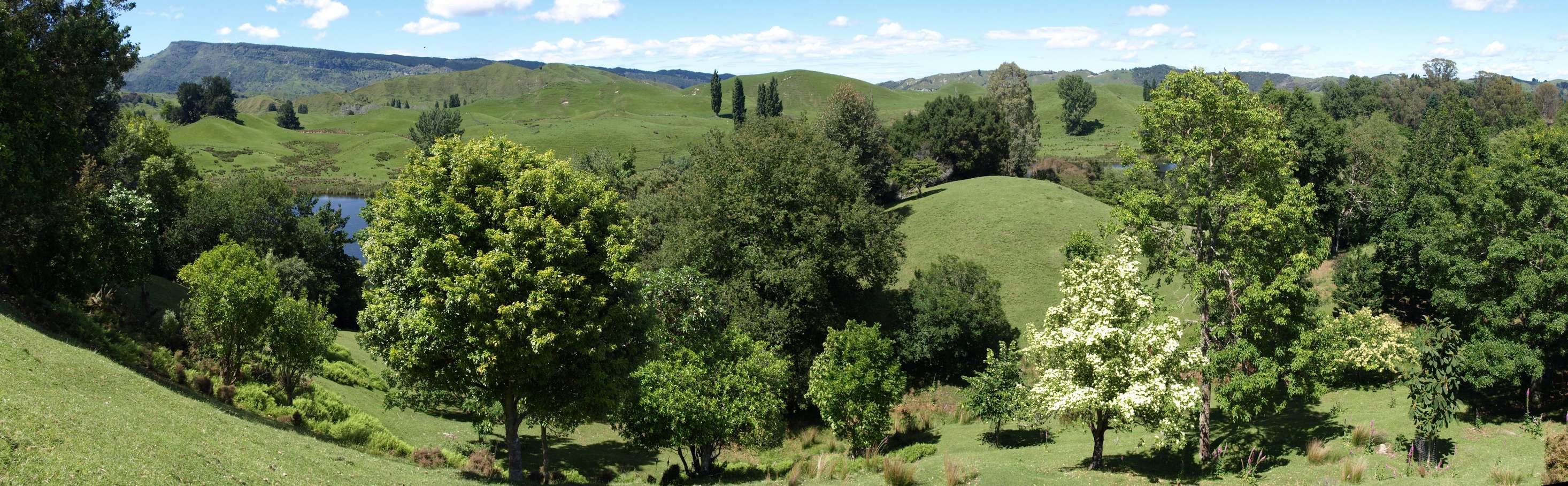
Hackfalls Arboretum
It started with willows. Bob Berry planted them near the edge of Lake Kaikiore because they were easy -- they grew fast, tolerated the wet ground, and looked decent while he figured out what else might survive on his family's sheep and cattle station at Tiniroto. Then he tried poplars. Then a few oaks, which he found did rather well. 'Thus began a forty year love affair with the genus Quercus,' wrote one observer, 'resulting in his now having the biggest collection in the country, with Bob our leading authority on oaks.' By the time Berry stopped planting in 2007, the arboretum tucked into the hills of his station held roughly 3,500 species of trees and shrubs, spread across 56 hectares along the shores of two lakes. No one driving the gravel road to Tiniroto would guess what lay beyond the next cattle gate.
Yorkshire to the Hangaroa
The Berry family came from Knaresborough in Yorkshire. They arrived in North Canterbury in 1883, settled at Tiniroto in 1889, and bought the station from the Whyte family -- who had called it Abbotsford -- in 1916. The name Hackfalls came later, in 1984, when Bob's niece Diane and her husband Kevin Playle took over the livestock operation and freed Bob to focus on what he actually cared about. He chose the name himself: Hackfall Wood, a forested ravine in the valley of the River Ure near the village of Grewelthorpe in Yorkshire. The resemblance between that English gorge and the Hangaroa River valley as it would have appeared to the first Berry settlers -- before Maori fires and European clearing stripped most of the original forest -- was apparently strong enough to make the name feel right.
The Mexican Oak Collector
In 1975, Berry received a single plant of Quercus rugosa, a Mexican oak. Something about it captivated him. When the International Dendrology Society organized a tour of Central and Southwest Mexico in 1982, Berry joined and returned with pockets full of seed. He made several return trips, each time bringing back acorns from species that few collectors outside Mexico had attempted to grow. The result, built over decades of patient germination and careful siting, is what the IDS itself has called 'probably the largest collection of Mexican oaks in cultivation anywhere outside of Mexico.' Around 50 different taxa of Mexican oaks grow at Hackfalls, each given enough space in the rolling pastureland to develop its full canopy. Berry limbed the lower branches to allow grass to grow underneath, so the oaks stand like specimens in a gallery -- visible from every angle, each tree its own exhibit.
A Landscape Shaped by Catastrophe
The hill country around Tiniroto was formed by an ancient landslide from the north and east, an event so massive that it reshaped the topography and created the chain of lakes that defines the district. Lake Kaikiore covers five hectares; Lake Karangata, ten. The altitude on Hackfalls Station ranges from 120 to 388 meters, with the homestead sitting at 270 meters. The soils on slopes are derived from yellow clay, while the flatter areas hold about 50 centimeters of volcanic ash -- pumice deposited by eruptions from the Taupo Volcanic Zone. Average annual rainfall runs to 1,650 millimeters, with light snowfalls expected each winter. This is not an easy landscape for exotic trees, but the volcanic soils and reliable rainfall proved hospitable to species from climates far removed from New Zealand's own.
The Lady from Rosemoor
In 1990, Berry married Lady Anne Palmer, an English gardener of considerable reputation. She had founded Rosemoor Garden in Devon and donated it to the Royal Horticultural Society before following Berry to New Zealand. Her influence transformed the homestead garden at Hackfalls into a curated collection of ornamental shrubs and endemic species, including the rare Muehlenbeckia astonii. More importantly, Anne encouraged the family to establish the Hackfalls Arboretum Charitable Trust, ensuring that the collection's maintenance could continue through grants rather than depending on one man's stubbornness alone. In 2002, the International Dendrology Society recognized the arboretum as 'a collection of outstanding merit,' installing a bronze plaque set in rock -- the kind of recognition that would have meant more to Berry than almost anything.
Three Thousand Five Hundred Reasons to Turn Off the Highway
Berry and Lady Anne moved to Gisborne in 2006. Since then, Diane Playle has cared for the arboretum with help from a small group of volunteers. The collection includes roughly 450 oaks, 400 rhododendrons, 220 poplars, 160 maples, 90 birches, 90 eucalyptus, 80 camellias, 70 magnolias, and dozens of other genera -- all catalogued in a 158-page plant list Berry published in 2007. A remnant of original native forest, about 40,000 square meters, survives under a Queen Elizabeth II Trust covenant established in 1985. Getting to Hackfalls requires commitment: 60 kilometers from Gisborne, 40 from Wairoa, then onto the Ruakaka Road -- a gravel track that crosses the Hangaroa River twice -- and finally up Berry Road to the homestead. The remoteness is part of the point. Bob Berry did not plant 3,500 species for an audience. He planted them because the oaks did rather well, and then he could not stop.
From the Air
Hackfalls Arboretum (38.77S, 177.54E) is located on Hackfalls Station near the tiny settlement of Tiniroto, in the hill country between Gisborne and Wairoa on New Zealand's North Island. From altitude, the station appears as rolling pastoral land interspersed with distinct clusters and rows of mature specimen trees -- unusual for the surrounding sheep country. Two small lakes (Kaikiore and Karangata) are visible on the property. The Hangaroa River runs nearby. Gisborne Airport (NZGS) is approximately 60 km to the northeast; Wairoa is about 40 km to the south. The terrain is hilly, with altitudes ranging from 120 to 388 m. Recommended viewing altitude: 2,000-4,000 ft AGL.