Hacklebarney State Park
Nobody can agree on where the name comes from. Some say it is Lenape: haki for ground, bohihen for fire, yielding something like "bonfire on the ground." Others blame a mine foreman named Barney Tracey, whose relentless heckling earned him the nickname "Heckle Barney." A third theory pins it on a landowner named Barney Hackle. Whatever the etymology, Hacklebarney State Park has been drawing hikers into its boulder-strewn gorge along the Black River since the 1920s, and the name has stuck precisely because it is strange enough to remember.
The Gorge and the River
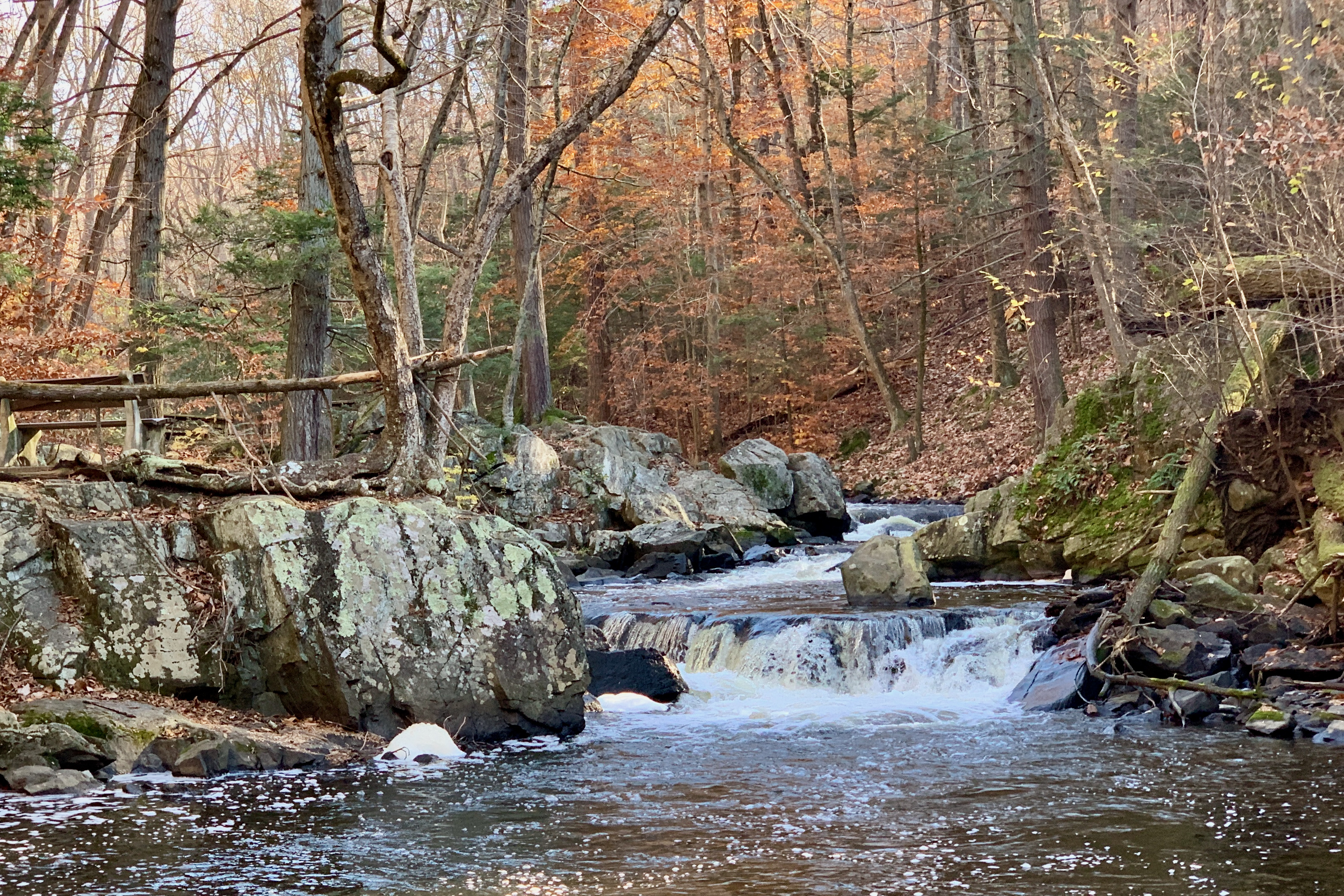
The Black River carves through the center of Hacklebarney's 978 acres, fed by Trout Brook and Rinehart Brook. Massive boulders line the riverbanks, remnants of the geologic forces that shaped this part of the New Jersey Highlands. Water tumbles over and between these rocks, creating small waterfalls visible from the trail network that threads through the park. In autumn, the hardwood canopy ignites in reds and golds, and the park becomes one of the most popular leaf-peeping destinations in northern New Jersey. The trails are hiking-only; no bikes, no horses. The simplicity is intentional. The sound of water over stone and wind through leaves is the entire point.
Iron, Zinc, and a Gift of Land
Long before hikers arrived, this was iron country. For more than a century, mines operated in the hills around what is now Hacklebarney, part of the iron industry that defined New Jersey's highlands economy. The Lenni Lenape had been here far longer, leaving traces along the Black River in the form of mushpots, stone grinding hollows worn into the bedrock. The transition from industrial landscape to public park began with Adolphe E. Borie, a zinc merchant who also served as president of the Savage Arms Company and vice president of Bethlehem Steel Corporation. On June 5, 1924, Borie and his wife Sarah donated 32 acres to the state, stipulating that the land be used for picnicking, family vacations, and forestry demonstrations. A memorial to his mother Susan Borie and niece Susan Patterson was required, fulfilled by two stone pillars at the park entrance. In 1929, Borie added 90 more acres, then bargained for still more: he would donate additional land if the state moved the entrance farther south along the river. The state agreed.
The CCC Years
Hacklebarney's development coincided with the Civilian Conservation Corps era, part of a national movement sometimes called "The Golden Age of Parks." From 1933 to 1943, over 1,000 young men worked in the park, building trails, constructing picnic tables, and laying the infrastructure that visitors still use today. The CCC's mandate blended conservation with employment: the corps created jobs for men aged 17 to 24 while building parks, preserving monuments, and conserving forests. Some of their additions have disappeared, like the original water system, but the trail network they carved through the gorge remains the park's backbone. C.E. Pollock, believed to be the first superintendent, oversaw the park through the CCC years and into the 1940s. Decades later, in 1981, budget cuts nearly closed Hacklebarney entirely. The park survived, and today it welcomes over 100,000 visitors annually.
A Quiet Place Close to Everything
Hacklebarney sits between Long Valley and Chester in Morris County, less than an hour from Manhattan, yet it feels far more remote than its geography suggests. The park opens at dawn and closes at dusk. There is no entrance fee. Over 100 picnic tables are scattered through the woods on a first-come, first-served basis, with charcoal grills nearby for those who plan ahead. A small playground near the parking lot and restrooms rounds out the amenities. The limited wheelchair accessibility, restricted to the parking lot and bathrooms, reflects the terrain's ruggedness rather than any lack of intent. This is a place where the landscape dictates the experience. The Black River gorge does not lend itself to paved paths or manicured gardens. It offers something rarer: a pocket of wildness in the most densely populated state in America.
From the Air
Located at 40.75°N, 74.73°W between Long Valley and Chester, Morris County, New Jersey. The park occupies a forested gorge along the Black River in the New Jersey Highlands. Nearest airports include Morristown Municipal Airport (KMMU, 15 nm E) and Somerset Airport (KSMQ, 14 nm SE). Best viewed at 2,000-3,000 ft AGL. Look for the dense tree canopy along the Black River corridor; the gorge is most visually striking during fall foliage season.