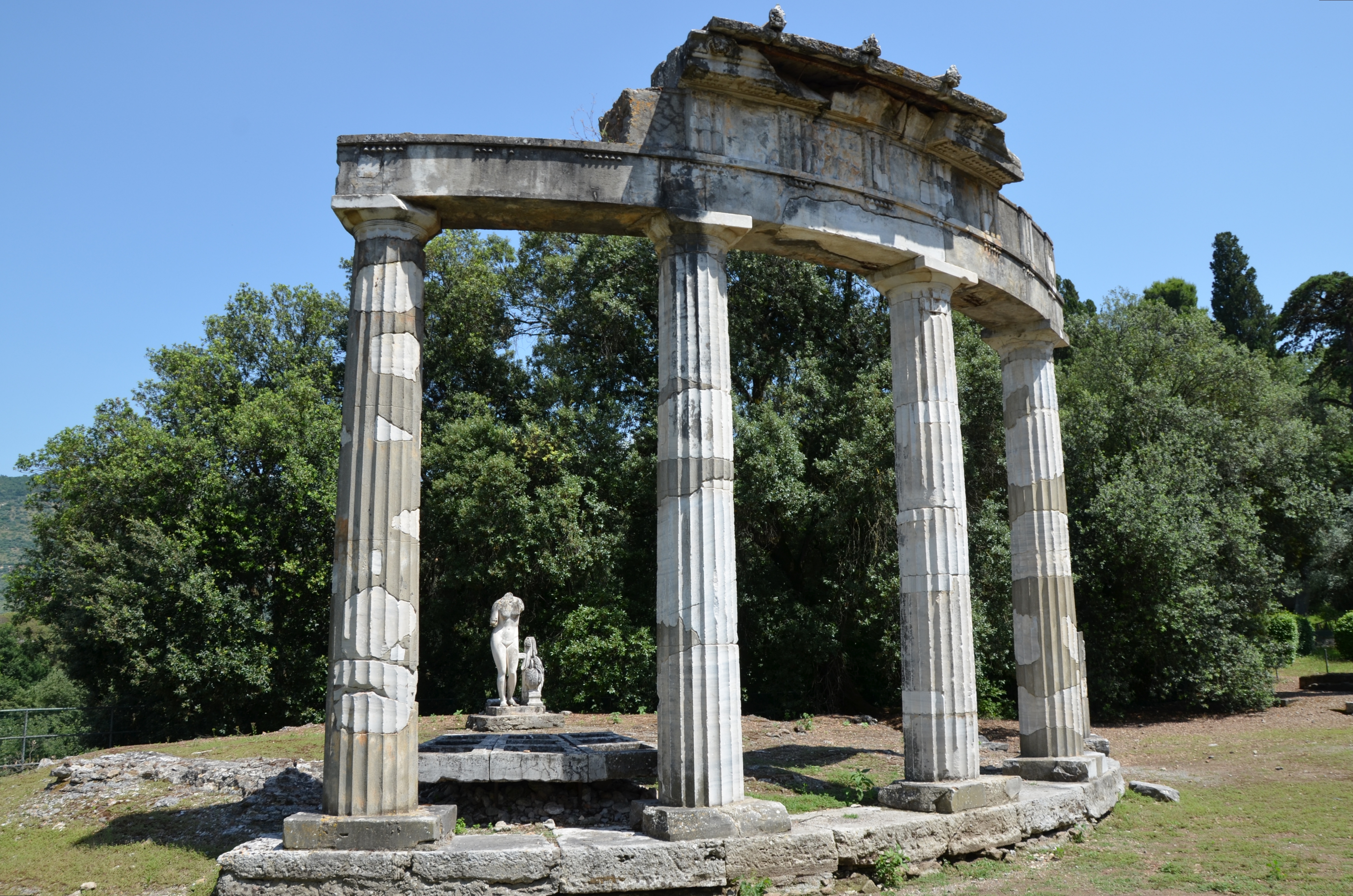
Hadrian's Villa
The emperor who disliked his own palace built something better. Hadrian, who reportedly found the imperial residence on the Palatine Hill in Rome unsuitable, spent the second and third decades of the 2nd century AD constructing an alternative retreat near Tivoli that defied every convention of Roman architecture. Covering more than a square kilometer -- an area larger than the city of Pompeii -- the complex contains over thirty monumental buildings arranged on artificial esplanades at different elevations, surrounded by gardens, fountains, and water basins. What sets it apart is not mere scale but ambition: the villa's buildings employ curved forms, complex symmetries, and daring concrete construction techniques that architectural historians consider unrivaled until the Baroque innovations of Borromini, who studied these very ruins for inspiration.
A Map of the Empire in Stone
Hadrian was Rome's most traveled emperor, and his villa reads like a three-dimensional memoir of those journeys. According to the Historia Augusta, the only ancient text that describes the complex, Hadrian named sections after places that had captivated him across the empire: the Lyceum, the Academy, even Hades. Scholars still use these names today. A small river running through the grounds evokes the Egyptian Nile. The Canopus, a long reflecting pool lined with columns, recreates a canal near Alexandria. Greek influences appear in copies of the Erechtheion's caryatids and figures called Poikilos. Egyptian elements are pervasive -- a crocodile sculpture at the Canopus, a statue of the dwarf fertility god Bes, and the Antinoeion, a memorial section rediscovered in 1998 that once held the Antinous Obelisk now standing on Rome's Pincian Hill. The villa was not a copy of anywhere specific. It was Hadrian's personal synthesis of the entire Mediterranean world, assembled in the hills outside Rome.
The Maritime Theatre
Among the villa's most intriguing structures is the so-called Maritime Theatre, a circular enclosure 40 meters in diameter that may have been Hadrian's most private retreat within his private retreat. A round portico with a barrel-vaulted ceiling, supported by unfluted Ionic columns, surrounds a ring-shaped moat. In the center sits a small island -- accessible originally only by retractable bridges -- that contains a miniature villa in itself: a lounge, a library, heated baths, three suites with heated floors, a washbasin, an art gallery, and a large fountain. Everything an emperor might need, surrounded by water, removed from the world. Whether Hadrian used this island as a study, a personal sanctuary, or simply as an architectural experiment remains debated. What is certain is that nothing quite like it existed before, and the idea of an island retreat within a larger estate captured imaginations for centuries afterward.
An Art Collection Scattered Across Europe
The villa functioned as one of the ancient world's greatest art museums. Hadrian filled its halls, gardens, and galleries with sculptures, mosaics, and paintings drawn from across the empire. After the villa fell into disuse and became a quarry for marble and statuary, its treasures dispersed into collections worldwide. The Discobolus ended up in one museum, the Diana of Versailles in the Louvre, the Crouching Venus in another. The Capitoline Antinous -- a portrait of Hadrian's beloved companion -- went to the Capitoline Museums. A lifelike dove mosaic, believed to copy a lost work by Sosus of Pergamon described by Pliny the Elder, went to the Capitoline as well and has been reproduced countless times since. In 1818, an encaustic painting depicting the death of Cleopatra VII was discovered on the grounds. In 2021, archaeologists from Spain's Pablo de Olavide University announced finding remains of what they interpreted as Hadrian's breakfast room -- a water triclinium designed to overwhelm visitors with imperial grandeur.
Ruins, Recognition, and the Fight to Preserve
After Hadrian's death, successive emperors used the villa occasionally -- busts of Antoninus Pius, Marcus Aurelius, Septimius Severus, and Caracalla have all been found on site. Zenobia, the deposed queen of Palmyra, lived nearby from 273 until her death. Diocletian restored parts of the complex late in the 3rd century. Then came centuries of neglect and plunder. UNESCO designated Hadrian's Villa a World Heritage Site in 1999, citing it as a masterpiece that brings together the material culture of the Mediterranean world and inspired both the Renaissance and the Baroque. The designation created a protective buffer zone, which the local government of Tivoli tested in 2011 by approving public housing on 120,000 square meters within it and proposing a waste dump nearby. UNESCO intervened, and the dump was cancelled. In 2019, the villa received special immunity from wartime destruction due to its symbolic value. Much of the site remains unexcavated -- a reminder that what visitors see today may be only a fraction of what Hadrian built.
From the Air
Hadrian's Villa is located at 41.942N, 12.775E, about 28 km east of central Rome near the town of Tivoli. From 3,000-5,000 feet AGL, the sprawling archaeological complex is visible as an extensive open area with ruins amid green countryside on the lower slopes below Tivoli. The hilltop town of Tivoli itself is a prominent landmark to the northeast. Rome Ciampino Airport (LIRA/CIA) lies roughly 20 km to the west. Leonardo da Vinci-Fiumicino Airport (LIRF/FCO) is about 40 km to the west-southwest. The terrain rises toward the Apennine foothills, with good visibility in clear weather.