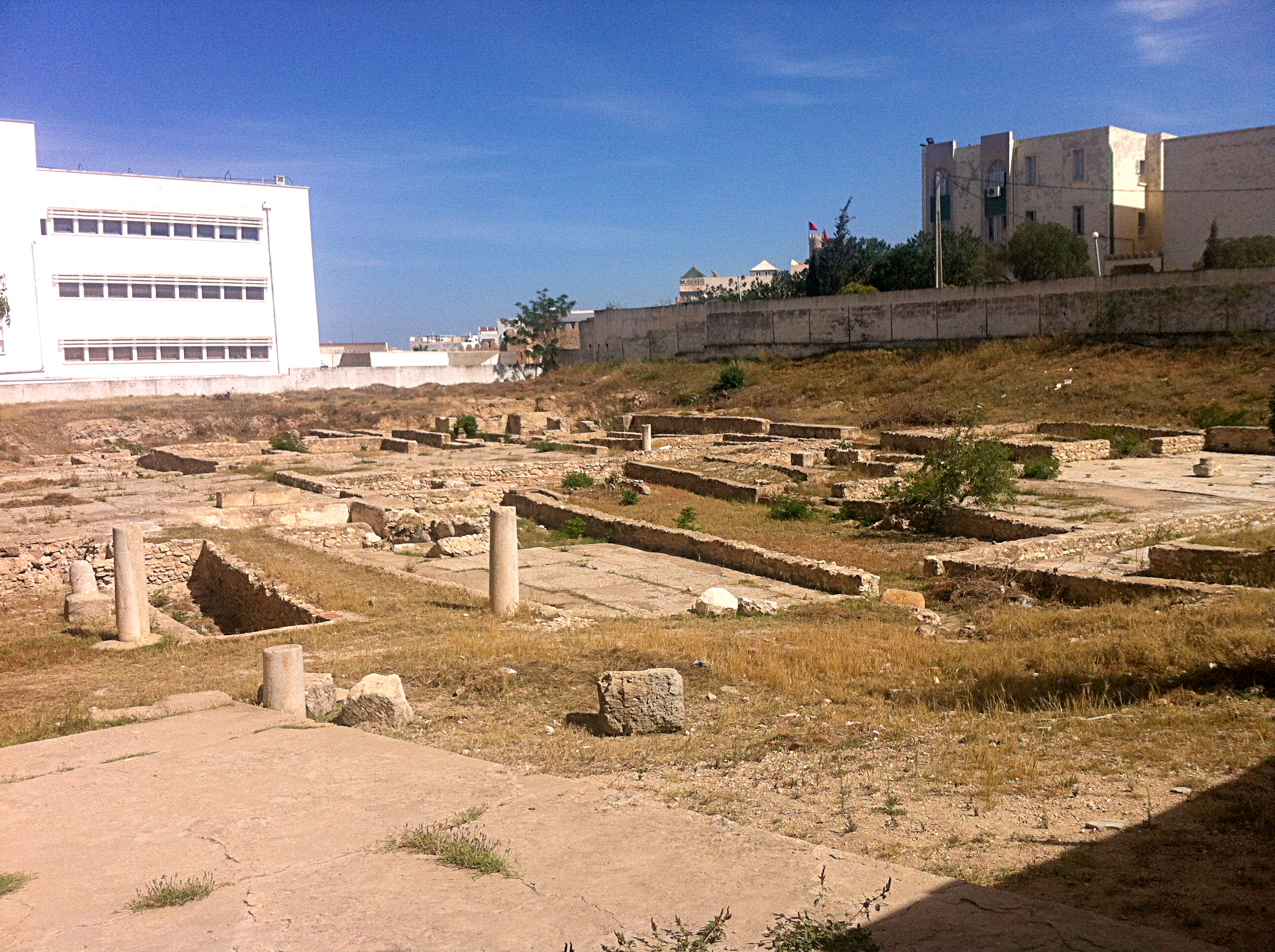
Hadrumetum
When Julius Caesar stumbled coming ashore in North Africa in December 47 BC, he grabbed handfuls of dirt and shouted, "I have you now, Africa!" The beach where he turned a bad omen into a declaration of conquest lay near Hadrumetum, a city already ancient by Caesar's time. Founded by Phoenician colonists before Carthage itself existed, Hadrumetum spent three thousand years at the crossroads of every power that sought to control the central Mediterranean.
Older Than Carthage
The Phoenician name for the settlement meant simply "southern," a marker of its position relative to the mother cities of the Levantine coast. Hadrumetum was established on the mouth of a small river, part of the network of Phoenician trading posts that stretched from Tyre to the Strait of Gibraltar. When Nebuchadnezzar's long siege of Tyre in the 580s and 570s BC shattered Phoenician independence, the western colonies were absorbed into the growing Carthaginian Empire. Hadrumetum became a Carthaginian city, but an important one. It sheltered Hannibal and surviving Carthaginian forces after their defeat at Zama in 202 BC, the battle that ended the Second Punic War. The city's Punic fortifications stretched for 6,410 meters, and remnants of those walls still survive.
Caesar's Foothold
During the civil war between Pompey and Caesar, Gaius Considius Longus secured Hadrumetum for the Optimates with two legions. Despite these defenses, he could not prevent Caesar from landing nearby. The campaign that followed led to Caesar's decisive victory at Thapsus in 46 BC, after which Longus was killed by his own troops for the money he was carrying, and Hadrumetum surrendered. The city had backed the wrong side but recovered quickly. Its fertile hinterland, the Sahel of modern Tunisia, produced grain that Rome could not do without. Under the Emperor Trajan, Hadrumetum received the rank of a Roman colony, granting its residents full Roman citizenship. The city minted coins bearing the faces of emperors and grew wealthy enough to quarrel with neighboring Thysdrus over a border temple dedicated to a goddess equated with Minerva.
Underground Faith
Beneath the streets of what is now Sousse, tunnels extend for miles. These are the Christian catacombs of Hadrumetum, rediscovered in 1904 by the archaeologists Louis Carton and Abbe Leynaud. The subterranean galleries are filled with Roman and Byzantine sarcophagi and inscriptions, evidence of a Christian community that thrived here from at least the third century. The city produced saints and martyrs: Mavilus, killed during persecutions under Caracalla, and Bishop Felix, martyred by the Vandal king Gaiseric. From 255 to 551, Hadrumetum served as the seat of a Christian bishopric, its underground dead testifying to a faith practiced in a city that had already been old when Christianity was new.
Layers Without End
The ruins of Hadrumetum include Punic walls, Roman harbors, a horse track, cisterns, a theater, a necropolis, a Byzantine acropolis, and a basilica. French engineers under colonial rule rediscovered the jetties and moles of two Roman harbors, one commercial and one military, both largely artificial and long since silted up. The Umayyad conquest in the seventh century brought yet another transformation, and the village of Hammeim grew up among the ruins. Today, Sousse has expanded to encompass everything, a modern city built on three millennia of accumulated layers. From the air, there is no visible break between what Hadrumetum was and what Sousse has become. The ancient city did not end; it was absorbed.
From the Air
Located at 35.824N, 10.639E on Tunisia's central-eastern coast. Hadrumetum's ruins underlie the modern city of Sousse, visible from altitude as a major coastal urban center. The silted-up Roman harbors are no longer distinguishable from the air. Nearest airport: Monastir Habib Bourguiba International (DTMB), approximately 20 km south. Sousse's medina and the Ribat are prominent landmarks. Recommended viewing altitude: 3,000-5,000 feet AGL.