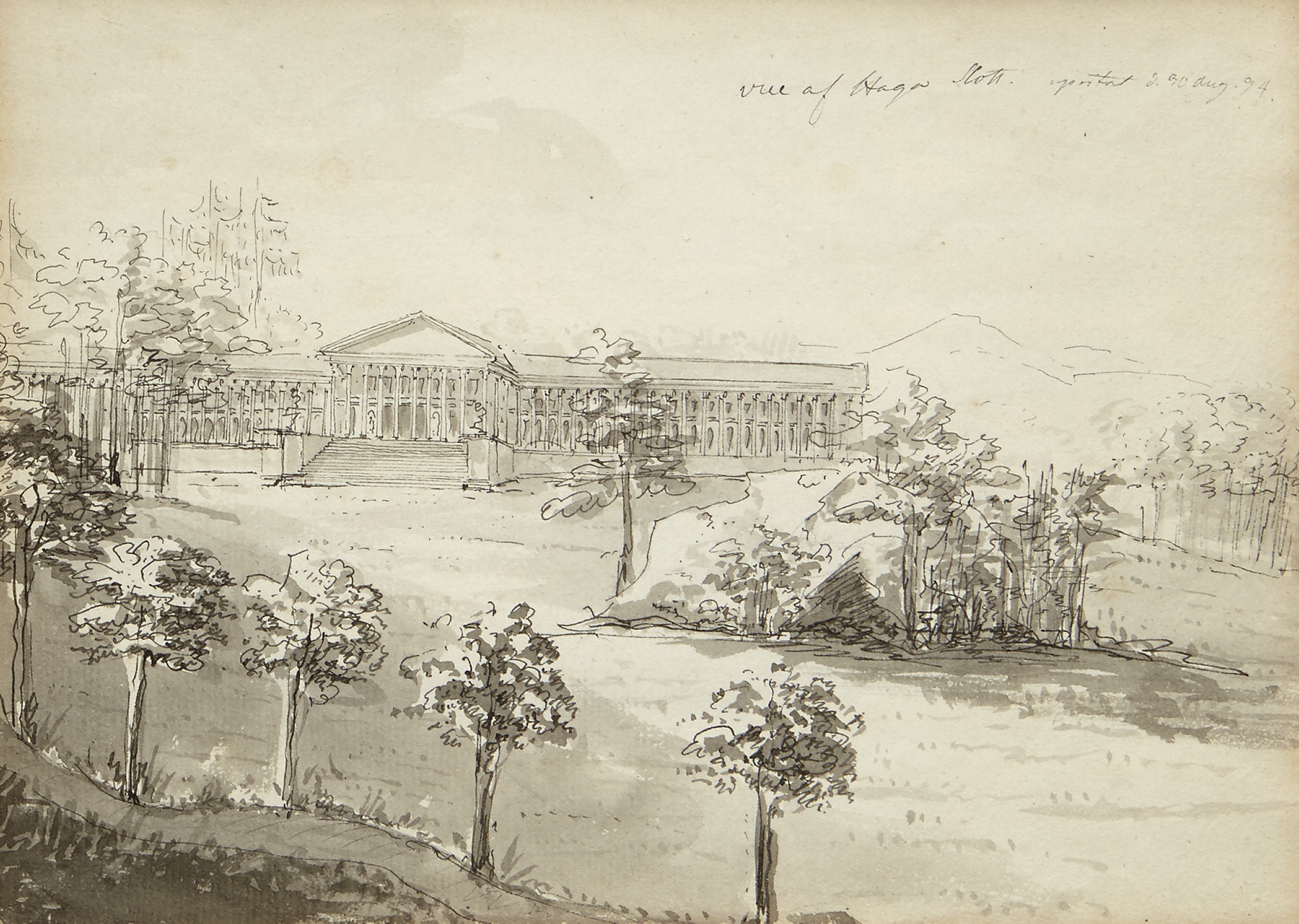
Haga Palace Ruins
Six architects. Nearly 800 workers. Designs inspired by the Pantheon, St. Peter's Basilica, and the Villa Rotonda. King Gustav III of Sweden was building nothing less than the grandest palace in Scandinavia. Then, on a March night in 1792, a nobleman's pistol ended both the king and his dream. Construction halted immediately. The massive foundation, already rising from a hill in Haga Park, was covered with wooden planks and left to the elements. Today, these weathered stone walls and archways stand as one of Stockholm's most evocative ruins - a monument not to what was built, but to what might have been.
A King's Obsession
Gustav III acquired the old Haga farm in 1771 and immediately began transforming it into an English landscape garden. But a simple pleasure ground was never enough. By the late 1770s, the king was sketching his own palace designs, hiring and firing architects in rapid succession as his vision grew ever more ambitious. First came Carl Fredrik Adelcrantz with a modest proposal inspired by Nicodemus Tessin's work. Then Fredrik Magnus Piper offered a design echoing Marie Antoinette's Petit Trianon at Versailles. The king rejected it. He tried the French architect Leon Dufourny, who worked too slowly. Erik Palmstedt got a brief turn before being passed over. Finally, Olof Tempelman produced plans that captured Gustav's imagination: a palace inspired by Palladio's Villa Rotonda, with echoes of Rome's greatest monuments. Even this was just the beginning.
The Foundation Stone
On August 19, 1786, the poet and composer Carl Michael Bellman provided music for the foundation stone ceremony. Hedvig Elisabeth Charlotte, the king's sister-in-law, recorded the event in her diary. The stone was placed beneath what would become the central pillar of the palace's great domed room. Work began immediately on the massive foundation and cellars, requiring substantial quarried stone walls to compensate for the steep terrain. But Gustav, ever the perfectionist, soon grew dissatisfied with Tempelman's plans. He wanted more grandeur. He envisioned wings extending from both sides, supported by rows of seventy Corinthian columns. The palace would house his collection of ancient Roman sculptures, acquired during Italian travels, along with a theater, banquet halls, and quarters for the entire court.
Desprez's Grand Vision
In 1787, Gustav handed the project to Louis Jean Desprez, a French painter and architect he had met in Rome. Desprez delivered what the king craved: monumentality. His final designs showed a palace of staggering ambition, its facade dominated by mighty columns, the southern approach flanked by obelisks or, in one version, equestrian statues. A grand staircase framed by eighteen columns would welcome visitors from the north, fronting a forecourt modeled on Giulio Romano's Palazzo del Te in Mantua. By 1790, construction was in full swing despite an expensive war with Russia. Work on the Great Stables ceased so all resources could focus on the palace. At peak activity, 650 soldiers and 150 Russian prisoners of war labored on the site. Contemporary accounts noted that the prisoners 'formed a more numerous than valuable reinforcement.'
The Night That Ended Everything
On March 16, 1792, Gustav III attended a masked ball at the Stockholm Opera. A disgraced former officer named Jacob Johan Anckarstrom approached the king in the crowded ballroom and shot him in the back. Gustav lingered for thirteen days before dying of his wounds. The palace project died with him. Workers covered the foundation with wooden planks. The stockpile of bricks was carted off to build wings at the Karlberg Palace military academy. Finely hewn stone intended for plinths and moldings was later used to construct the Queen's Pavilion, now known as Haga Palace, where the Swedish Crown Princess lives today. The only element completed after Gustav's death was a detailed wooden model, furniture maker Christopher Borenstrand's masterpiece, which now resides in the Haga Park Museum housed in the nearby Copper Tents.
A Ruin Reborn
For two centuries, the foundation slowly disappeared beneath vegetation. Major restoration work in 1968 cleared the growth and repaired the masonry. Another restoration between 1998 and 1999, led by palace architect Erik Langlet, patched holes and remortared fallen stones. In 2007, students from the Royal Institute of Art conducted a detailed survey, their work exhibited at the park museum that summer. Today, the ruins have become a beloved local gathering spot. Visitors climb the central column where the foundation stone lies buried. On summer evenings, small fires flicker within the thick stone walls as Stockholmers gather in a space that Gustav III imagined filled with Roman statues and glittering courtiers. The palace foundation is now a classified historical monument, protected by law as a testament to ambition, artistry, and the cruel randomness of history.
From the Air
The Haga Palace Ruins are located at 59.364N, 18.036E in Hagaparken, north of central Stockholm. From altitude, look for the rectangular foundation structure partially hidden by trees on a small hill in the park, northwest of the present-day Haga Palace (the Crown Princess's residence) and north of Gustav III's Pavilion. The ruins appear as weathered stone walls forming geometric patterns, most visible when trees are bare. Brunnsviken lake lies to the east. Stockholm Bromma Airport (ESSB) is 5km west; Arlanda (ESSA) is 35km north. Best viewed at 1,000-2,000 feet when the foundation layout becomes clear. The site is part of the Royal National City Park, a protected green corridor running through metropolitan Stockholm.