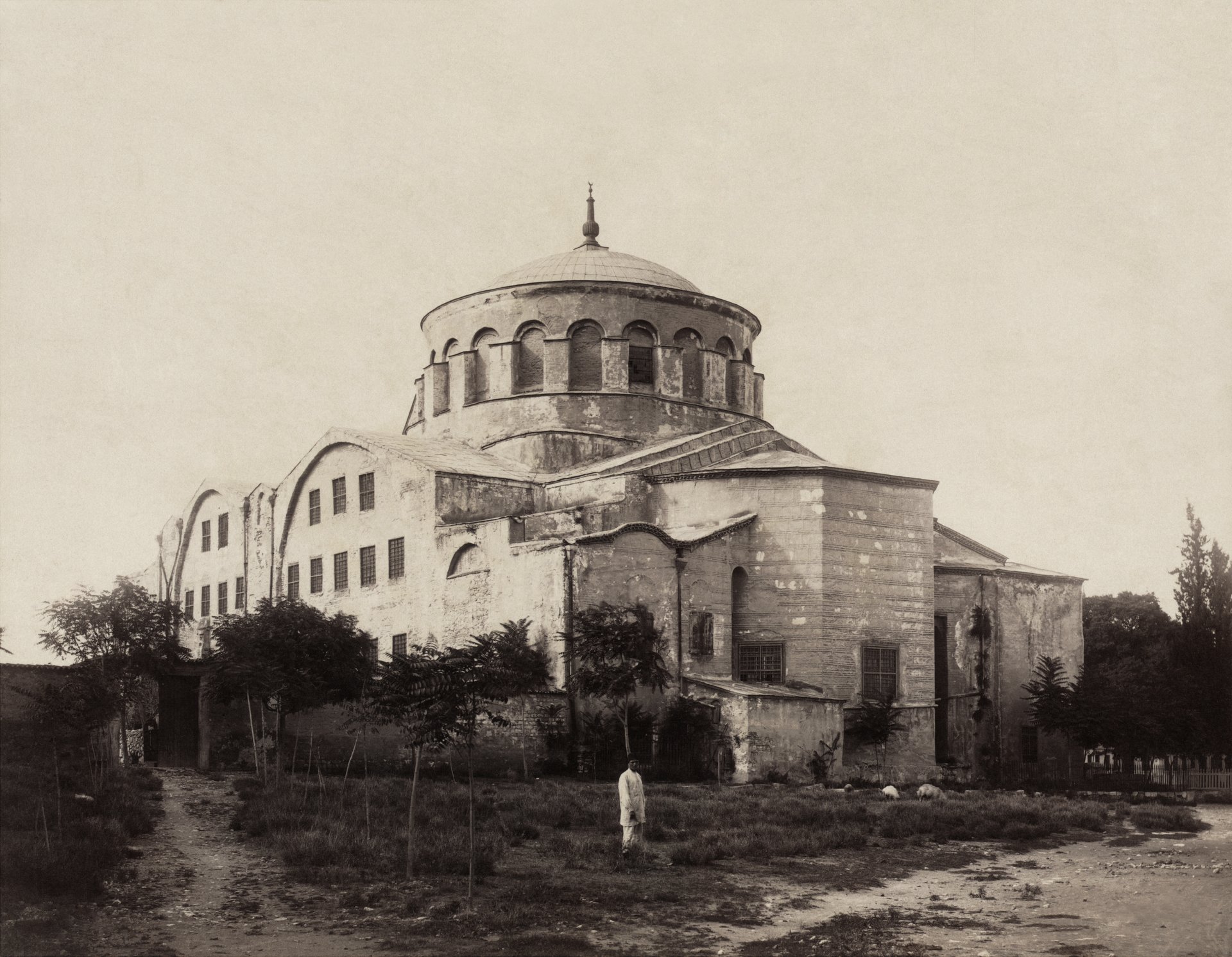
Hagia Irene
When Mehmed II's army poured into Constantinople in May 1453, they swept Hagia Irene up inside the walls of what would become Topkapi Palace, and there a strange thing happened. The church, dedicated to the peace of God since the 4th century and second oldest of the great Constantinopolitan churches, was not turned into a mosque. The Janissaries needed a strong, dry, secure building to store gunpowder, weapons, and military trophies. Hagia Irene was perfect. For nearly four hundred years the building called Holy Peace served as an armory, and that quirk of military convenience is the reason it survives today as one of only two Byzantine churches in Istanbul never reconverted. It is also why you can attend a classical music concert there on any summer evening.
Before Hagia Sophia
Constantine the Great commissioned Hagia Irene around 330, and it was complete by his death in 337. For roughly two decades it served as the cathedral of Constantinople, the seat of the Patriarch. Then Hagia Sophia was finished in 360 under Constantius II, and Hagia Irene became, in effect, the older sibling who steps aside when the more brilliant younger one arrives. The two churches sat within a single compound, served by the same clergy. Three churches honored attributes of God in early Constantinople: Hagia Sophia for Wisdom, Hagia Irene for Peace, and a third for Hagia Dynamis, divine Power, which has not survived. Tradition holds that Hagia Irene stands on the site of an earlier pre-Christian temple, the layered foundations of which can still be partly traced beneath the present building.
The Nika Riot Burns It Down
January 532. The Hippodrome's Blue and Green chariot factions spilled into the streets of Constantinople with a slogan, Nika, Conquer, and within days the riot had nearly toppled Justinian. By the time imperial troops finally crushed the uprising in the Hippodrome itself, much of central Constantinople was in ashes, including Hagia Sophia, the Augustaion, and Hagia Irene. Justinian rebuilt all three. The Hagia Irene that stands today was completed in 548, designed in the new centrally-planned style that would define Byzantine architecture for centuries. It came under attack again from natural forces almost two hundred years later, when the great Constantinople earthquake of 20 October 740 cracked the foundations and damaged the dome. The repairs that followed strengthened the substructure and gave the church its current form: a domed basilica with a smaller dome over the narthex, reached through an atrium that few Byzantine churches still possess.
Iconoclasm in the Apse
Look up at the apse semidome and the bema arch and you see something you cannot easily see anywhere else: the surviving iconography of Byzantine Iconoclasm. From 726 to 843, with brief interruptions, successive emperors banned the veneration of religious images and ordered the destruction of mosaic icons across the empire. Most other Byzantine churches were redecorated after Iconoclasm ended, but at Hagia Irene the iconoclast-era work survives. A simple cross outlined in black floats on a gold ground, a deliberate refusal to depict Christ or the saints. Around it, an inscription drawn from Psalms reminds the faithful that God's truth endures. These mosaics are nearly unique. They are also believed to have inspired some of the cross-themed mosaics in Hagia Sophia.
Janissaries and Helmets
After 1453, the church became Cebehane, the arsenal. The Janissaries, the elite slave-soldiers of the Ottoman army, used Hagia Irene to store muskets, sabres, and the ceremonial armor they took as trophies of war. A surviving Ottoman helmet bearing the Saint Irene arsenal markings sits today in the Musee de l'Armee in Paris, made around 1520. The building also held regalia captured from defeated foreign armies: European helmets and breastplates, Persian shields, and the gold-decorated arms that the Ottomans considered worthy of preservation. When the Janissary corps was abolished in the bloody crackdown of 1826 known as the Auspicious Incident, the building's military function began to wind down. From 1908 to 1978 it served as the Imperial Military Museum. Then it passed to the Turkish Ministry of Culture.
The Concert Hall
Step inside today and the first thing you notice is the silence, then the acoustics. Hagia Irene's interior, with its long nave and high dome, has the sound qualities concert halls spend millions trying to engineer. Since 1980, the Istanbul International Music Festival has used it for many of its summer performances. In 2000 the Turkish couture designer Faruk Sarac staged a remarkable show here: 700 garments inspired by the wardrobes of 36 Ottoman sultans, from Osman I in the 14th century to Mehmed VI, the last sultan, who left for exile in 1922. For decades visitors could enter only during events or by special permission. Since January 2014 the building has been open as a museum every day except Tuesday. Walking the nave, listening to footsteps echo against walls that have been a cathedral, a patriarchal seat, an armory, a museum, and now a concert hall, you understand why this church got its name. Holy Peace, after a great deal of history, is in some ways exactly what the building offers.
From the Air
Located at 41.010 degrees north, 28.981 degrees east, inside the outer courtyard of Topkapi Palace in the Sultanahmet district of Istanbul. The church sits about 150 meters north of Hagia Sophia, just inside the first courtyard wall of Topkapi. Istanbul Airport (LTFM) lies 35 kilometers northwest; Sabiha Gokcen (LTFJ) is 35 kilometers east. From the air Hagia Irene appears as a smaller domed structure overshadowed by Hagia Sophia immediately to the south. The triangular promontory of the historic peninsula, with the Bosphorus to the east and the Golden Horn to the north, makes orientation straightforward.