Hagia Sophia
Two mathematicians designed it. Not architects, in the modern sense of the word. The men Justinian commissioned in 532 to rebuild his cathedral after the Nika riots burned it down were Anthemius of Tralles, who wrote a treatise on conic sections, and Isidore of Miletus, who edited the works of Archimedes and ran the leading mathematics school in the eastern empire. They had never built anything like what they were now expected to build. The result, completed in five years and ten months and dedicated on 27 December 537, was a dome 32.6 meters in diameter floating apparently unsupported above an interior so vast that, when the Russian emissaries of Vladimir of Kiev visited in the 980s, they reported back that they did not know whether they were in heaven or on earth.
The Riot That Required It
In January 532, the Blues and Greens, the chariot-racing factions of the Hippodrome, set aside their rivalry and rioted against the emperor Justinian for five days. They burned the Augustaion, much of the Great Palace, and the second church on the site of Hagia Sophia. By the time imperial troops trapped the rebels in the Hippodrome and slaughtered as many as 30,000 of them, central Constantinople was a cinder. According to the chronicler Procopius, Justinian's wife Theodora stiffened her husband's resolve when he was preparing to flee, telling him that the imperial purple made a fine winding-sheet. He stayed. He won. And then he commissioned a cathedral whose scale would silence any future challenge to imperial authority. Construction began before the riot's ashes had cooled. Funding came initially through Phocas the praetorian prefect, who provided 4,000 Roman pounds of gold.
How They Built It
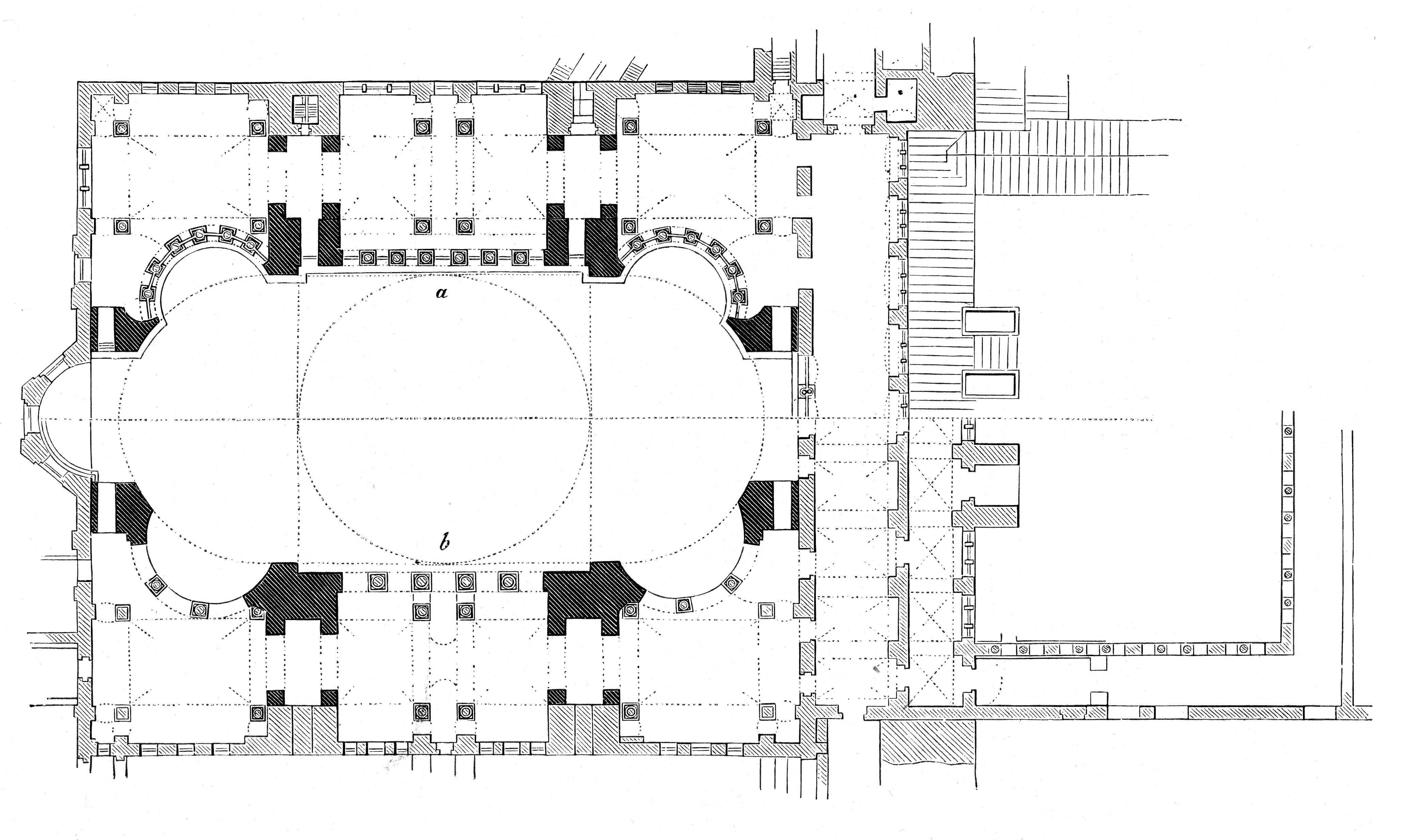
More than 10,000 workers labored on the site. Marble columns and panels were imported from across the Mediterranean, shipped from quarries in Egypt, the Aegean, and Anatolia. Procopius describes the masons at work and the way the engineers solved problems no one had solved at this scale. The dome rests on four pendentives, the spherical triangles that translate the circular base of the dome onto the square chamber below. Hagia Sophia was the first large-scale use of pendentives in monumental architecture, and it remained the largest pendentive dome in the world until St Peter's Basilica was completed in 1626. Forty windows ring the base of the dome, which is why interior light seems to lift the dome free of the walls. Mainstone calculated the dome's shell at no more than the thickness of a single brick. The original dome collapsed in the earthquake of 558. Isidore the Younger rebuilt it in 562, six meters higher and reinforced with 40 ribs. The reopening on 24 December that year was celebrated with a long ekphrasis composed by the poet Paul the Silentiary.
Cathedral for a Thousand Years
From 537 until 1453, with one interruption during the Latin Catholic occupation of 1204 to 1261, Hagia Sophia served as the cathedral of Constantinople, the seat of the Ecumenical Patriarch, and the principal venue for Byzantine imperial ceremony. Coronations happened here. Excommunications happened here. In 1054, on a July afternoon, Cardinal Humbert of Silva Candida laid a papal bull on the altar excommunicating Patriarch Michael Cerularius, and the East-West Schism that has divided Christianity ever since formally began. Olga of Kiev was probably baptized in the baptistery in the 950s. Generations of Byzantine emperors prayed beneath the seraphim mosaics in the four pendentives, faces revealed once again to modern visitors during the 2009 restoration after centuries hidden under Ottoman plaster. The empire that built Hagia Sophia shrank for centuries around the cathedral that gave the empire its self-understanding.
From Cathedral to Mosque
On 29 May 1453, Mehmed II entered a Constantinople that had finally fallen to Ottoman siege. He went directly to Hagia Sophia, ordered an end to the looting, and converted the building into a mosque. The first Friday prayer was held on 1 June. Over the next century the four minarets that now define the silhouette were added, the most famous of them by the great architect Mimar Sinan, who in the 1570s also reinforced the structure with 24 buttresses and built the mausoleum of Selim II beside it. Sultan Abdulmejid I commissioned a major restoration from 1847 to 1849, supervised by the Swiss-Italian Fossati brothers, who consolidated the dome with iron bands, exposed Byzantine mosaics for cleaning, then re-covered most of them. The eight enormous calligraphic medallions hanging in the nave, designed by Kazasker Mustafa Izzet Efendi and bearing the names of Allah, Muhammad, the four Rashidun caliphs, and Muhammad's grandsons, date from this restoration.
Museum, Mosque, Continuing Story
In 1934, Mustafa Kemal Ataturk's secular republic transformed the building into a museum, with a Council of Ministers decree taking effect 1 February 1935. Ottoman plaster was removed from many of the mosaics. The marble floor, including the omphalion where Byzantine emperors had been crowned, was uncovered. By 2014 it was the second most-visited museum in Turkey, drawing 3.3 million people a year. In July 2020, the Council of State annulled the 1934 museum decree, and the building was redesignated a mosque under President Recep Tayyip Erdogan. The decision drew condemnation from UNESCO, the Ecumenical Patriarchate, several governments, and many Muslim and Christian voices, while it was welcomed by others. The Byzantine mosaics remain visible during non-prayer hours. A turquoise carpet covers the floor for prayer. Foreign visitors began paying an entrance fee starting 15 January 2024. Whatever you think about the politics of the change, the dome still appears to float, the light still pours through forty windows, and a building 1,488 years old continues, as it always has, to do the difficult work of meaning many things to many people at once.
From the Air
Located at 41.008 degrees north, 28.980 degrees east, in the Sultanahmet district at the southeastern tip of Istanbul's historic peninsula. Hagia Sophia is the most prominent landmark on the peninsula, with four minarets and a great central dome 55 meters high. The Blue Mosque sits 200 meters to the south. Istanbul Airport (LTFM) lies 35 kilometers northwest; Sabiha Gokcen (LTFJ) is 35 kilometers east. From the air the historic peninsula appears as a triangular promontory bordered by the Golden Horn, the Bosphorus, and the Sea of Marmara, with Hagia Sophia and the Blue Mosque dominating the skyline.