Hague Congress (1872)
Karl Marx never came to The Hague except to win. From September 2 to 7, 1872, in the Café Concert Excelsior on Lange Lombardstraat, he ran a congress he had stacked and a vote he had whipped, and at the end of it he expelled his most dangerous rival, Mikhail Bakunin, from the international workers' movement they had both helped build. Bakunin was not there to defend himself. He was wanted by the French and German police for his role in the failed Communes, and he had sent his Swiss lieutenant James Guillaume to speak for him instead. When the delegates filed out of the hall on the last evening, the crowds in the street booed them and shouted 'Down with the International!' Few of them yet understood what they had witnessed: the moment two visions of revolution split apart and walked off in opposite directions.
Two Revolutionaries, One Organisation
The International Workingmen's Association had been founded in London in 1864 to gather the scattered radical currents of industrial Europe into a single body. For a while it worked. Marx and Bakunin, the German theorist and the Russian agitator, were even allies of a sort. Bakunin pushed to get Das Kapital published in Russian; Carlo Cafiero rendered it into Italian. But the alliance was always uneasy. Marx believed that workers needed a centralised party and, after the revolution, a transitional state - the dictatorship of the proletariat - to abolish capitalism. Bakunin believed any such state would simply become a new tyranny, and that the people Marx dismissed - peasants, criminals, sex workers, beggars - could be revolutionary too. The argument was philosophical, but it was also personal, and by 1871 the International's federations were openly choosing sides.
Stacking the Hall
By the summer of 1872 the Bakuninists - anarchists, anti-authoritarians, federalists - held a clear majority of the International's membership. Spain alone, where the federation had gone explicitly Bakuninist, made up a huge share of the organisation. Marx's base was narrower: German Marxists, a few American sections, and his Blanquist allies. Outflanked in the 'race for membership,' Marx's General Council in London resolved to win the next congress instead, and chose its battleground with care. The Hague was far from Switzerland, where previous congresses had met, and far from the Bakuninist strongholds in Spain, Italy, and France, where the International was banned outright. Many of the Marxist 'French' delegates turned out to live in London and to be members of Marx's own circle. Some carried blank mandates. The Italian Federation, meeting that summer in Rimini, saw the trap clearly and voted to break with the General Council before the congress even opened.
Five Days at the Concordia
Sixty-five delegates assembled in The Hague: roughly forty Marxists and Blanquists, twenty-five anti-authoritarians. The numbers were no accident, and the anti-authoritarians knew it. Marx tried to bar the Spanish federation, the International's largest, on the pretext that it had not paid its dues. The Spanish delegates produced the money on the spot and were grudgingly admitted. Engels declared that any Italian delegates would be refused entry at the door. Marx took the floor to accuse Bakunin personally of being a thief - for failing to pay a Russian printer - and of being no true revolutionary. On the central vote, twenty-seven delegates voted to expel Bakunin, seven against, eight abstaining. Guillaume was expelled in a separate vote. Adhémar Schwitzguebel, denied the expulsion he demanded on principle, was forced to remain a member of an organisation that had just thrown out his friends.
The Schism Walks to Saint-Imier
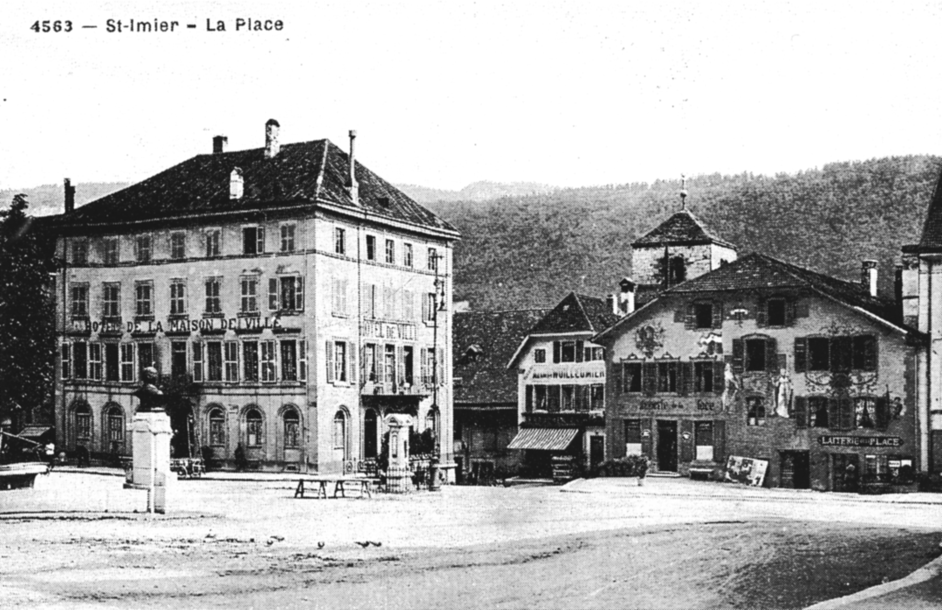
Marx had won the room. He had not won the movement. A week later, on September 15, the expelled federations - Spanish, Italian, Jurassian, Belgian, and others - reconvened in the small Swiss watchmaking town of Saint-Imier. There they founded the Anti-authoritarian International, rejected Marx's strengthened General Council, and declared themselves the true continuation of the body that had been founded in 1864. To make sure his rivals could never recapture what was left, Marx then moved the General Council's headquarters from London to New York, far across the Atlantic from the Blanquists he had used and now wanted out. The historian Nunzio Pernicone judged it precisely: Marx 'in effect killed the International to save it from his rivals.' The Marxist body limped on until 1876 and quietly expired. The anti-authoritarian one lasted into the 1880s before dissolving into the looser anarchist networks that followed.
What The Hague Started
Lange Lombardstraat 109, the address of the old Café Concert Excelsior where the congress actually met, is an ordinary street today. The Concordia hall is gone. But the argument the building hosted is still alive every time the political left has the same fight over centralism and autonomy, party discipline and direct action, the seizure of state power and its refusal. Marx and Engels went on to seed the Second International, founded in Paris in 1889, and from there much of twentieth-century social democracy and communism. The anarchists kept their suspicion of all states, including socialist ones - a suspicion the Soviet experience would, depending on whom you ask, either vindicate or betray. The schism at The Hague has been re-fought in Barcelona in 1936, in Kronstadt in 1921, in countless meetings since. It is one of the rare congresses whose votes are still being counted.
From the Air
The Hague, Netherlands. Coordinates 52.08 N, 4.31 E. The congress site at Lange Lombardstraat 109 sits in the central old city, between the Binnenhof and the train station. Approach via Rotterdam The Hague Airport (EHRD), 15 km southeast, or Amsterdam Schiphol (EHAM), 45 km northeast. Low Dutch coastal terrain; cruising-altitude visibility easily reaches all the canals and church spires of the medieval centre.