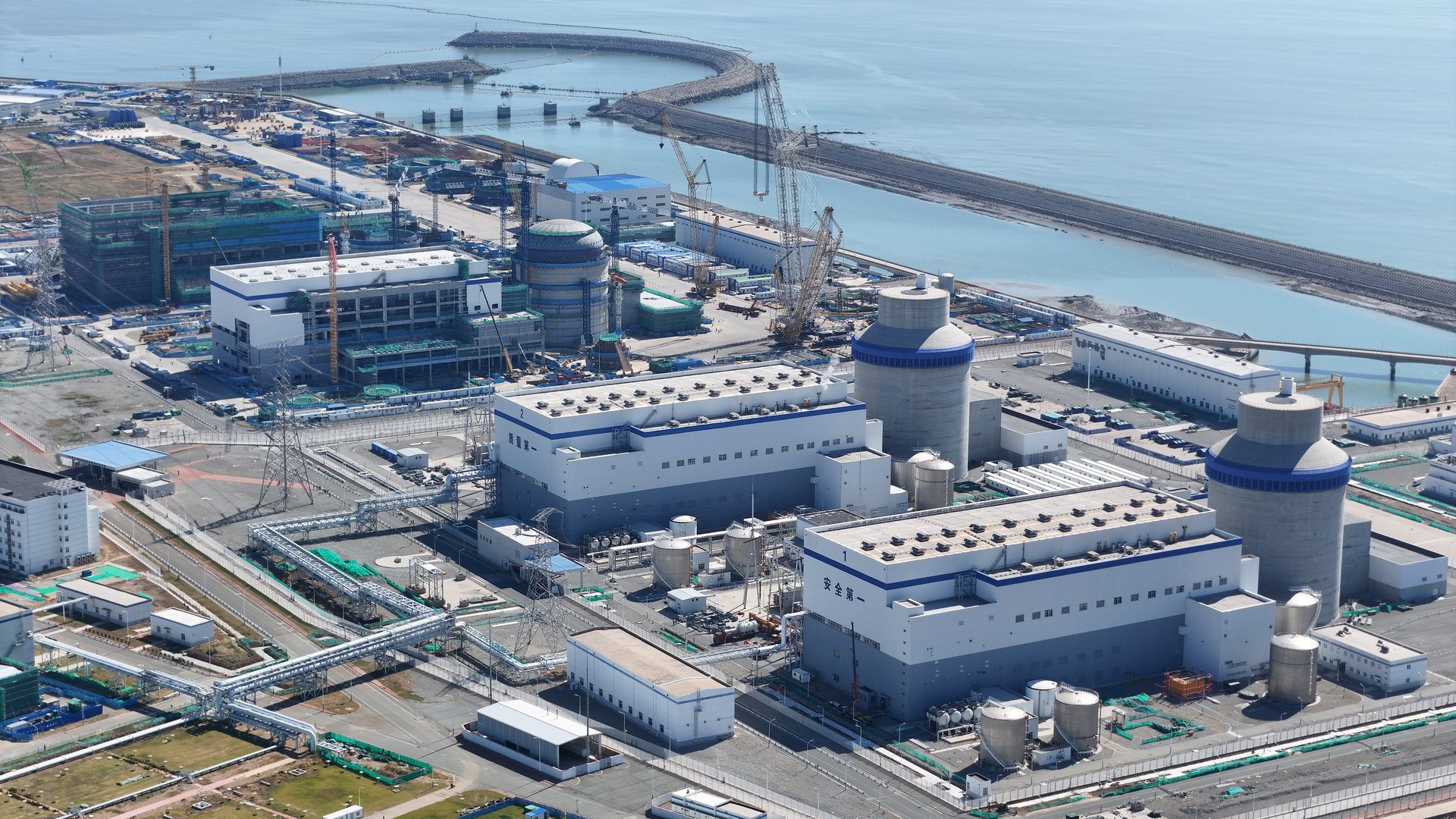
Haiyang Nuclear Power Plant
Most nuclear power plants generate electricity. Haiyang does that too -- its two operational reactors pump roughly 20 terawatt-hours per year into Shandong province's grid. But what makes this facility on China's northeastern coast genuinely unusual is what it does with its waste heat. Since 2020, the Haiyang plant has piped thermal energy into the surrounding city, replacing coal-fired heating plants with nuclear warmth. By November 2022, it was heating 200,000 homes using 345 megawatts of thermal output, making it China's largest nuclear district heating project.
The AP1000 Arrives in Shandong
Haiyang was the second site in China to receive AP1000 reactors, the Westinghouse-designed pressurized water reactors that represented a new generation of nuclear technology emphasizing passive safety systems. Groundbreaking came one month ahead of schedule on July 30, 2008, and construction of Unit 1 began in September 2009. The road from construction to power was long: civil construction of Unit 1 wrapped up in March 2013, but fuel loading did not begin until June 2018. The first grid connection came on August 17, 2018, and commercial operation of Unit 1 started on October 22 of that year. Unit 2 followed into commercial operation in January 2019 after completing a 168-hour full-power test run.
From Electricity to Radiators
The plant's district heating program began modestly, warming roughly 700,000 square meters of housing in its initial phase. The concept is straightforward but ambitious: extract thermal energy from the reactor's secondary cooling loop and pipe it to residential buildings, eliminating the need for coal-burning boilers that had previously choked the local air. By its second full heating season, the system had replaced twelve coal heating plants entirely. For a province where winter temperatures regularly drop below freezing, the switch represents both a practical solution to heating demand and a demonstration that nuclear energy can serve communities in ways beyond generating electricity.
Building Toward Six Reactors
Haiyang's ambitions extend well beyond its first two units. Construction on Unit 3, using the domestically developed CAP1000 reactor design derived from the AP1000, began on July 7, 2022. Unit 4 followed on April 22, 2023. Plans exist for Units 5 and 6 as well, which would bring the plant's total capacity to roughly 7,500 megawatts gross when fully built out. Each CAP1000 unit produces approximately 1,253 megawatts of gross electrical power from 3,400 megawatts of thermal capacity. The progression from imported AP1000 technology to domestically produced CAP1000 reactors traces China's broader strategy of absorbing foreign nuclear technology and iterating on it at scale.
A Coastal Campus of Concrete and Steam
Sitting on the Yellow Sea coast of Shandong province at Haiyang, the plant occupies a stretch of shoreline that provides the cold seawater essential for reactor cooling. The facility is operated by Shandong Nuclear Power Company and represents one node in China's rapid expansion of nuclear capacity -- a country that has built more new reactors in the 21st century than any other nation. From the air, the plant's distinctive containment domes and cooling infrastructure stand out against the agricultural landscape of the Shandong Peninsula, a visible marker of the energy transition unfolding along China's coast.
From the Air
Located at approximately 36.71N, 121.38E on the Yellow Sea coast of the Shandong Peninsula. The nuclear plant's containment domes and associated infrastructure are visible from altitude. Nearest major airport is Yantai Penglai International (ZSYT), roughly 80 km to the north. Qingdao Jiaodong International (ZSQD) lies to the southwest. The coastal setting and distinctive industrial footprint make the plant identifiable from cruising altitude.