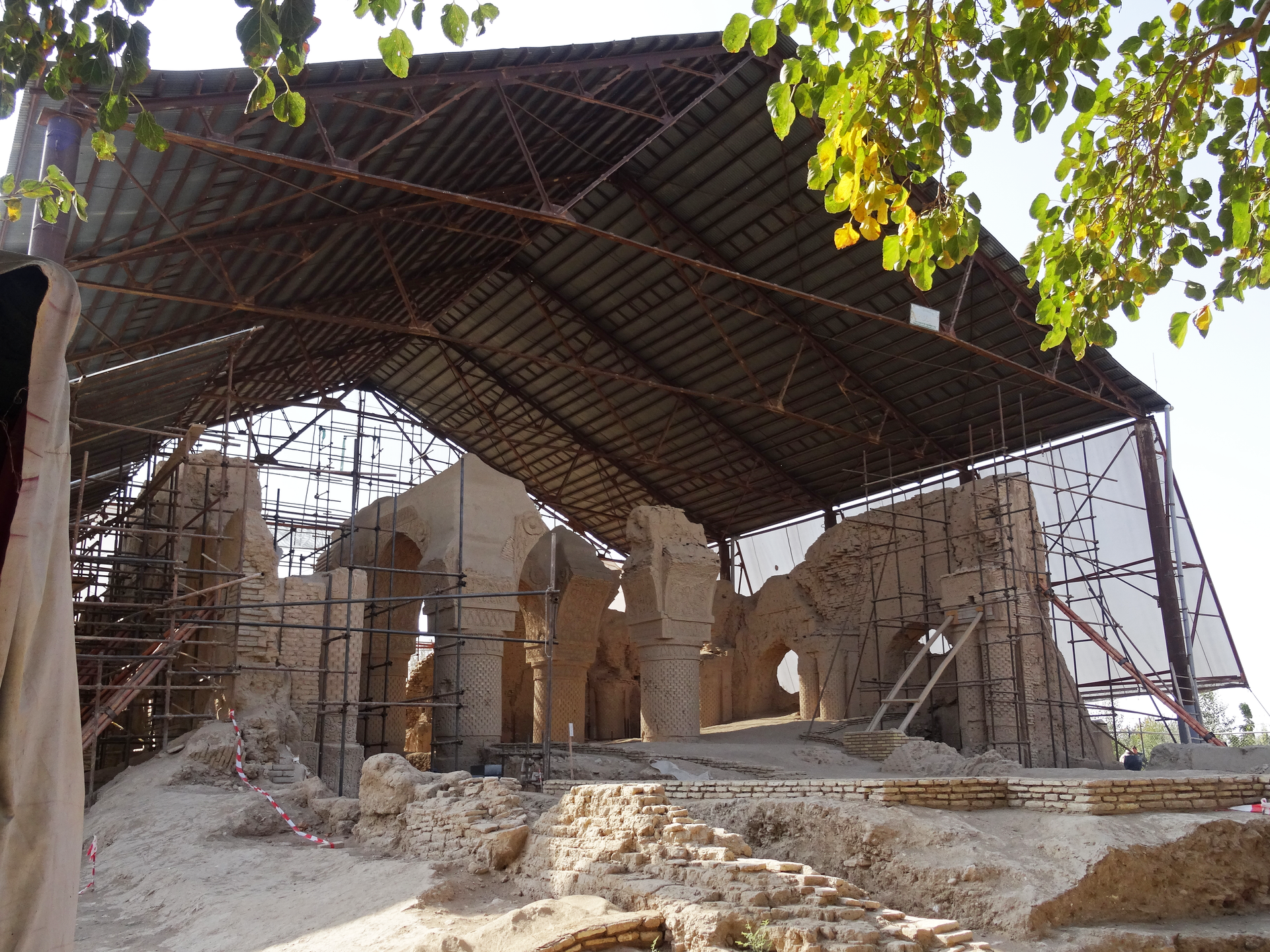
Haji Piyada Mosque
Nine domes once crowned this mosque. All of them have collapsed, and the walls beneath have weathered more than a thousand years of Central Asian winters, yet the Haji Piyada Mosque remains standing near the ancient city of Balkh. Known also as the Noh Gonbad Mosque, meaning 'Nine Domes,' it is thought to be the oldest Islamic building in Afghanistan, dating to the 9th century and possibly as far back as the late 8th. What survives is fragmentary but extraordinary: carved stucco columns bearing vine-leaf scrolls and geometric interlace that represent some of the earliest Islamic decorative art ever found in this part of the world.
Where Empires Planted Prayer
Balkh was already ancient when Islam arrived. Known in classical sources as the 'mother of cities,' it had been a center of Zoroastrian, Buddhist, and Greek civilization before Arab armies brought the new faith to Central Asia in the 7th and 8th centuries. The Haji Piyada Mosque rose during this transformation. Scholars date its construction to the 9th century based on stylistic parallels with the Abbasid architecture of Samarra in present-day Iraq, though French archaeologists have suggested it could date to 794-795 CE. If that earlier date holds, the mosque was built during the reign of the Abbasid caliph Harun al-Rashid, a period when Balkh sat at the crossroads of empire. The building reflects that position, blending artistic traditions from the Abbasid heartland with proto-Samanid motifs native to Central Asia.
Stone Lace in Stucco
The mosque's stucco decorations are its most remarkable surviving feature. Deeply carved vegetal scrolls spiral across the remaining columns and arches, interwoven with vine-leaf motifs and geometric patterns that lock together in precise interlace. The work draws from both the ornamental vocabulary of the Abbasid caliphate and the emerging artistic language of the Samanid dynasty, which would soon dominate the region. Scholars from the University of Florence who led conservation work on the site have called the ornamentation a masterpiece of early Islamic architecture. The Aga Khan Development Network, which oversees ongoing preservation efforts, emphasizes the fragility of the plasterwork and its rarity as material evidence of Islamic stucco production in Afghanistan during this early period.
Saving What Remains
By the early 2000s, the mosque was in serious danger. Its domes had long since fallen, and the exposed walls were eroding steadily. A metal roof had been placed over the ruins to slow the damage, but more comprehensive intervention was needed. In 2006, Afghan authorities, UNESCO, and the French Archaeological Delegation in Afghanistan requested an expert assessment. The Aga Khan Trust for Culture took the lead, and in 2009, conservation work began with funding from the U.S. Embassy in Kabul. Scholars from the University of Florence coordinated the reconstruction, completing the first phase in 2011. A larger temporary metal roof now shields the site from rain, wind, and the harsh northern Afghan climate. The mosque is also a pilgrimage site: visitors come to pay respects at the tomb of the saint Haji Piyada, who was buried within the building and whose name it carries.
A Fragile Witness
The Haji Piyada Mosque sits in a landscape that has been shaped by conquest and destruction for millennia. Balkh was devastated by Genghis Khan in 1220 and never fully recovered its ancient prominence. The mosque endured, quietly aging on the outskirts of a diminished city. Today it stands under its protective canopy, surrounded by the dry terrain of northern Afghanistan, a rare physical link to the moment when Islamic civilization first took root in the region. The World Monuments Fund has included it on its watch list of endangered heritage sites. Its carved columns, still sharp after twelve centuries, record the aesthetic ambitions of a culture in its first flowering, before the traditions it borrowed and the ones it would create had fully separated.
From the Air
Coordinates: 36.73N, 66.89E. The Haji Piyada Mosque is located near the ancient city of Balkh, approximately 20 km west of Mazar-i-Sharif in Balkh Province, northern Afghanistan. The site is small and best identified by its protective metal roof structure visible at low altitude. Nearest airport is Mazar-i-Sharif International Airport (OAMS). Elevation approximately 365 meters (1,198 feet). The terrain is flat and arid with scattered agricultural settlements.