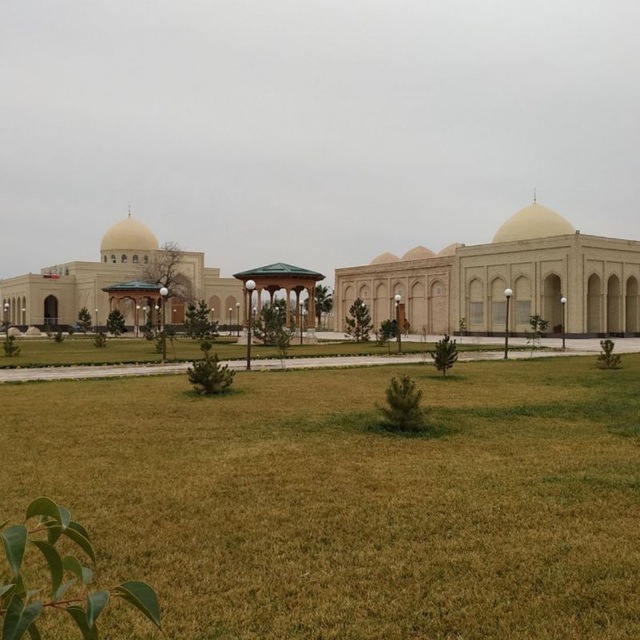
Hakim at-Termizi Mausoleum
For more than a millennium, pilgrims have been walking to the grave of Abu Abdallah Muhammad al-Hakim at-Termizi. The Islamic scholar died in the late 9th century, and the mausoleum built over his resting place in Uzbekistan's Surxondaryo region has been growing ever since -- a mosque added here, a guesthouse there, cells for pilgrims, an entrance porch, another small mausoleum, each century layering its architecture on top of the last. The complex is less a single building than a geological record of devotion, each stratum revealing a different dynasty's way of honoring the same man.
The Scholar Beneath the Stone
Al-Hakim at-Termizi was one of the most influential thinkers of early Islamic mysticism. Born near Termez, he developed a theory of sainthood that would profoundly shape Sufi thought for centuries. His writings explored the nature of spiritual authority, arguing that certain individuals attain a closeness to God that grants them a special status -- a concept that became foundational to Sufi hierarchies of saints. The mausoleum was constructed directly on top of his grave, and the marble cenotaph inside one of its chambers became the complex's spiritual center. That original cenotaph was eventually relocated to the Museum of Termez, replaced by a modern replica crafted by contemporary artisans. The swap was practical -- preservation over piety -- but the pilgrims still come.
A Thousand Years of Building
The complex grew outward from the tomb in concentric waves of construction. In the 10th century, the scholar's son, al-Hakim Abdullokh, received his own mausoleum nearby. During the 11th and 12th centuries, a three-domed mosque was added for prayer. The Timurid dynasty left its mark in the 15th century, raising the guesthouse by half a meter and refurbishing its cells. The most dramatic expansion came under Abdullakhan in the late 16th century, between 1583 and 1598. His builders erected a new mosque with eight domes, added an entrance porch, and created a pilgrimage area at the southern entrance, stitching the mausoleum more tightly to the guesthouse. Each renovation respected the original tomb while asserting the authority of whoever happened to hold power.
Stucco, Muqarnas, and Light
The mausoleum's architecture rewards close attention. The core structure is roughly square -- about 4.3 by 4.5 meters -- with four chambers connected through passageways. An eastern-style entrance on the northeastern side was added later. The cenotaph chamber is adorned with elaborate stucco designs and inscriptions. Three gumbads crown the exterior of the guesthouse, their square forms ornamented with squinches and six-ribbed muqarnas. Rectangular windows on the outer walls are covered by carved wooden latticework, and terracotta friezes line the facade in intricate floral patterns. Six rows of windows admit filtered light through ornate tracery. The effect is dense and meditative -- a surface that keeps revealing new details the longer you look, as though the building itself were teaching patience.
Restoration and Continuity
The complex has been studied and restored in cycles that mirror the scholarly arguments it has provoked. D.N. Logofet conducted the first formal examination, publishing his findings in road sketches. V.L. Voronina measured the building comprehensively in 1945. Between 1955 and 1957, scientific investigations reassessed the mausoleum's condition and restored elements typical of the 14th and 15th centuries. Further restoration work took place in 1980-1981, and a full refurbishment of both the mausoleum and guesthouse followed in 2001-2002. In honor of the 660th anniversary of the birth of Amir Temur, the cenotaph and decorative lattice windows were reinstalled. The pattern holds: each generation finds its reason to tend the place, whether out of religious devotion, architectural preservation, or national pride. At-Termizi's grave keeps gathering attention, just as it has since the 9th century.
From the Air
The Hakim at-Termizi Mausoleum complex is located at 37.68N, 67.08E in the Sherobod district of Surxondaryo Region, Uzbekistan. The domed structures of the complex are visible from moderate altitudes. Nearest airport: Termez Airport (UTST), approximately 30 km southeast. The site lies in the Amu Darya river valley with generally flat terrain. Best viewed in clear weather when the domes and courtyards cast distinct shadows.