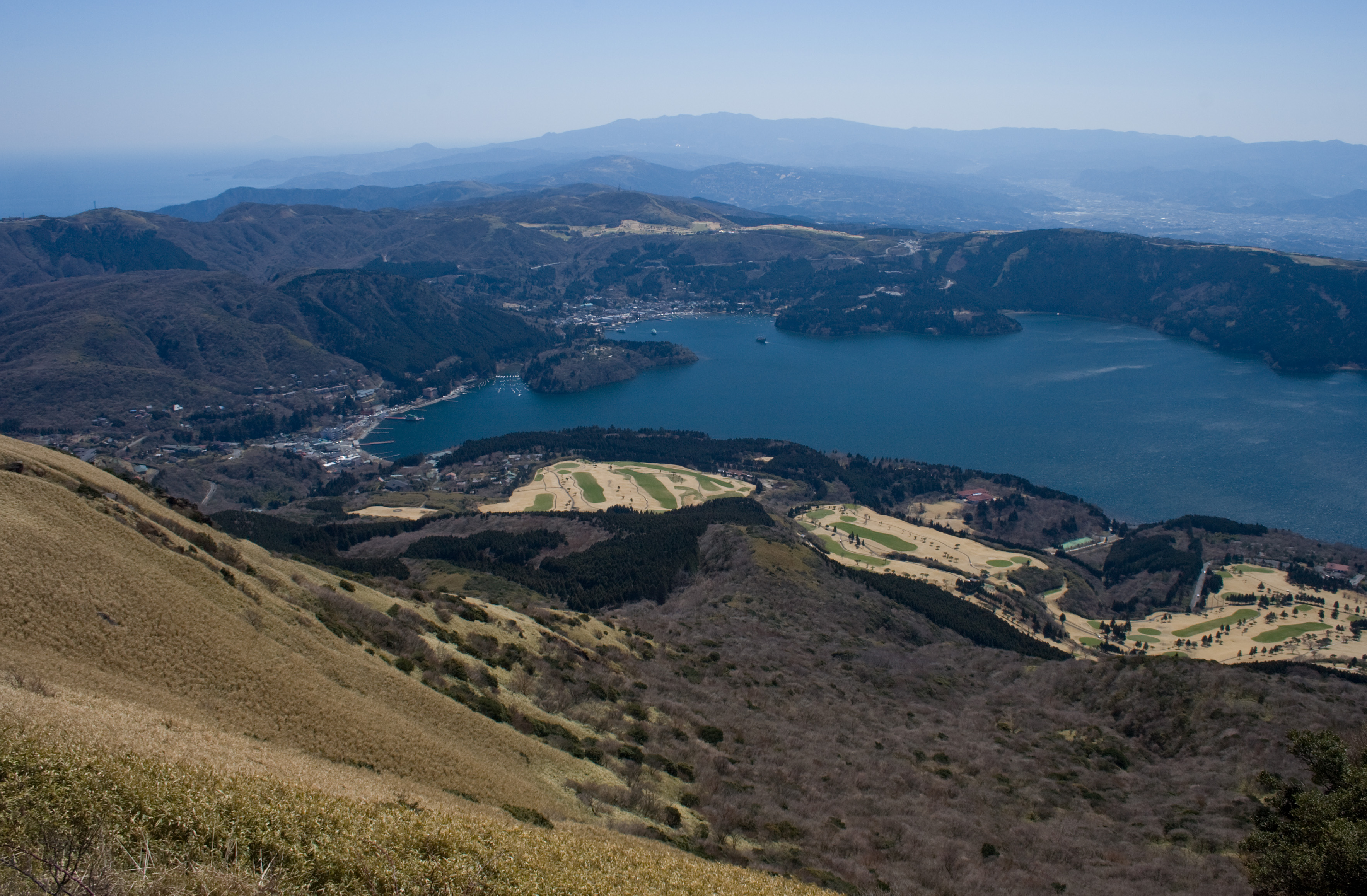
Hakone
Every New Year, tens of millions of Japanese television viewers watch a single relay runner stagger up the final mountain pass toward Lake Ashi, legs burning on the steep grade, a cloth sash clutched like a sacred relic. The Hakone Ekiden, first run in 1920, is more than a foot race. It is a national ritual, and the town at its turnaround point is no ordinary mountain village. Hakone sits inside the caldera of a complex volcano that last erupted around 1170 CE, its hot springs bubbling up through fractured rock just 80 kilometers from the neon sprawl of Tokyo. For centuries, this small town in Kanagawa Prefecture has occupied an outsized place in Japanese culture: as a gateway, a checkpoint, a resort, and a mirror reflecting whatever era happens to be looking into its sulfurous mists.
The Barrier at the Edge of Power
Long before it became a resort destination, Hakone was a chokepoint. During the Edo period, the Tokugawa shogunate maintained the Hakone Barrier, one of the most fearsome checkpoints on the Tokaido highway connecting Edo with Kyoto. Every traveler entering or leaving the shogun's capital was stopped here. Officials examined travel permits and baggage with particular vigilance for two things: women fleeing Edo, where feudal lords were required to keep their families as political hostages, and weapons being smuggled toward the capital. The checkpoint's reputation was so formidable that the phrase 'harder than passing through Hakone' entered the Japanese language. Sections of the original stone-paved Tokaido road survive in the cedar forests around the town, their worn surfaces still bearing the grooves of centuries of foot traffic.
Smoke and Healing Waters
The same volcanic geology that makes Hakone geologically restless also makes it one of Japan's premier onsen destinations. The town's hot springs draw from the caldera of Mount Hakone, a complex volcano whose overlapping craters span roughly 10 by 11 kilometers. At Owakudani, the volcanic heart of the caldera, sulfurous steam hisses from vents in a barren, yellow-streaked landscape that translates as 'Great Boiling Valley.' Visitors line up to buy kuro-tamago, eggs boiled in the sulfurous hot springs until their shells turn jet black from a chemical reaction between iron in the water and hydrogen sulfide gas. Local tradition holds that each black egg adds seven years to your life, though the benefit supposedly maxes out at two eggs. The commercial production of these eggs began in 1955, but the healing reputation of Hakone's waters stretches back far longer. The Fujiya Hotel in Miyanoshita, established during the Meiji era, hosted foreign dignitaries and literary figures in its Western-style rooms while offering Japanese bathing traditions, becoming one of the country's first international resort hotels.
Rails, Ropes, and Pirate Ships
Getting around Hakone is half the adventure. The Hakone Tozan Railway, Japan's oldest mountain railway, began operations in 1919 after engineer Mitsugu Handa traveled to Switzerland to study the Bernina Railway's switchback techniques. The resulting 8.9-kilometer line employs three switchbacks to negotiate gradients as steep as 8 percent, among the steepest for a conventional railway anywhere in the world. At each switchback, the driver and conductor swap ends of the train. From the railway's terminus at Gora, a cable car funicular climbs to Sounzan, where the Hakone Ropeway gondola carries passengers over the steaming Owakudani valley and down to Lake Ashi. There, cartoonishly decorated 'pirate ships' carrying up to 500 passengers each make 30-minute crossings, with Mount Fuji filling the horizon on clear days. The whole chain of transport, from Tokyo to lake and back, can be ridden on a single Hakone Free Pass.
Where the Sacred Meets the Fictional
Hakone Shrine has stood in these mountains since 757 CE, its vermillion torii gate rising from the waters of Lake Ashi, one of the most photographed scenes in Japan. The current lakeside torii was erected in 1952, but the shrine itself has drawn shoguns, samurai, and pilgrims for over twelve centuries. Minamoto no Yoritomo prayed here during the Genpei War after his defeat at the nearby Battle of Ishibashiyama. In the modern era, Hakone has gained an entirely different kind of pilgrimage. The town serves as the setting for Neon Genesis Evangelion, reimagined in the anime as 'Tokyo-3,' and in 2017 the Anime Tourism Association designated Hakone as one of Japan's 88 official anime pilgrimage sites. The local craft tradition of Yosegi, an intricate form of marquetry using naturally colored woods to create geometric patterns, predates the anime fans by centuries but shares the same spirit of meticulous, almost obsessive craftsmanship.
The Mountain and the Mirror
Hakone's population peaked around 1970 and has been declining since, a common story in rural Japan. Yet the town remains one of the country's most visited destinations, its economy almost entirely driven by tourism. Mount Fuji dominates nearly every vista, reflected in the still waters of Lake Ashi on calm mornings, framed by the cedar trees surrounding Hakone Shrine. The Hakone Ekiden, that grueling two-day collegiate relay covering 217.1 kilometers from central Tokyo to the shores of Lake Ashi and back, commemorates the couriers who once ran the Tokaido road. When the final runner collapses past the finish line each January, the nation exhales. Hakone has served its ancient purpose once again: a place where journeys turn around, where travelers pause to soak in hot water and take stock before heading back to the city.
From the Air
Hakone is located at 35.19N, 139.02E within the caldera of Mount Hakone in Kanagawa Prefecture, roughly 80 km southwest of Tokyo. Lake Ashi is a prominent caldera lake visible as a distinctive water feature surrounded by forested volcanic ridges. Mount Fuji dominates the western horizon. Recommended viewing altitude: 3,000-5,000 feet for caldera detail, higher for Fuji context. Nearest airports include RJTT (Tokyo Haneda, 80 km NE) and RJAA (Narita, 140 km NE). RJTO (Oshima) lies to the south. The Odawara coastal plain to the east provides good visual reference for approach.