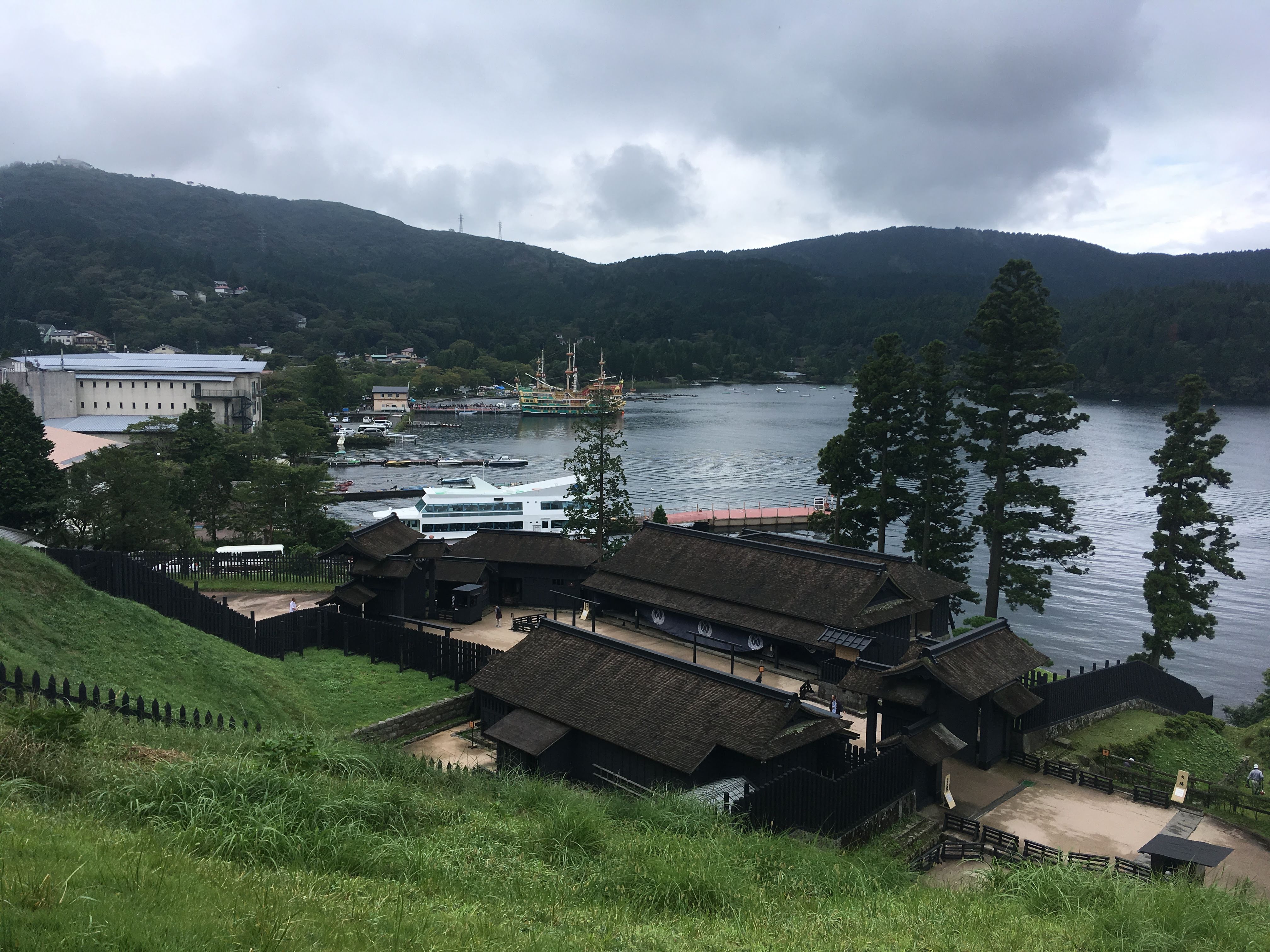
Hakone Barrier
Of all the regulations enforced at the Hakone Barrier, none was stranger than the last one on the list: check the women. The Tokugawa shogunate required every feudal lord's wife and family to live in Edo as hostages, a leash of silk that kept the provinces obedient for over two centuries. At this checkpoint on the Tokaido highway, perched on the shore of Lake Ashi where the volcanic mountains of Hakone squeeze Japan's most important road into a narrow pass, female inspectors conducted physical examinations of every woman who tried to leave the capital. Weapons coming in, women going out -- that was the formula the guards watched for, day after day, from 1619 until the Meiji government abolished the barrier in 1869.
The Chokepoint That Shaped a Nation
Geography made Hakone a fortress long before the Tokugawa shoguns built their checkpoint here. The ancient Tokaido highway -- the vital corridor linking Kyoto and the Kansai region to the Kanto plain and Edo -- threads through the Hakone Mountains at a pass that military commanders recognized as a natural chokepoint as early as the Nara period. The Hakone Shrine was constructed partly to control this narrow passage. When the rebel warlord Taira no Masakado positioned troops here during the Heian period, he understood the same truth the Hojo regents grasped during the Jokyu War of the Kamakura period: whoever held Hakone Pass controlled traffic between eastern and western Japan. By the Muromachi period, barriers here served mostly to tax travelers -- in 1380, one was erected for three years solely to fund the reconstruction of Engaku-ji temple in Kamakura.
Eighteen Meters of Absolute Control
The Tokugawa shogunate transformed the Hakone Pass from a toll station into an instrument of political control. They built a new post town called Hakone-juku and relocated the barrier to the shore of Lake Ashi, where the caldera lake itself served as an additional obstacle to anyone thinking of going around the checkpoint. The physical structure was deceptively simple: two wooden gates set 18 meters apart on the highway, with buildings flanking the corridor on both sides. Inside those buildings, a staff of 20 people examined travel permits, inspected goods, levied taxes on merchants, and -- most critically -- enforced the shogunate's twin obsessions. No weapons were to enter Edo unchecked, and no woman of rank was to leave. The Odawara Domain operated the barrier for most of its 250-year existence, and the consequences for attempting to slip past were severe.
Ghosts on the Lakeshore
The Meiji government swept away the Hakone Barrier in 1869, along with every other checkpoint in the country. For decades the site sat quiet. In 1923, it was designated a National Historic Site, and a small museum opened in 1965. But the real revelation came between 1999 and 2001, when archaeological excavations uncovered the original foundations of the barrier buildings. Using those foundations and detailed mid-Edo period descriptions, researchers reconstructed the checkpoint to its authentic appearance -- the only sekisho in Japan to receive this treatment. The rebuilt Edoguchi Gate and Kyoguchi Gate now frame the same 18-meter corridor where travelers once waited nervously for inspection. An archery range stands nearby, a reminder that the guards were not merely bureaucrats. The museum, remodeled in 2013, houses artifacts recovered from the excavations and tells the story of a place where the state's power was felt most intimately.
The View They Left Behind
Stand at the barrier today and you see what every Edo-period traveler saw: Lake Ashi stretching south, its surface reflecting the volcanic ridgeline of Mount Hakone, and on clear days, the unmistakable silhouette of Mount Fuji rising beyond. The beauty of this setting was never lost on the people who passed through it. Ukiyo-e artists, including Hiroshige, depicted the Hakone station on the Tokaido road as one of its most dramatic landscapes. For the daimyo's wives trapped in Edo, this lake view from behind the barrier gates must have been particularly poignant -- a glimpse of the provinces they could not reach. The reconstructed checkpoint now sits quietly among cedar trees, visited by tourists arriving by bus or the Hakone sightseeing boats that ply Lake Ashi. The barrier no longer stops anyone, but its story of control, obedience, and the price of peace in feudal Japan lingers in the mountain air.
From the Air
Located at 35.19N, 139.03E on the western shore of Lake Ashi, the caldera lake of Mount Hakone. From the air, the checkpoint site is identifiable by its position on the narrow strip of land between the lakeshore and the forested mountain slope. Lake Ashi itself is a prominent visual landmark -- an elongated volcanic lake oriented roughly north-south. The Hakone mountain complex, with its distinctive caldera rim and steaming Owakudani geothermal valley to the north, is clearly visible from cruising altitude. Nearest major airport: Tokyo Haneda (RJTT), approximately 95 km northeast. Odawara, the nearest city, lies about 15 km to the east. Expect volcanic haze from Owakudani and frequent cloud cover around the Hakone ridgeline.