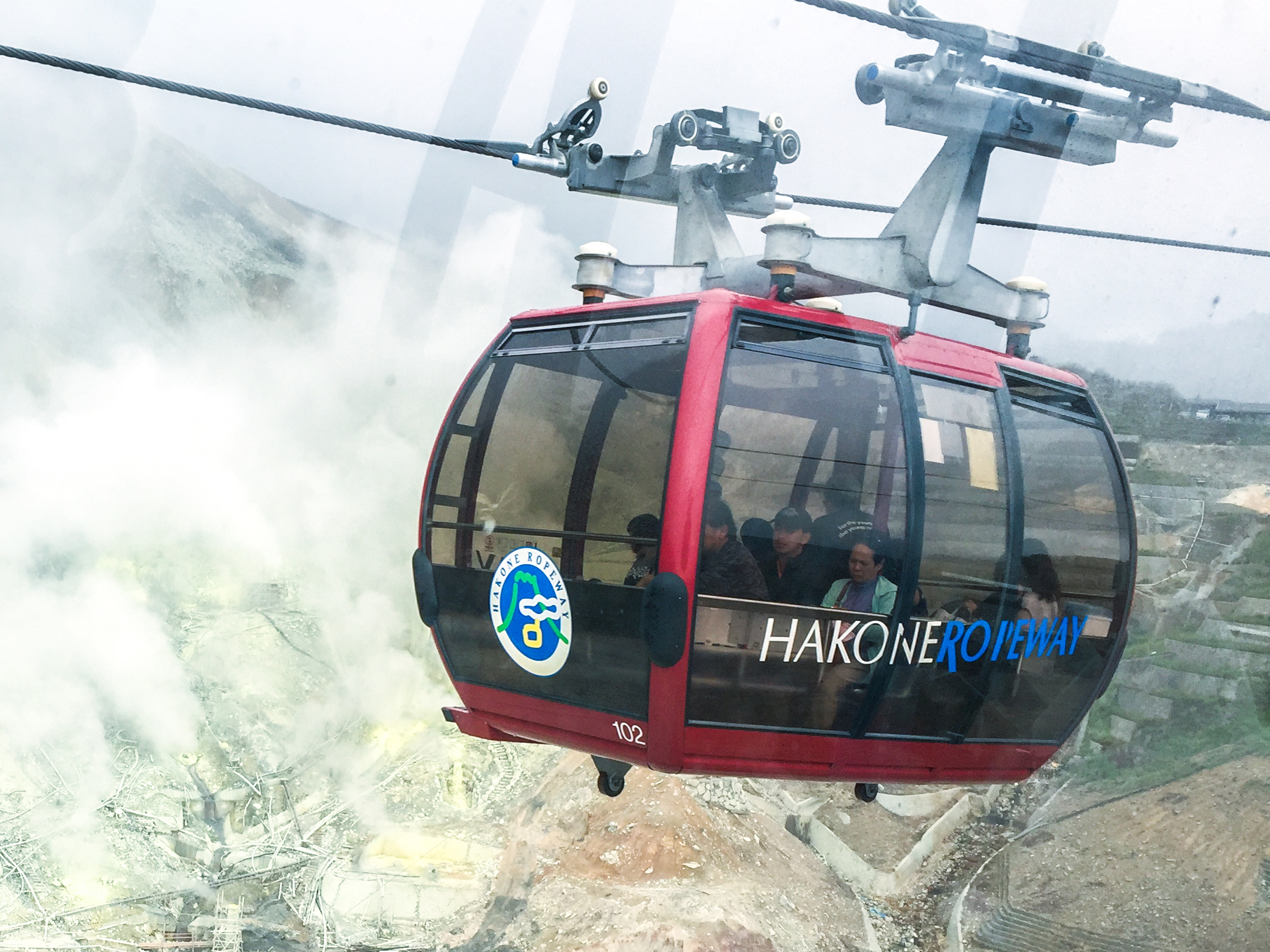
Hakone Ropeway
The eggs are black. Jet black, cooked in pools of sulfurous water so hot that the minerals fuse into the shells, turning them the color of volcanic rock. Eat one, locals say, and you gain seven years of life. This is Owakudani, the Great Boiling Valley, and the only practical way to reach it is to dangle above it in a small glass-and-steel gondola, watching the steam rise through the floor of clouds below your feet. The Hakone Ropeway carries more paid passengers than any other aerial tramway on Earth, a fact certified by Guinness World Records in 2009 after it logged over two million riders in a single year. But the record is almost beside the point. People ride because the view is staggering: an active volcanic landscape scarred by fumaroles and sulfur deposits, with the snow-capped cone of Mount Fuji filling the horizon beyond.
Hell Valley, Renamed for an Emperor
Owakudani sits inside the Hakone caldera, a vast volcanic bowl that formed between 80,000 and 130,000 years ago. The valley itself was born roughly 3,000 years ago, when a section of the caldera collapsed in a phreatic eruption, leaving behind a moonscape of reddish-brown earth, hissing fumaroles, and boiling streams. For centuries, locals called the place Jigokudani, meaning Hell Valley, a name that captured its desolate, sulfur-choked terrain. That changed in 1873, when Emperor Meiji visited the area. Officials, apparently deciding that an emperor should not be touring hell, rechristened the spot Owakudani, the Great Boiling Valley. The sulfur stayed. The name became gentler.
Strung Between Two Worlds
The ropeway operates in two sections, strung like a clothesline across the caldera's interior. The lower section runs from Sounzan Station up to Owakudani, climbing steeply through volcanic terrain at gradients exceeding 25 degrees. The upper section descends from Owakudani to Togendai Station, on the shore of Lake Ashi, where pirate-themed sightseeing boats wait at the dock. Together, the two legs take about 30 minutes. Until 2002, the line used a conventional bicable gondola system, but the lower section was rebuilt that year as a funitel, a twin-cable design that resists high winds and allows the gondolas to keep running in conditions that would ground most aerial tramways. The upper section followed suit in 2007. Each gondola holds 18 passengers and departs roughly every minute, a cadence that moves enormous crowds through a landscape too fragile and too dangerous to absorb foot traffic.
A Link in the Golden Course
The ropeway does not exist in isolation. It is one segment of Hakone's celebrated Golden Course, a loop route that connects the mountain resort's trains, cable cars, boats, and buses into a single sightseeing circuit. The journey typically begins at Odawara or Hakone-Yumoto aboard the Hakone Tozan Railway, a switchback-laden mountain train, then transfers to the Hakone Tozan Cable Car at Gora Station for the steep climb to Sounzan. The ropeway takes over from there, carrying riders above the volcanic valley to Lake Ashi, where cruise boats shuttle passengers to the lakeside village of Hakone-machi. A bus completes the loop back to Odawara. The entire circuit, operated by the Odakyu Group, can be done in a day, and the ropeway leg is the showpiece, the moment when the landscape shifts from forest and hot-spring village to raw, steaming geology.
Living with a Restless Mountain
Hakone's volcanic activity is not historical decoration. The mountain system remains classified as active, and seismic swarms periodically close the ropeway and restrict access to Owakudani. In 2015, increased volcanic activity forced a months-long closure, with the Japanese Meteorological Agency raising the alert level and banning entry to the valley floor. Riders on the ropeway, when it is running, can see the evidence directly below: jets of steam bursting from cracks in the hillside, pools of milky-blue water, the orange stain of iron deposits on exposed rock. The smell of sulfur seeps into the gondola. It is a reminder that the scenery here is not static, that the caldera is still cooking. The black eggs of Owakudani, boiled in those same volcanic pools and sold at the station kiosk, are the landscape turned into a souvenir, proof that you hovered above a place where the earth has not finished making itself.
From the Air
The Hakone Ropeway sits at approximately 35.244N, 139.019E, strung across the interior of the Hakone caldera in Kanagawa Prefecture. From altitude, look for the prominent white steam plumes of the Owakudani fumarole field on the caldera's inner slope, with Lake Ashi to the south and the distinctive silhouette of Mount Fuji to the northwest. The ropeway's gondola cables are visible as thin lines crossing the volcanic terrain between Sounzan and Togendai. Nearest major airport is RJTT (Tokyo Haneda), approximately 85 km northeast. RJTO (Oshima) lies to the southeast across Sagami Bay. Approach from the east along the Sagami coastline and turn inland at Odawara to enter the caldera. Recommend viewing at 3,000-5,000 feet. Watch for turbulence and reduced visibility from volcanic steam vents.