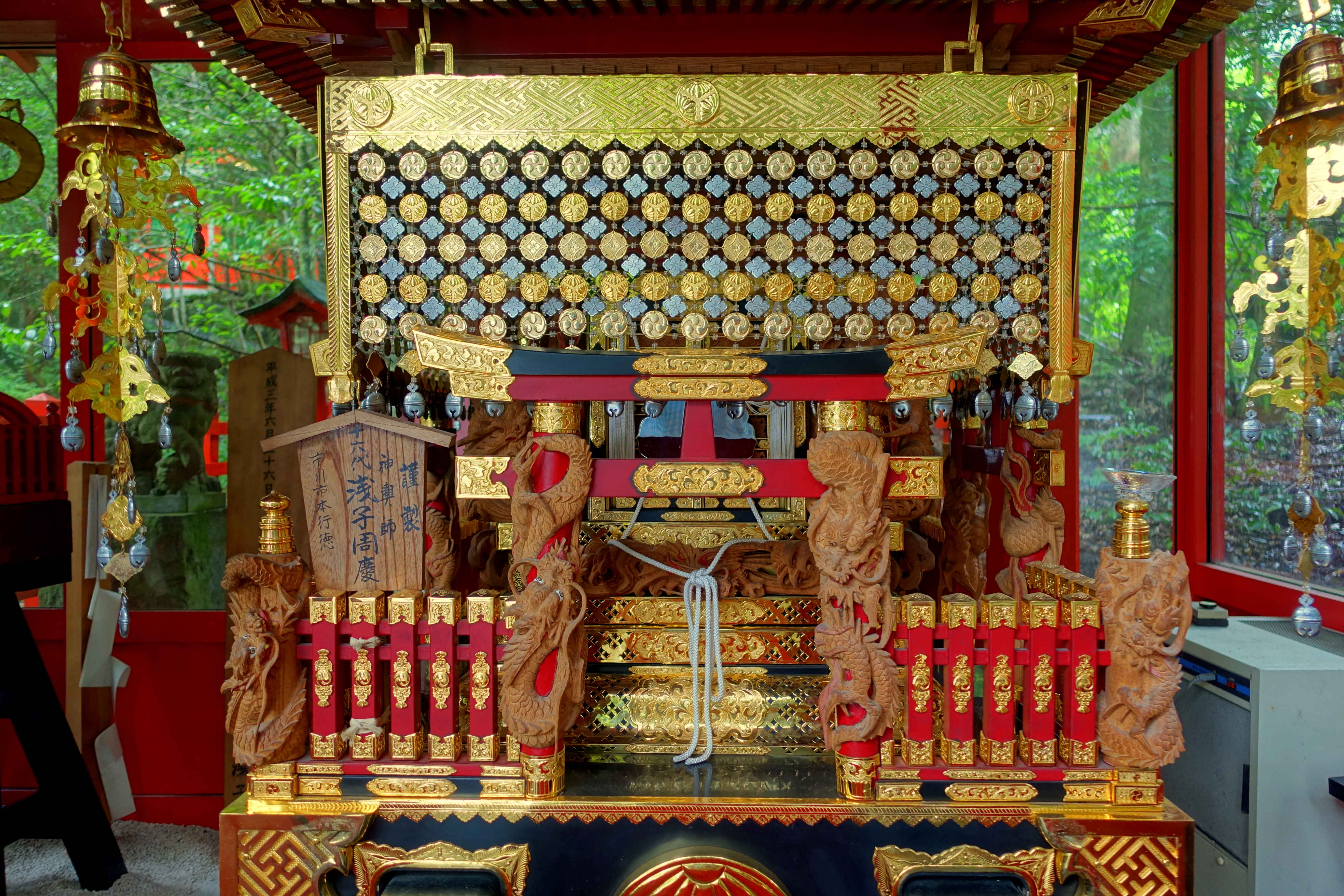
Hakone Shrine
Before the priest arrived, the people of Lake Ashi offered their daughters to the dragon. Kuzuryu, the nine-headed serpent, lived at the bottom of the lake, and its rage was measured in floods and poisoned water. In the year 757, a wandering ascetic named Mangan Shonin walked to the lakeshore, placed a stone slab in the shallows, sat down, and prayed for three days and three nights. By the end, the dragon surrendered. It promised to guard the region in exchange for an annual prayer. A small torii gate still marks the spot offshore where Mangan is said to have sat, and behind it, climbing the forested hillside above Lake Ashi, stands Hakone Shrine, one of the most powerful spiritual sites in Japan's Kanto region.
From the Summit to the Lakeshore
Hakone Shrine began at the top. Its original sanctuary stood on the summit of Komagatake, the highest peak of the Mount Hakone volcanic complex, where mountain worship had drawn pilgrims since antiquity. Mangan Shonin built the first lakeside structure in 757, bringing the sacred down from the clouds to the water's edge. Over the centuries, the shrine evolved and expanded, though fire and earthquakes periodically reshaped its buildings. The structures visitors see today date primarily to 1667, when the shrine was comprehensively rebuilt in the style that endures: cedar-bark roofs, vermillion lacquer, and stone lanterns lining the approach through dense cryptomeria forest. The mountain sanctuary on Komagatake remains as a subsidiary shrine, connected by a separate ropeway, so the spiritual geography still stretches vertically from lakeshore to summit.
The Shogun's Debt
In 1180, a young warrior named Minamoto no Yoritomo lost a decisive battle at Ishibashiyama, the opening clash of the Genpei War that would determine Japan's political future. Defeated and hunted, Yoritomo fled into the Hakone mountains and sought refuge at the shrine, praying to its kami for protection and guidance. He survived, regrouped, and within five years had crushed the rival Taira clan and established the Kamakura shogunate, becoming Japan's first military ruler of a unified government. Yoritomo never forgot the shrine that sheltered him in his lowest moment. He became its devoted patron, pouring resources into its upkeep and elevation. His loyalty established Hakone Shrine as the second most important shrine of the shogunate, trailing only Tsurugaoka Hachimangu in Kamakura, and it sparked the custom of Nisho-mode, the pilgrimage to both shrines that samurai of the Kamakura period considered essential.
The Gate on the Water
The image that defines Hakone Shrine today was built in 1952. The Heiwa no Torii, the Great Gate of Peace, is a vermillion torii standing in the shallows of Lake Ashi, its pillars reflected in water that was once said to be home to a dragon. It was erected to commemorate Japan's return to sovereignty after the signing of the San Francisco Peace Treaty. The gate is both a spiritual boundary, marking the transition from the profane world to sacred ground, and a monument to a nation reconstituting itself after catastrophe. On clear days, Mount Fuji rises directly behind it, and the composition of red gate, blue lake, and white-capped volcano has become one of the most photographed scenes in Japan. Sightseeing boats pass close enough to the torii that passengers can hear the water lapping against its base.
Treasures in the Forest
The approach to Hakone Shrine is itself a kind of architecture. A long avenue of towering cryptomeria trees, some centuries old, channels visitors uphill from the lakeside torii through filtered green light. Stone steps climb steeply through the forest, passing moss-covered stone lanterns and subordinate shrines. The main hall sits at the top, sheltered by the canopy, and houses a small museum displaying five items designated as national Important Cultural Properties of Japan. These include swords, masks, and ritual objects accumulated over twelve centuries of patronage. Each August 1, the shrine's main festival fills the grounds with processions, taiko drumming, and the ceremonial lake crossing of portable shrines, a tradition that recalls the ancient compact between Mangan and the dragon: devotion in exchange for protection.
From the Air
Hakone Shrine sits at 35.204N, 139.026E on the southwestern shore of Lake Ashi, inside the Hakone caldera in Kanagawa Prefecture. From the air, look for the vermillion Heiwa no Torii gate standing in the lake just offshore, the most distinctive visual marker. The shrine complex itself is largely hidden beneath a dense cryptomeria forest canopy on the hillside above. Lake Ashi fills the caldera floor to the south, with Mount Fuji visible to the northwest on clear days. Nearest major airport is RJTT (Tokyo Haneda), approximately 85 km northeast. Approach from the east along Sagami Bay, turning inland at Odawara toward the caldera. Recommend viewing at 3,000-5,000 feet. The red torii against the blue lake is visible from altitude in good conditions.