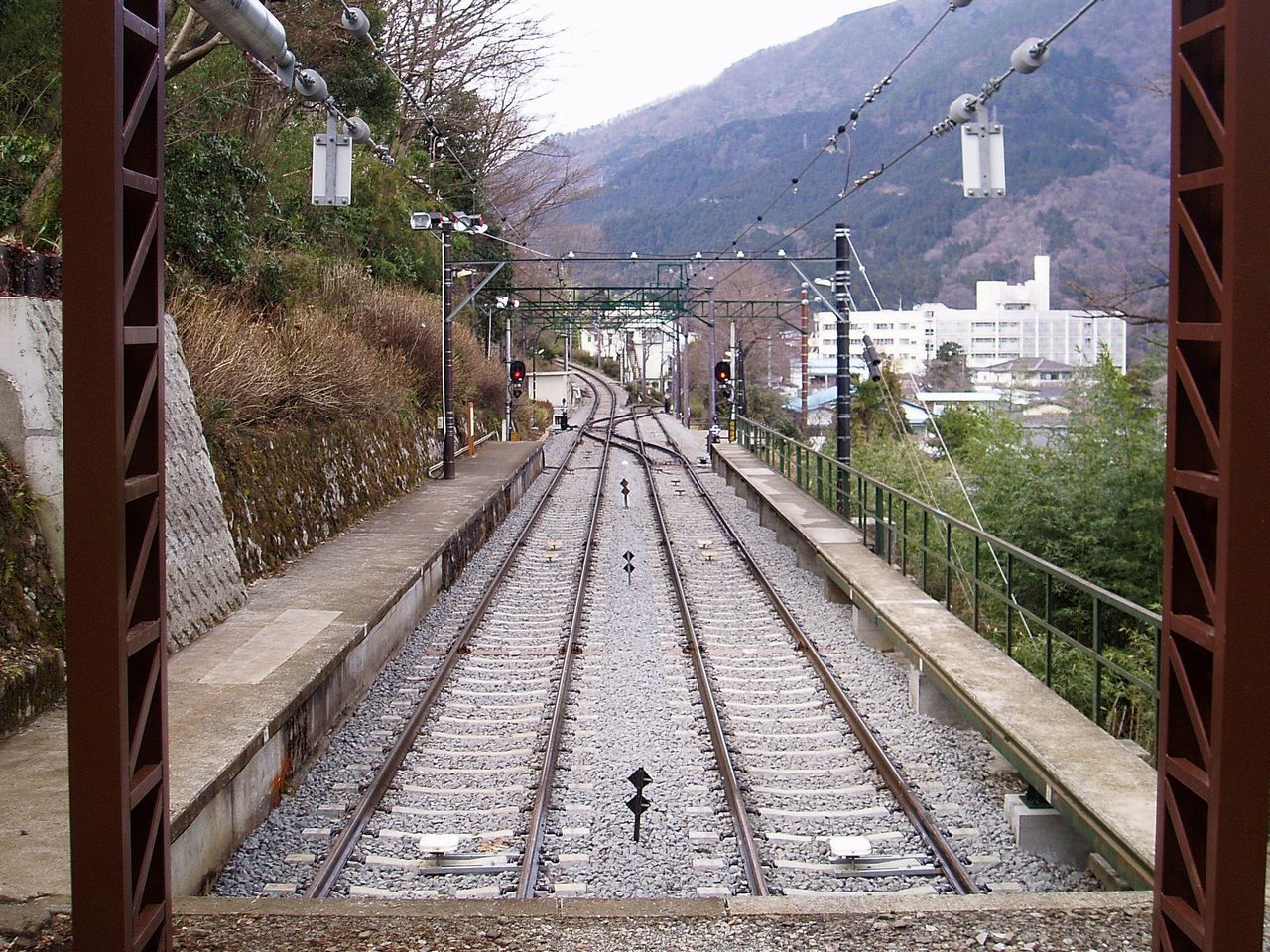
Hakone Tozan Line
Three times on the climb from Hakone-Yumoto to Gora, the train stops, and the driver walks to the other end. The locomotive becomes the caboose. The passengers stay in their seats. This is a switchback, and the Hakone Tozan Line uses three of them to haul itself up gradients that reach eight percent, one of the steepest climbs for any adhesion railway in the world. The train threads through a narrow valley of dense forest, across iron bridges over gorges, and around curves so tight that the minimum turning radius pushes the limits of what standard-gauge rail can manage. In June and July, ten thousand hydrangea bushes planted along the trackside burst into bloom, turning the line into a tunnel of blue, purple, and pink. Locals call it the Ajisai Densha, the Hydrangea Train, and on certain evenings the railway runs special services with the flowers lit from below.
From Horse-Drawn Tram to Mountain Railway
The line's origin story begins not with steam engines but with horses. On October 1, 1888, the Odawara Horse-drawn Railway opened a route from Kozu Station through Odawara to Hakone-Yumoto, following the ancient Tokaido road toward the hot springs. The company electrified in 1900, running as a 600-volt DC tramway, making it one of Japan's earliest electric rail operations. The real engineering feat came on June 1, 1919, when the electrified mountain section opened between Hakone-Yumoto and Gora, pushing rail into the volcanic heart of the Hakone caldera. The company was formally established as Hakone Tozan Railway on August 16, 1928, and it joined the Odakyu Group in 1948. In 1950, Odakyu began running Limited Express Romancecar services from Shinjuku Station in central Tokyo all the way to Hakone-Yumoto, making the mountain resort a single-ticket ride from the capital.
Two Railways in One
Despite being mapped as a single line, the Hakone Tozan Line is actually two railways sharing a name. The lower section, from Odawara to Hakone-Yumoto, runs on narrow-gauge track electrified at 1,500 volts DC and is operated entirely by Odakyu Electric Railway's through-service trains. The upper mountain section, from Hakone-Yumoto to Gora, runs on standard-gauge track at 750 volts DC and uses purpose-built mountain trains with reinforced braking systems designed for steep grades and tight curves. Passengers must change at Hakone-Yumoto, stepping from a sleek Romancecar onto a compact mountain train with open windows. The dual-gauge arrangement is a relic of history: when Odakyu extended through-service to Hakone-Yumoto in 1950, the track was laid with three rails to accommodate both gauges, a solution that persisted until 2006, when most of the dual-gauge track was finally removed.
The Switchback Ballet
The three switchbacks between Hakone-Yumoto and Gora are the line's defining feature. At Deyama, Ohiradai, and Kami-Ohiradai signal stations, the train pulls into a dead-end siding, the driver walks to the opposite cab, and the train reverses direction to continue climbing at a different angle. It is a nineteenth-century solution to a timeless problem: how to gain altitude on a mountainside too steep for a direct ascent. The technique allows the train to zigzag up the slope in stages, each leg gaining a few dozen meters of elevation before reversing. The entire 40-minute journey from Hakone-Yumoto to Gora covers a vertical gain of approximately 450 meters through Fuji-Hakone-Izu National Park. The train passes through tunnels carved into volcanic rock, crosses bridges over ravines where streams tumble toward the valley below, and rounds curves so sharp that passengers in the front car can see passengers in the rear.
Bernina and St. Moritz in Japan
The mountain trains themselves carry Swiss names. The 1000 series is called Bernina, after the Rhatische Bahn's Bernina Railway in the Swiss Alps. The 2000 series is called St. Moritz, after the resort town at the Bernina line's terminus. The naming is not accidental; Hakone Tozan Railway has long acknowledged its kinship with European mountain railways, and the similarities are real: tight curves, steep gradients, dramatic scenery, and purpose-built rolling stock that could not operate on flatland mainlines. Newer 3000 and 3100 series trains have joined the fleet since 2014, and a 4000 series three-car EMU is planned for 2028. In October 2019, Typhoon Hagibis dealt the line its worst blow, triggering landslides that washed away track ballast and closed the mountain section for nine months. Test trains resumed in July 2020, and full service was restored on July 23, the railway proving as stubborn as the mountain it climbs.
From the Air
The Hakone Tozan Line runs through the Hakone caldera at approximately 35.232N, 139.087E, in Kanagawa Prefecture. From the air, the line is visible as a narrow rail corridor threading through dense forest between the town of Hakone-Yumoto and Gora Station. The three switchback locations at Deyama, Ohiradai, and Kami-Ohiradai are identifiable as Z-shaped track patterns on the mountainside. The line follows the Hayakawa River gorge for much of its route. Nearest major airport is RJTT (Tokyo Haneda), approximately 80 km northeast. The caldera's rim, Lake Ashi, and Mount Fuji to the northwest provide orientation landmarks. Approach from the coast at Odawara and follow the river valley inland. Recommend viewing at 3,000-5,000 feet. In June-July, hydrangea blooms along the trackside create visible bands of color.