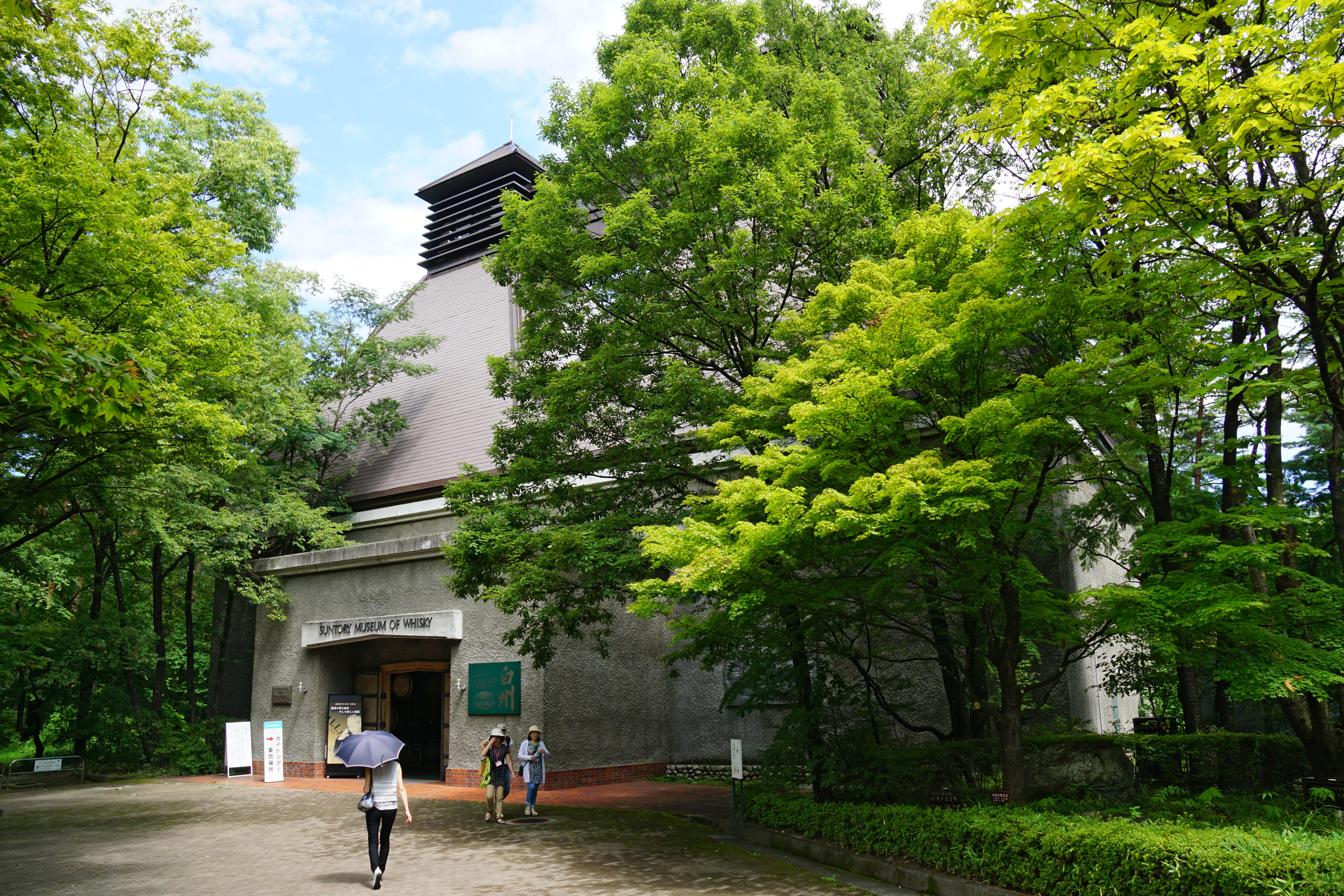
Hakushu Distillery
Eighty-three percent of the property is forest. Not manicured garden, not parking lot, not warehouse space -- forest. When Keizo Saji chose this 825,000-square-meter tract of woodland along the Kamanashi River in 1973, he was not simply building a distillery. He was embedding one inside a living ecosystem at 700 meters elevation in the Japanese Southern Alps, at the foot of Mount Kaikoma. The Hakushu Distillery produces whisky the way a forest produces a river: by filtering everything through layers of granite and greenery until what emerges is impossibly clean.
The Second Vision
Suntory's founder Shinjiro Torii had established the Yamazaki Distillery in 1923, creating Japan's first malt whisky distillery near Kyoto. Forty years later, his son Keizo Saji inherited that pioneering ambition and began searching for a second site -- one that would produce a whisky fundamentally different from Yamazaki's rich, complex character. He found it in the mountains of Yamanashi Prefecture, where the Minami Alps funnel snowmelt through granite formations, producing water that is soft, sharp, and loaded with a precise mineral balance. The distillery opened in 1973, and Saji doubled down in 1981 by commissioning a second facility, Hakushu East, adjacent to the original (now called Hakushu West). At its peak, the complex could produce up to 30 million liters of new-make spirit annually, briefly making it the largest whisky distillery in the world.
Distilling in a Bird Sanctuary
In the same year Hakushu opened, Suntory did something no other private company in Japan had done: it established a wild bird sanctuary on the distillery grounds. The forest that blankets the property is not decorative -- it is actively managed habitat. Over 50 species of birds nest among the trees, and the company maintains the woodland as a functioning ecosystem rather than trimming it back to make room for expansion. Suntory later designated the Hakushu forest as one of its Natural Water Sanctuaries, part of a broader conservation program to protect the watersheds that feed its products. The same pristine water that filters through the mountains into the distillery's mash tuns is also bottled as Suntory Tennensui, one of the most popular mineral water brands in Japan. The distillery, in other words, exists because the forest exists -- and the forest endures because the distillery depends on it.
A Whisky Shaped by Altitude
Elevation changes everything about how whisky matures. At 700 meters, temperatures swing wider between seasons, the air carries the resinous scent of Japanese white birch and conifers, and the humidity profile differs sharply from the lowland warmth of Yamazaki. These conditions seep into the casks. Hakushu single malts are known for a bright, herbal, almost minty freshness -- a character that whisky writers often describe as "forest-like," which is less metaphor than literal fact given the distillery's surroundings. The core expression, Hakushu Distiller's Reserve (43% ABV), was introduced in 2014 after Suntory discontinued its age-statement bottlings due to surging global demand outstripping aged stock. Japanese whisky's explosive international popularity in the 2010s, driven partly by Suntory's Hibiki blend winning multiple global awards, meant that decades of quietly maturing casks were suddenly not enough.
Mountain Water, Global Reach
Hakushu sits 120 kilometers west of Tokyo, close enough for day-trippers but remote enough that the surrounding forest feels genuinely wild. The distillery tour is one of the most popular whisky pilgrimages in Japan, and visitors can taste expressions unavailable anywhere else. But the distillery's influence reaches far beyond its mountain valley. Hakushu single malt is a key component of Suntory's blended whiskies, including Hibiki, which in 2007 became the first Japanese whisky to win 'World's Best Blended Whisky' at the World Whiskies Awards. That victory, and others that followed, fundamentally changed how the world perceived Japanese whisky -- transforming it from a regional curiosity into a category that now regularly competes with Scotland's finest. The mountain forest distillery, hidden in its alpine sanctuary, helped spark a global revolution in whisky appreciation.
From the Air
Located at 35.83N, 138.30E in the Minami Alps region of Yamanashi Prefecture, at an elevation of approximately 700 meters. The distillery sits in a densely forested valley along the Kamanashi River, on the slopes of Mount Kaikoma (2,967m). From the air, look for a clearing in continuous forest cover with industrial buildings -- it is surprisingly compact given its production capacity. Nearest airports: Matsumoto Airport (RJAF) approximately 50nm northwest, Mount Fuji Shizuoka Airport (RJNS) approximately 55nm southeast. The Southern Alps peaks to the west provide dramatic visual references. Expect clear conditions in autumn and winter with occasional mountain wave turbulence near the ridgelines.