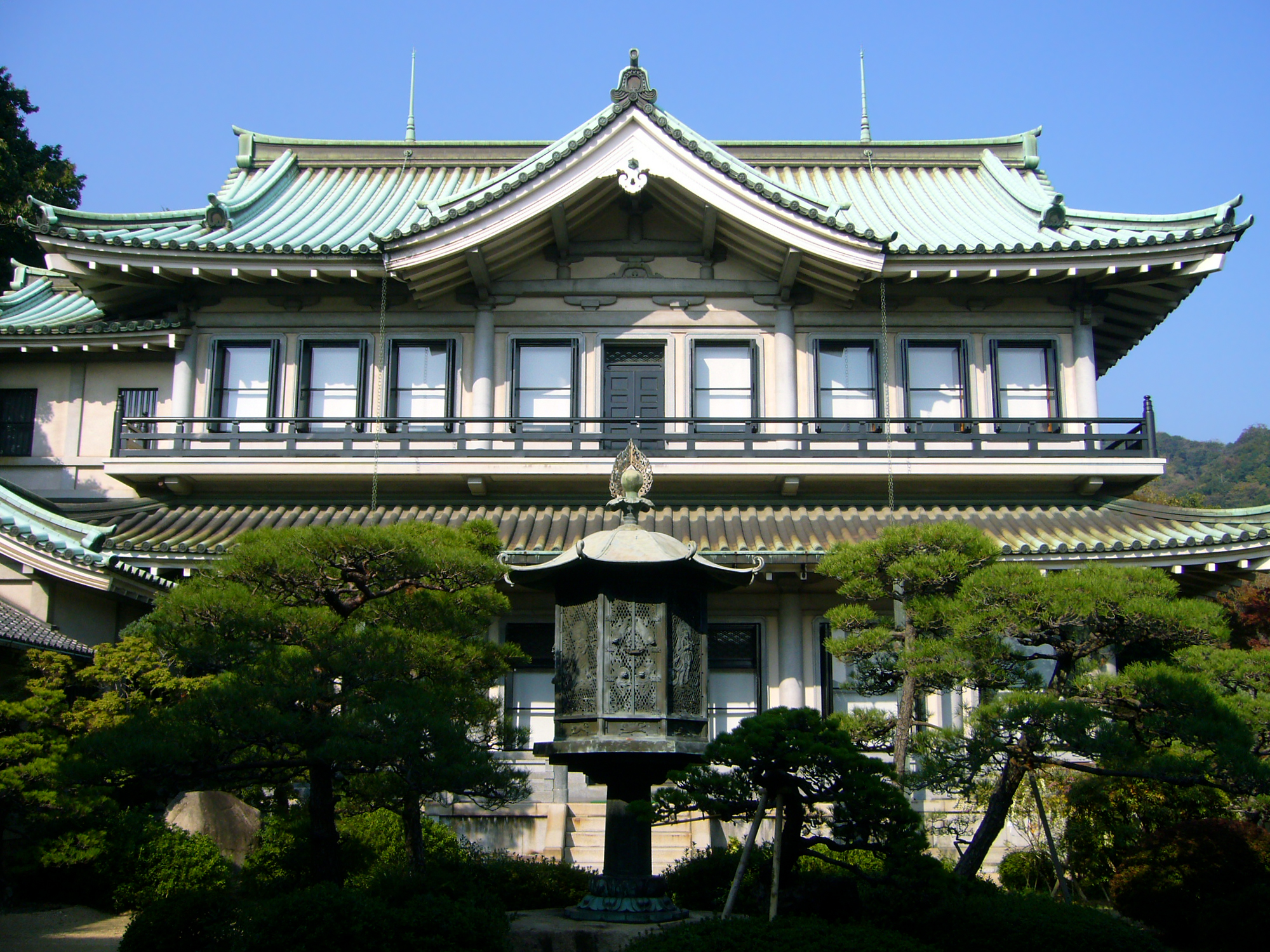
Hakutsuru Fine Art Museum
The name Hakutsuru means "white crane," and for nearly three centuries the Kano family has built an empire around it. Founded in 1743 as a humble sake brewery in the Nada district of Kobe, Hakutsuru grew into Japan's largest sake producer. But the seventh head of the family, Kano Jihei, harbored a passion that extended well beyond the fermenting vats. He collected art with the same intensity his ancestors applied to rice and water, assembling a trove of some 1,450 pieces that spans Chinese bronzes, Nara-period sutras, and Kofun-era gold jewelry. In 1934, he opened a museum to share it all -- making it one of the first private museums in Japan.
Scrolls Fit for an Emperor
The crown jewels of the collection are two works designated as National Treasures of Japan, the highest cultural honor the government bestows. The first is a pair of Nara-period scrolls from the Sutra of the Wise and Foolish, attributed to Emperor Shomu himself, the 8th-century ruler who also commissioned the Great Buddha at Todai-ji in Nara. These scrolls once belonged to Todai-ji before finding their way into the Kano family's hands. The second treasure is a set of seventy-one scrolls comprising an instruction manual on the Nirvana Sutra, spanning the Nara through Edo periods. Together with twenty-two Important Cultural Properties in the collection, these works represent over a thousand years of Japanese and Asian artistic achievement.
Bronze, Jade, and Gold
Beyond the sutras, the museum's galleries hold a cross-section of Asian civilization. Ancient Chinese bronzes share space with Chinese ceramics, silverware, mirrors, and jewelry. One standout piece is a gold necklace set with jadeite magatama -- the curved, comma-shaped beads that have held spiritual significance in Japan since the Kofun period, roughly the 3rd to 7th centuries. Designated an Important Cultural Property, this necklace connects the museum's collection to some of the earliest expressions of Japanese culture. The breadth of the holdings reflects Kano Jihei's eclectic eye: he collected not for a single era or medium, but for beauty and historical significance wherever he found them.
A Building with Its Own Heritage
The museum's architecture carries its own cultural weight. The 1934 reinforced concrete main building, the Honkan, wears a copper-tiled roof that has patinated to a distinctive green over nine decades. An earthen storeroom and office building from the same year, along with a chashitsu -- a traditional tea house -- dating to 1929, are all designated as Registered Tangible Cultural Properties. The tea house offers a quiet counterpoint to the main galleries, its intimate scale recalling the centuries-old Japanese tradition of appreciating art in contemplative settings. In 1995, a new wing opened to exhibit Near Eastern carpets, extending the museum's geographic reach westward and adding yet another layer to Kano Jihei's original vision.
Sake, Art, and the Nada Legacy
The museum sits on the west bank of the Sumiyoshi River, at the heart of Kobe's Nada district, where the mountain water flowing down from Mount Rokko has sustained sake brewing for centuries. Nada remains Japan's most prolific sake-producing region, and Hakutsuru still operates its breweries here. The proximity of art museum and brewery is no accident -- it speaks to a family tradition where cultural stewardship and commercial enterprise fed each other. The Hakutsuru Sake Brewery Museum, opened nearby in 1982, tells the production side of the story. Together, the two institutions form a portrait of a dynasty that measured its legacy not just in bottles sold, but in beauty preserved.
From the Air
Located at 34.731N, 135.258E in the Nada district of eastern Kobe, along the north shore of Osaka Bay. Best viewed from 3,000-5,000 ft approaching from the south over the bay. Kobe Airport (RJBE) is approximately 8 km to the south on its artificial island. Osaka Itami Airport (RJOO) lies 26 km to the northeast. The Rokko mountain range rises dramatically behind the museum to the north, providing a clear visual reference. The Nada sake brewery district is visible as a cluster of traditional and industrial buildings along the waterfront.