Halabja
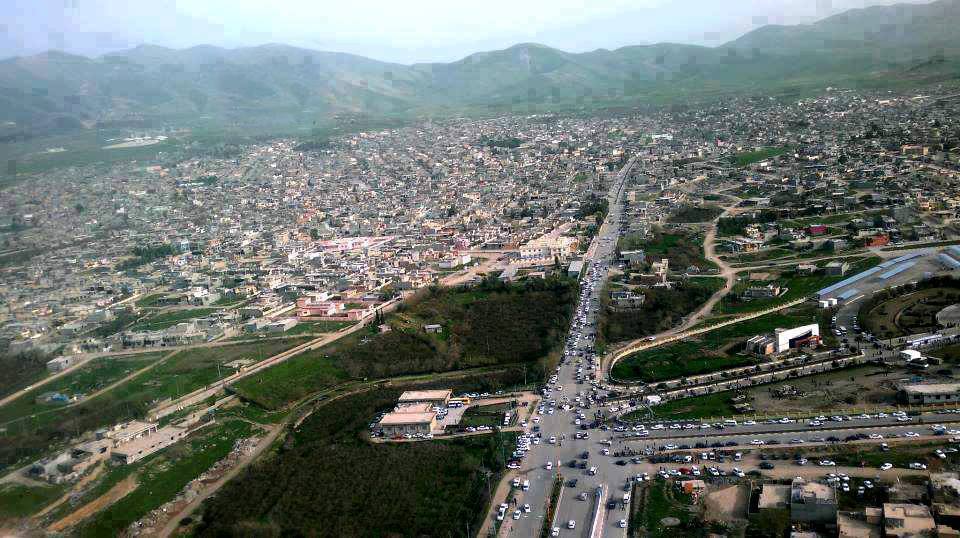
Halabja's sister city is Guernica. The pairing is not symbolic decoration. Both places were bombed by their own governments. Both became single-word shorthand for atrocity. But Halabja is also a living city -- capital of Iraq's 19th province as of April 2025 -- where people raise families in a fertile valley at the base of the Hawraman Mountains, nine miles from the Iranian border. The Shahrizor Plain stretches to the west, green and agricultural. The Zagros range rises to the east. Kurds here speak Sorani in the city and Hewrami in the surrounding villages. The landscape is beautiful. The history is brutal. Both are true at once.
Roots in the Zagros Foothills
The history of Halabja reaches back to the Akkadian Empire in the 24th century BC. The ancient city-kingdom of the Lullubi, a highland people who clashed with Mesopotamian empires, is believed to have been located in the Halabja area. Excavations at nearby Bakr Awa have confirmed continuous habitation spanning millennia. The city sits at roughly 700 meters elevation in the Shahrizor Plain, surrounded by mountains that shaped its climate and its strategic importance. Ottoman sources place the founding of the modern settlement around 1850, though development came slowly. The post office did not open until 1924. The first school followed a year later. Electricity arrived in 1940. The Qaysari Pasha and Hamid Beg bazaars, built in 1932, became the commercial heart of a city that grew steadily but modestly.
The Princess of the Brave
During World War I, British soldiers stationed in Halabja encountered Adela Khanum, a Kurdish leader whose authority transcended the expectations of the era. She saved the lives of several British soldiers, and the British honored her with the title Khan Bahadur -- Princess of the Brave. But she was far more than a wartime ally. Adela Khanum oversaw the construction of a prison, established a court of justice over which she presided as judge, and built a bazaar. In a region where power was traditionally held by tribal chiefs and Ottoman administrators, she carved out a role that combined governance, commerce, and justice. The cemetery in Halabja still holds the tombs of the Jaff family leaders -- Ahmed Mukhtar Jaff, Tayar Bag Jaff, and Adela Khanum herself -- their graves marking the continuity of a Kurdish political tradition that predated the modern Iraqi state.
March 16, 1988
On that date, during the final phase of the Iran-Iraq War, Iraqi government forces carried out a large-scale chemical weapons assault on Halabja. Kurdish Peshmerga fighters, supported by Iranian units, had briefly captured the town, prompting a rapid Iraqi counterattack. The response was not conventional. After artillery and aerial bombardment, chemical agents were deployed over the civilian population. Estimates of immediate deaths range from 3,200 to 5,000 people. Thousands more were wounded or suffered long-term health effects. The attack was part of the broader Anfal campaign, Saddam Hussein's systematic assault on the Kurdish population that destroyed entire neighborhoods -- Kani Ashqan and Mordana among them -- as reprisal for supporting the Peshmerga. Studies of survivors document elevated rates of respiratory illness, cancer, and disabilities that persist decades later. The suffering did not end when the bombs stopped falling.
Rebuilding and Its Discontents
After the fall of Saddam Hussein's government in 2003, the Kurdistan Regional Government began reconstruction in Halabja, rebuilding bombed-out homes and paving new roads. A memorial was constructed for the victims of the chemical attack. But residents grew frustrated with the pace and priorities of rebuilding. On the 2006 anniversary of the attack, an estimated 7,000 people demonstrated, protesting that officials were not genuinely addressing the needs of gas attack survivors. The memorial museum was set on fire. Police opened fire on the crowd, killing a 14-year-old boy and wounding others. The anger was not directed at remembrance itself but at the gap between symbolic gestures and material improvement. Survivors wanted hospitals, not monuments. Clean water, not speeches. The tension between memory and daily life defines modern Halabja as much as the attack itself.
A Province of Its Own
On April 14, 2025, the Iraqi Parliament designated Halabja as Iraq's 19th province, giving the city and its surrounding region a degree of administrative autonomy it had never held. The decision carried symbolic weight far beyond bureaucratic reorganization. For a city that had been targeted for destruction by its own national government, provincial status represented formal recognition -- not just of the suffering, but of Halabja's right to govern itself. The city today sits in a landscape shaped by geology and politics alike. A magnitude 7.3 earthquake struck 32 kilometers south-southwest of Halabja on November 12, 2017, a reminder that the ground beneath this valley is as restless as its history. Plans for an international airport, announced in 2008, signal ambitions that look forward. But the past is never far away in Halabja. It is in the memorial, in the health records, and in the soil itself.
From the Air
Located at 35.18N, 45.98E in the Shahrizor Plain, Kurdistan Region of Iraq, at approximately 700 meters elevation. The city sits at the base of the Hawraman Mountains, 9 miles from the Iranian border and approximately 150 miles northeast of Baghdad. The Balambo range lies to the south and the Sirwan River to the west. Nearest major airport is Sulaymaniyah International Airport (ORSU), approximately 70 km to the northwest. The city is visible from altitude as an urban cluster in the green valley between mountain ranges.