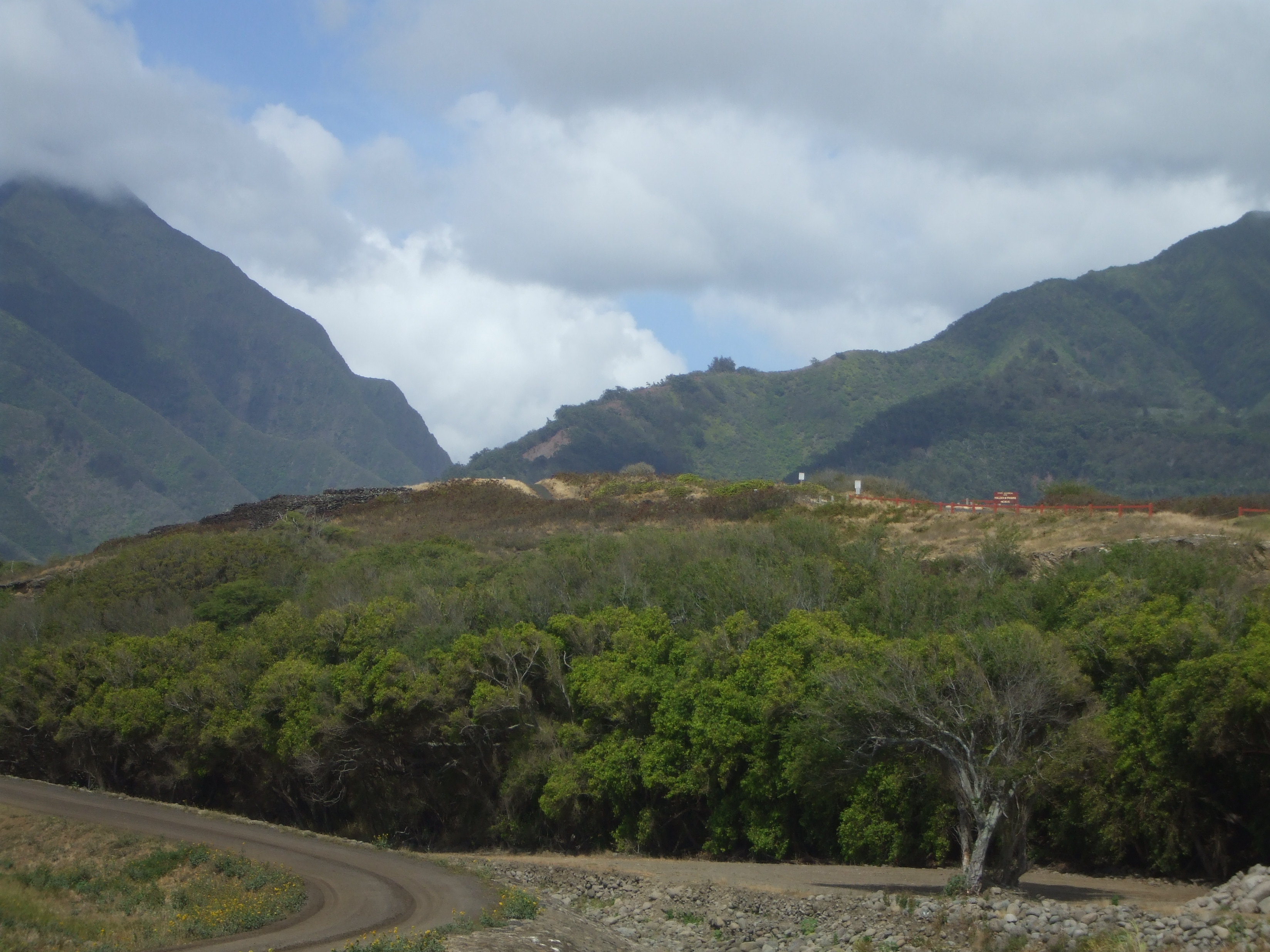
Halekiʻi-Pihana Heiau State Monument
From a ridge above the mouth of ʻĪao Stream in Wailuku, you can see exactly why someone built temples here. Below, four streams — Wailuku, Waikapu, Waihēe, and Waiehu — irrigate one of the most fertile regions in Maui, a place the Hawaiians called Nā Wai Ehā, the "Four Waters." Whoever controlled this ridge controlled the water, the agriculture, and the people who depended on both. The Halekiʻi and Pihana heiau have stood on this high ground for centuries, stone platforms that were at once religious sanctuaries, political command posts, and declarations of power visible for miles.
Seven Centuries of Stone
Archaeological studies place the earliest construction at this site between 1260 and 1400, when a small temple first appeared on the ridge. Over the next two centuries, the complex was expanded significantly, growing between 1410 and 1640 into a residence and luakini — a war temple where human sacrifices were performed to consecrate military campaigns and the authority of ruling chiefs. The luakini heiau were the most sacred and politically significant structures in Hawaiian religion, reserved exclusively for the highest-ranking aliʻi. Kiihewa, a chief who lived during the time of Kakae, the father of Kahekili I, used the site as both home and temple. The dual nature of the complex — sacred space and seat of power — reflects the inseparability of religion and governance in pre-contact Hawaiʻi.
Temples of Command
The ten-acre park contains two distinct heiau. Halekiʻi, whose name translates roughly to "House of Images," and Pihana sit on the ridge overlooking the Nā Wai Ehā plain. Both were closely associated with Maui's ruling chiefs across multiple generations. The site's strategic value is immediately apparent from the ground: standing on the platform walls, you look down on agricultural lands that sustained large populations and generated the surplus wealth that allowed chiefs to wage wars, build fleets, and maintain courts. When Kamehameha I's son Liholiho rededicated Pihana heiau, the act connected the new unified Hawaiian kingdom to the deep traditions of Maui's aliʻi. The complex was added to the National Register of Historic Places on November 25, 1985, recognizing its significance to Hawaiian history and religion.
The Ridge Today
The heiau remain as stone foundations on a ridge that feels remarkably unchanged despite the suburban development of Wailuku below. No reconstructed walls or visitor centers intrude on the platforms. What you see is stone and sky and the broad view down to the coast that the chiefs saw — the same streams still running through taro fields below, the same West Maui Mountains rising steeply behind. The monument is a quiet place, rarely crowded, carrying a weight that comes not from dramatic ruins but from the knowledge of what these stones witnessed: centuries of ceremony, sacrifice, political maneuvering, and eventually the transformation of an entire civilization. For many Native Hawaiians, the heiau remain spiritually significant, not artifacts of a dead culture but living connections to ancestral traditions.
From the Air
Located at 20.90°N, 156.49°W on a ridge near the mouth of ʻĪao Stream in Wailuku, Maui. The heiau platforms are visible from low altitude as cleared areas on the ridgeline above the town. Nearby airport: Kahului Airport (PHOG/OGG), approximately 3 nm east. At 2,000-3,000 ft AGL, the Nā Wai Ehā irrigation region stretching below the ridge is clearly visible, as is the entrance to ʻĪao Valley to the southwest.