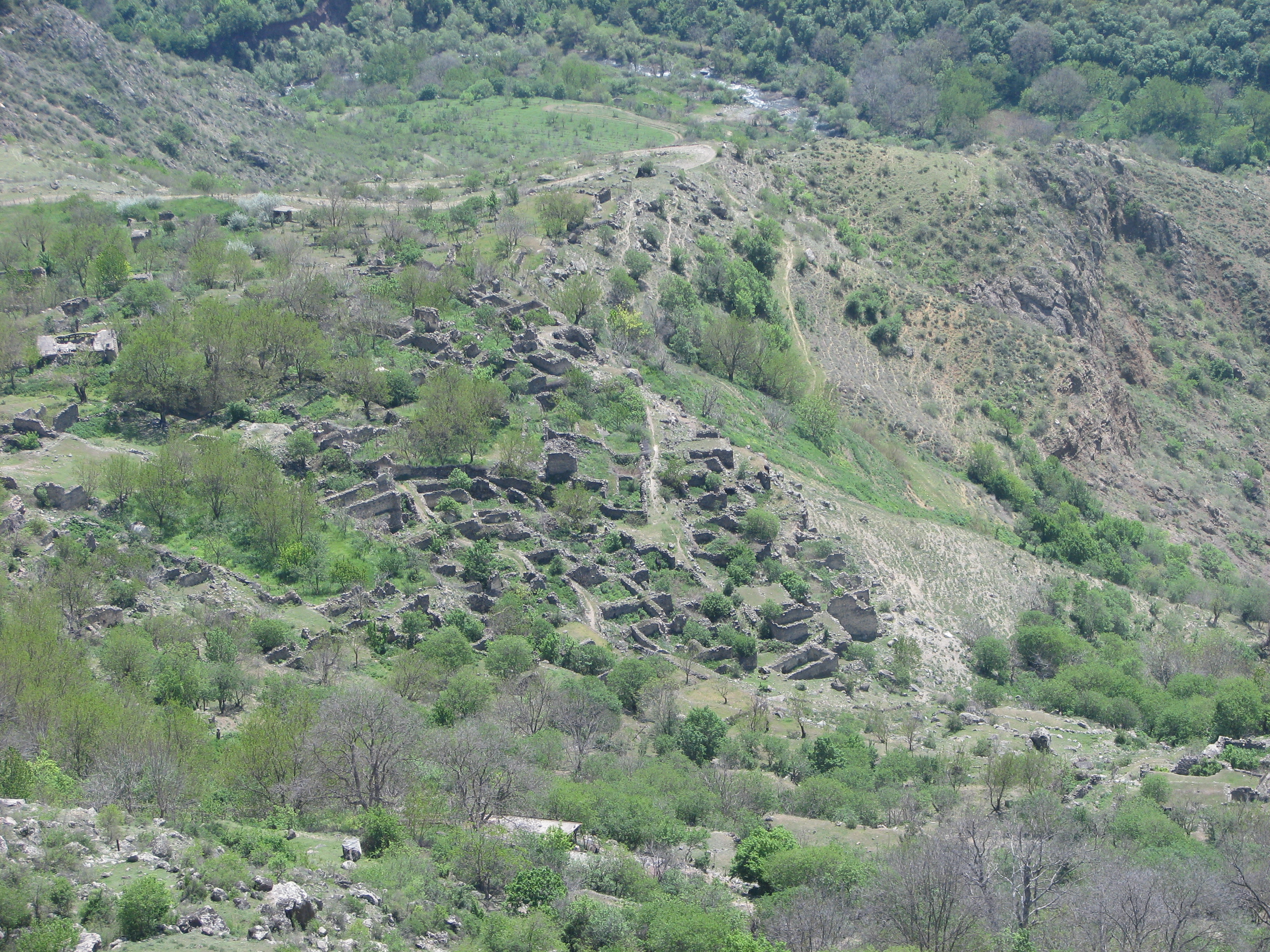
Halidzor Fortress
Three hundred soldiers, thirteen bishops, and three priests against an army of seventy thousand. The math was impossible, but the terrain was not. Halidzor Fortress sits 1,051 meters above sea level on a hill overlooking the Voghji River in Armenia's Syunik Province, and in 1723 its commander Davit Bek turned that elevation into the most unlikely Armenian victory of the 18th century.
From Nunnery to Command Post
Armenian meliks built Halidzor in the 17th century as a nunnery, a quiet religious retreat above the river valley near Kapan. The Melik Parsadanian family later converted it into a family fortress, but its transformation into a site of military legend began when Davit Bek arrived. The Armenian commander and liberator, fighting alongside his lieutenant Mkhitar Sparapet, chose Halidzor as headquarters for their resistance against both the Ottoman Empire and Safavid Iran. The fortress became the administrative center of Syunik, the nerve center from which Bek coordinated a war of survival fought across some of the most rugged terrain in the Caucasus.
Seven Days on the Hill
Between 1723 and 1727, the Ottoman army descended on Halidzor with a force reportedly numbering 70,000 soldiers. Bek's garrison of 300 fighters, bolstered by the clergy who refused to leave, held the walls for seven days. The fortress design favored the defenders: its irregular quadrangle of walls channeled attackers into killing zones, and a secret tunnel running 500 meters to the Voghji River ensured the garrison could draw fresh water even under siege. But after a week, food ran dangerously low. Exhaustion set in. Bek made a decision that defied military logic. Rather than surrender, he led a suicidal charge down the hillside. The ferocity of the assault so terrified the besieging army that the Ottoman forces broke and fled, reportedly leaving 12,000 dead on the field below.
A Flower Carved in Secret
Davit Bek died at Halidzor in 1728, felled not by enemy blades but by illness. An elderly bishop traveled from Tatev to conduct a funeral service of unusual grandeur. Bek was buried in the cemetery just outside the fortress walls, but according to oral tradition, his tombstone bears no identifying marks on its surface. A single flower is carved on the underside of the stone, hidden from view, so that enemies who might desecrate the grave would never know whose bones lay beneath. After Bek's death, the Ottoman army returned and offered terms: surrender the fortress peacefully, and the garrison and residents would go unharmed. Mkhitar Sparapet, now in command, went with the priest Der Avedis to negotiate. When the fortress doors opened, some of the defenders were killed.
Stone, Tunnel, and Restoration
The fortress walls trace an irregular quadrangle across the hilltop. Within them stand the remains of the church of S. Minas, a chapel, and the foundations of dwellings. Two arched portals pierce the north and south walls. A tower anchors the southwestern corner, and a terrace stretches from north to east. The churches were built in vaulted hall style from large rubble masonry stones, with sacristies flanking the apse and two-storied porticos along the outer walls. The secret water tunnel, though now partially collapsed, remains one of Halidzor's most remarkable features -- the engineering that kept the garrison alive during the siege. Restoration work began in 2006 and concluded in 2010, stabilizing what centuries of warfare, weather, and neglect had nearly erased.
From the Air
Located at 39.22N, 46.35E on a hilltop above the Voghji River, approximately 1 km northeast of Kapan in Syunik Province, Armenia. Elevation 1,051 m. Best viewed at 3,000-5,000 ft AGL. The fortress is visible as ruins on a prominent hill above the river valley. Nearest major airport is Zvartnots (UDYZ) in Yerevan, approximately 280 km north. Kapan has a small airfield. Look for the Voghji River corridor as a navigation reference.