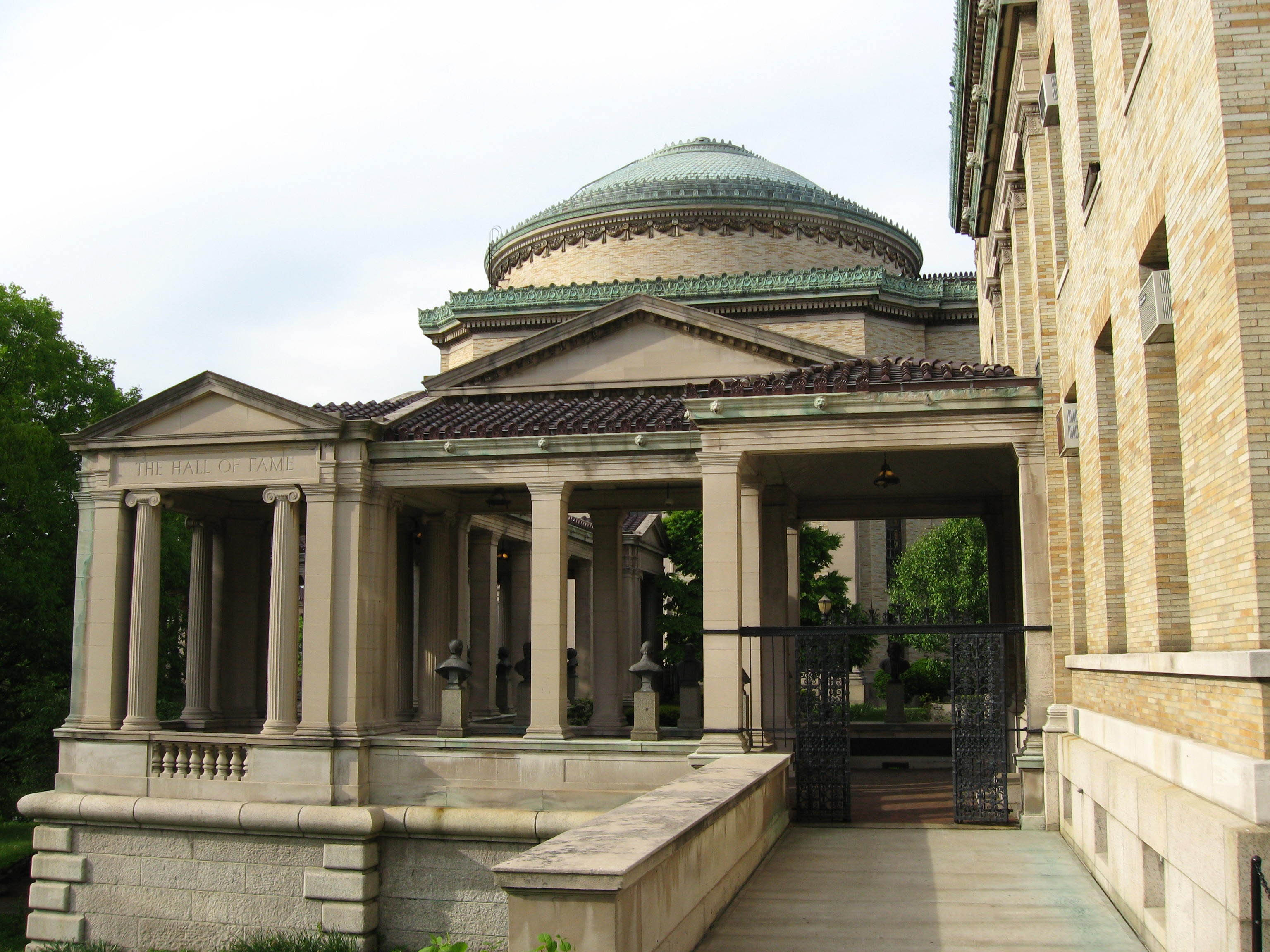
Hall of Fame for Great Americans
Before Cooperstown, before Canton, before any athlete or entertainer was inducted into anything, there was a curved stone colonnade on a hilltop in the Bronx. The Hall of Fame for Great Americans, designed by Stanford White and dedicated in 1901, was the first hall of fame in the United States -- the institution that gave the English language the very concept. That it now sits largely forgotten on the campus of Bronx Community College, its busts weathered and its elections suspended since 1976, makes it less a ruin than a parable about how Americans choose to remember.
A Retaining Wall with Ambitions
The Hall of Fame owes its existence to a problem of geography. Dr. Henry Mitchell MacCracken, chancellor of New York University, needed to conceal a retaining wall for the Gould Memorial Library on NYU's University Heights campus, where the ground sloped steeply to the west. His solution was to commission Stanford White to design an open-air colonnade -- a 630-foot loggia whose ceiling of Guastavino tile and roof of red Spanish tile would frame bronze busts of the nation's most accomplished citizens. The words inscribed above the northern gates read "Enter with Joy that those within have lived." The southern gates carry the counsel: "Take counsel here of Beauty, Wisdom, Power." The firm of Crow, Lewis and Wick later added a 130-foot annex, with McKim, Mead & White supervising. What started as a solution to an engineering problem became, for a time, one of the most celebrated spaces in New York.
Electing Greatness
The Hall of Fame's nomination process was elaborate and deeply democratic. A board of electors -- at least one from every state -- voted on nominees who had to be American citizens, dead at least 25 years, and credited with a major contribution to the nation's life. When the first 29 inductees were announced in 1900, the New York Times covered the results with the kind of attention now reserved for presidential primaries, reporting how many votes each nominee received. Elections happened every five years, then every three. Early ballots were segregated by gender: eight electors in 1905 refused to vote for any woman, so female nominees needed fewer votes to qualify. That rule was abolished in 1922, and the tablets, which had been arranged by gender, were rearranged -- though new plaques had to be fabricated because the originals were wedged so firmly into the colonnade's foundation they could not be moved.
The Slow Fade
Between the world wars, the Hall of Fame drew up to 50,000 visitors a year. But by the time NYU sold its Bronx campus to the City University of New York in 1973, the institution's cultural currency had evaporated. CUNY officials explicitly stated that the Hall of Fame had no value and excluded it from the purchase. The new halls of fame springing up across America honored living celebrities -- athletes, musicians, entertainers -- making the Bronx colonnade's insistence on historical distance seem antiquated. "Lots of celebrities and very few heroes," sculptor Charles Parks observed about the newer institutions. Funding dried up almost entirely after the 1976 Bicentennial. The last election that year inducted Clara Barton, Luther Burbank, and Andrew Carnegie, but there was never enough money to commission their busts. Guides were fired, the information booth shuttered, and by 1987 the Hall attracted just 1,000 visitors annually, not counting school field trips.
Vandals and Restorers
Neglect took its toll. Many of the 96 busts corroded in the weather. The bust of Andrew Jackson was knocked from its niche and pushed down the hill. In 1992, the Cavalier Renaissance Foundry restored 90 busts for about $40,000, though conservators criticized the removal of original finishes. The Municipal Art Society gave Bronx Community College a preservation award the following year for "outstanding building restoration." In August 2017, Governor Andrew Cuomo ordered the removal of busts depicting Confederate generals Robert E. Lee and Stonewall Jackson following the white supremacist rally in Charlottesville, Virginia. That left 96 busts and space for six more -- but no funds to hold elections, commission sculptures, or maintain the colonnade. The Cultural Landscape Foundation has listed the Hall of Fame among historic American sites "at risk."
The Original Hall of Fame
Critic Paul Goldberger described the Hall of Fame's architecture as making it "one of the most remarkable places in New York." More than 700 halls of fame have opened across the United States since Stanford White's colonnade was dedicated. As Richard Rubin wrote in The Atlantic Monthly in 1997, the proliferation reflected a shift: "Now achievement alone was enough, even achievement within a narrow context." The original Hall of Fame demanded something broader -- a contribution to the economic, political, or cultural life of an entire nation. Walking the colonnade today, past busts of Alexander Hamilton and Eli Whitney, Susan B. Anthony and Thomas Edison, the visitor encounters a 125-year experiment in collective memory. Some honorees remain household names. Others have faded into obscurity. The hall itself, half-forgotten on its hilltop, asks a question it was never designed to answer: what happens to a monument when the culture that built it moves on?
From the Air
Located at 40.858N, 73.910W on the campus of Bronx Community College (formerly NYU's University Heights campus). The curved colonnade is visible from the air on the western edge of the hilltop campus overlooking the Harlem River. Nearby airports include LaGuardia (KLGA) to the east and Teterboro (KTEB) to the northwest. Best viewed at 1,500-2,500 feet AGL. The High Bridge across the Harlem River serves as a useful visual landmark nearby.