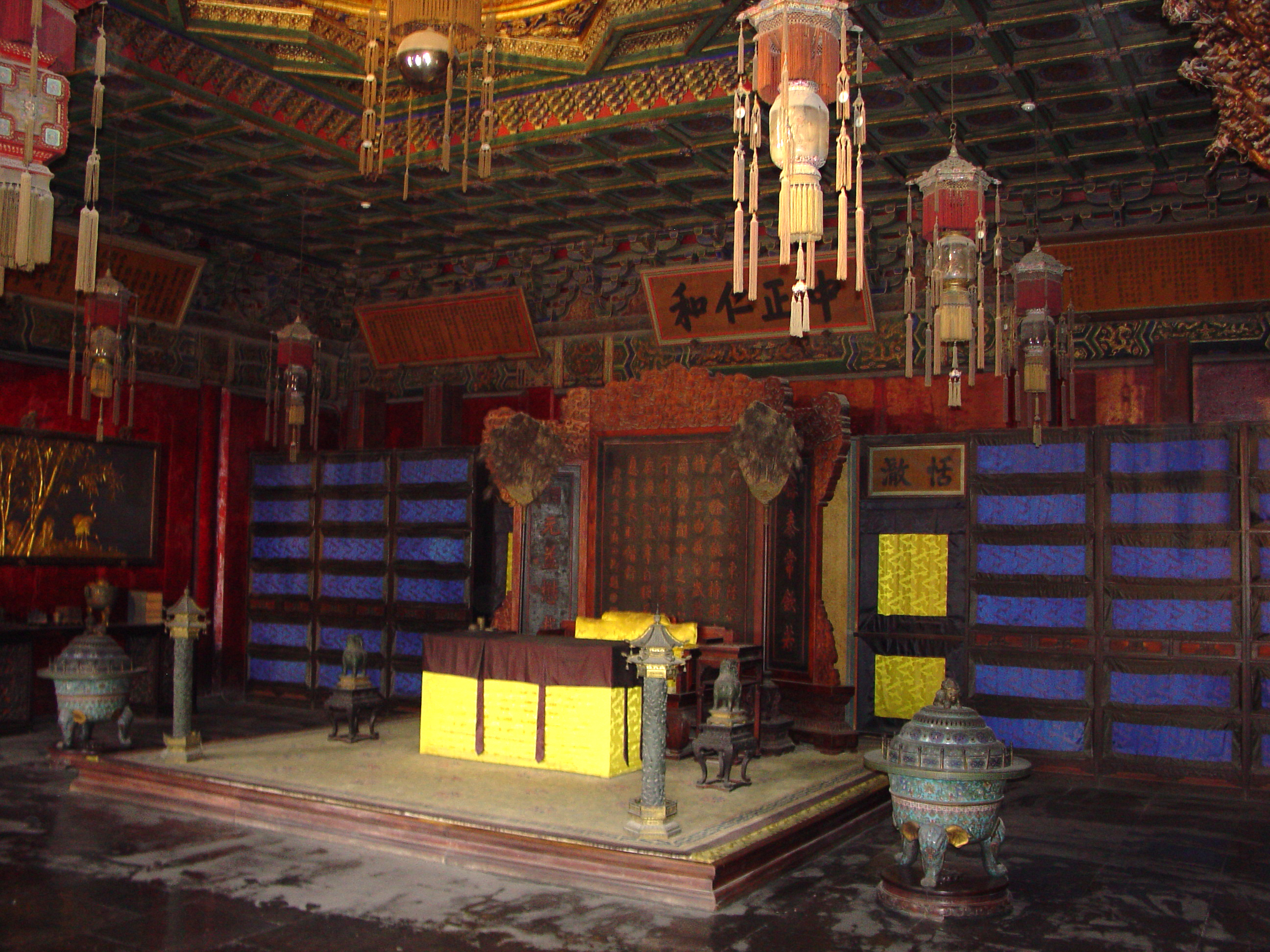
Hall of Mental Cultivation
Three scrolls changed a room's name and, in a sense, its identity. When the Qianlong Emperor gathered the calligraphic works of Wang Xizhi, Wang Xianzhi, and Wang Xun -- a family of master calligraphers spanning the fourth century -- he designated their display chamber the Hall of Three Rarities, a name that still clings to the western alcove of the Hall of Mental Cultivation. These were not decorations. They were relics of a civilization's highest artistic achievement, and the emperor who collected them understood their power as clearly as he understood the political dispatches he reviewed in the same building every morning.
From Workshop to Throne Room
The Hall of Mental Cultivation was first built in 1537 during the Ming dynasty, a wooden structure with coffered dome ceilings that initially served practical rather than political purposes. Under the Kangxi Emperor in the early Qing dynasty, the hall became an imperial workshop -- an atelier for the newly established Zaobanchu, the Department of Imperial Household Construction. Artisans working inside produced clocks, jade carvings, weapons, and maps, and their skills in glass and enamel craft influenced techniques that European visitors later adapted. The Kangxi Emperor would describe the function and design of a clock he wanted, court artists would sketch it, and craftsmen would build it to his exact specifications, always subject to imperial approval. Gradually, the hall's role expanded beyond craft production, and it became the place where the emperor handled daily administrative and political duties.
Ruling from Behind the Curtain
The hall's Eastern Warmth Chamber holds one of the most evocative political stories in Qing history. Here, Empress Dowagers Cixi and Ci'an governed China from behind a yellow silk screen -- the practice known as "listening to politics behind the curtain." The arrangement was deemed necessary because propriety prevented women from sitting openly before male officials, yet both dowagers wielded real power after the death of the Xianfeng Emperor in 1861. Lectures drawn from the biographies of former rulers were used to educate the two women in statecraft. The Grand Council offices surrounded the hall, placing the empire's highest advisory body within steps of the throne. Eunuchs, the only men besides the emperor permitted to reside in the Inner Court, were housed in buildings fronting the gate.
Ink on Stone, Light on Screen
The Qianlong Emperor's three treasured calligraphic scrolls traveled complicated paths after leaving the Hall of Three Rarities. In the 1950s, Premier Zhou Enlai ordered China's Ministry of Culture to reacquire Wang Xizhi's Timely Clearing After Snowfall and Wang Xun's Letter to Boyuan, both of which had left the palace collections. These works returned to the Palace Museum. In 1747, the Qianlong Emperor had also ordered 134 calligraphic works from the Imperial Collection to be carved into stone and displayed at the Pavilion of Reviewing the Past in nearby Beihai Park. Some works from the Hall of Three Rarities are now archived at the Metropolitan Museum of Art in New York. The hall itself has been closed for restoration since September 2018, but a digital exhibition called Discovering the Hall of Mental Cultivation, displayed in the Duanmen Digital Museum built in 2015, won the Golden Award at the 2018 Festival of Audio-visual Multimedia -- ancient architecture reimagined through screens.
From the Air
Located at 39.9184N, 116.3894E in the Inner Court (western section) of the Forbidden City in central Beijing. The hall is one of many traditional structures within the palace complex, not individually distinguishable from the air but situated in the western portion of the inner courtyard. Beijing Capital International Airport (ZBAA) is approximately 28 km to the northeast. Best viewed as part of the broader Forbidden City complex at 2,000-5,000 ft AGL.