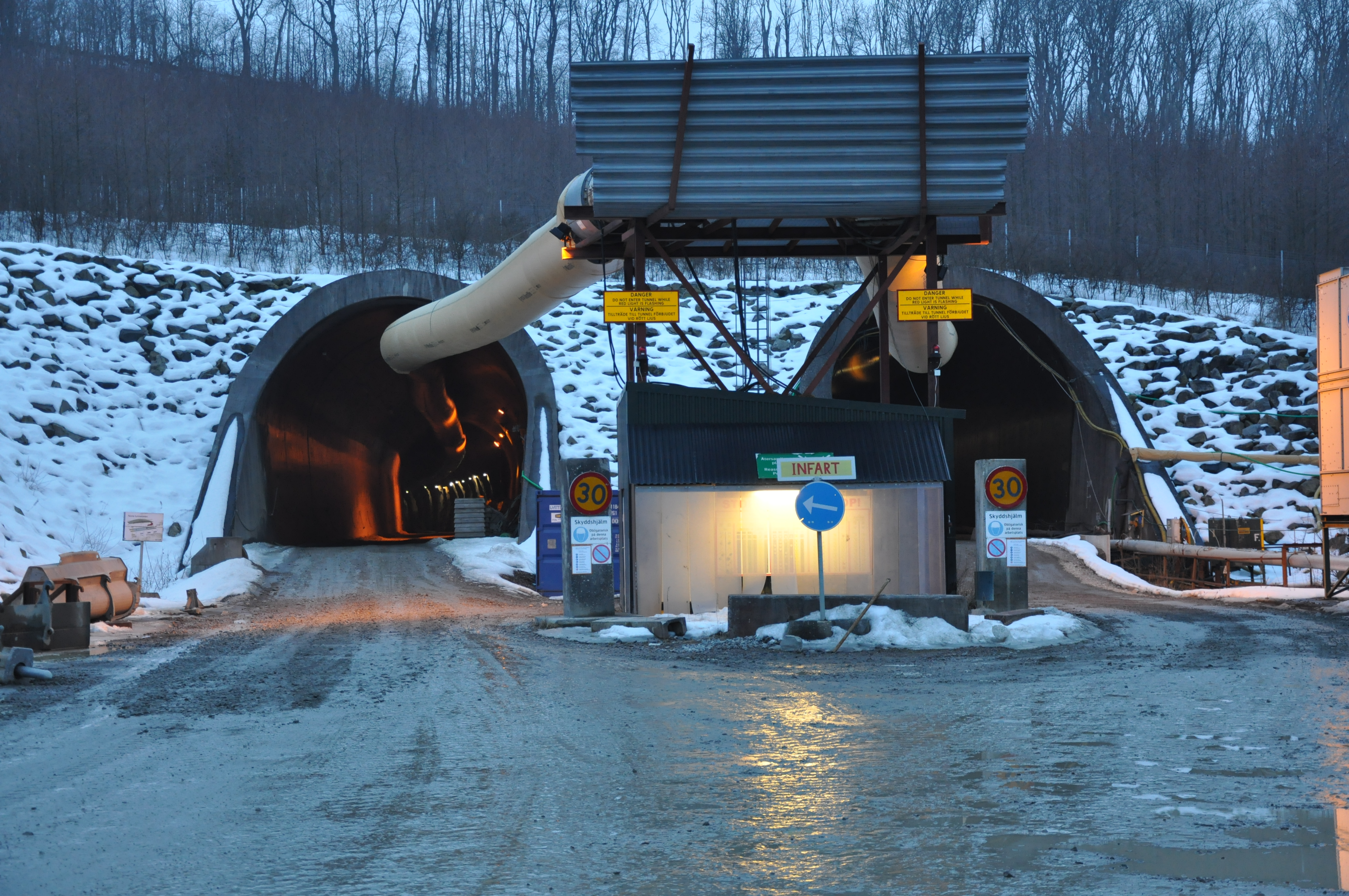
Hallandsås Tunnel
The drilling machine was supposed to bore 100 meters per week. It broke down after 800 meters. The rock was too soft, too wet, too unpredictable. When workers and contractors resorted to a toxic sealant called Rhoca-Gil, cattle in nearby fields began dying, fish floated belly-up in streams, and the project ground to a halt while criminal charges were filed. The Hallandsås Tunnel would eventually take 23 years to complete—a cautionary tale of ambition colliding with geology, of corporate negligence and extraordinary engineering innovation.
The Ridge That Stopped the Railway
The Hallandsås is a horst—a geological formation where ancient rock has been thrust upward, creating a ridge that runs like a wall across southwestern Sweden. For over a century, trains crossing this ridge had to climb steep grades and navigate tight curves, a single-track bottleneck that slowed passenger services and forced freight trains onto lengthy detours. The vision was simple: bore straight through and connect Gothenburg to Copenhagen with a modern, high-capacity rail line. The reality proved anything but simple. Construction began in 1992 with completion planned for 1995. The tunnel would eventually open in December 2015.
When Water Wins
The ridge's geology defeated the first contractor entirely. Water poured through the rock faster than anyone had predicted—a fraction of the inflow had been anticipated in surveys. The original tunnel boring machine couldn't grip the soft, saturated stone; it simply couldn't pull itself forward. Traditional drilling methods meant constant battles against leaks. The first contractor went bankrupt. Skanska took over, faced identical problems, and turned to desperate measures. The sealant Rhoca-Gil contained acrylamide, a mutagenic and possibly carcinogenic chemical. No special precautions were taken. Workers weren't warned. Neither was the local population.
The Scandal
By October 1997, the consequences became impossible to ignore. Local cattle sickened and died. Fish populations collapsed in nearby waterways. Tunnel workers reported mysterious illnesses. Local journalists investigated, tests confirmed acrylamide contamination, and the site became a high-risk zone overnight. Agricultural sales from the region were banned. Criminal charges followed against Skanska, the chemical supplier Rhone-Poulenc, and Swedish Railways. Senior executives resigned. Construction halted with less than half the tunnel completed, and for eight years the unfinished bores sat abandoned beneath the Hallandsås ridge.
Åsa Breaks Through
When construction resumed in 2005, everything had changed. The new approach tackled the water problem head-on: drilling pilot tunnels ahead of the main bore, then freezing the surrounding rock to minus 40 degrees Celsius, creating solid ground through which the massive tunnel boring machine nicknamed 'Åsa' could advance. As Åsa drilled, she simultaneously installed precast concrete segments and injected stabilizing slurry into voids. The eastern tunnel broke through in August 2010. The western followed in September 2013. The final cost exceeded 10.5 billion Swedish kronor—more than ten times the original estimate.
The Link Complete
On December 13, 2015, the first trains passed through the Hallandsås Tunnel. The twin bores stretch 8.7 kilometers through rock that had defied engineers for over two decades. Capacity across the ridge jumped from 4 trains per hour to 24. Journey times between Gothenburg and Malmö dropped by 10-15 minutes. The tunnel now forms a key segment of the West Coast Line, and planners envision it as part of a future high-speed rail corridor linking Oslo to Hamburg via Copenhagen. The old single track over the ridge, with its 13 level crossings and Victorian curves, has been dismantled for recycling.
From the Air
Located at 56.36°N, 12.81°E in southwestern Sweden. The tunnel portals are visible at both ends of the Hallandsås ridge. The northern portal sits near Båstad, the southern near Förslöv. The ridge itself is a distinctive linear feature running northwest-southeast. Nearest airports: Ängelholm-Helsingborg (ESTA), approximately 20 km north; Malmö (ESMS), 85 km south. Best viewed at 3,000-5,000 feet to appreciate the ridge's interruption of the coastal plain.