Halle train collision
Twenty-eight minutes past eight, Monday morning, 15 February 2010. Snow on the tracks outside Buizingen, twelve kilometres south of Brussels. The local from Leuven was accelerating away from the station toward its next stop at Halle. The intercity from Quiévrain was rolling toward Liège on a path that crossed it. They met at speed. The first three carriages of both trains were destroyed; the second carriage of the Leuven train was hurled into the air and came down on top of the third. A third train, eastbound from Geraardsbergen to Brussels, came around the curve seconds later, its driver saw the wreckage ahead, threw the emergency brake, and stopped just short. Nineteen people did not get off either of those first two trains alive. One hundred and seventy-one were injured. Among the dead was the driver of the intercity train from Quiévrain, who had no warning at all.
Ordinary Morning
Between two and three hundred people were aboard the two trains that collided. They were commuters, mostly. Office workers heading into Brussels from the Walloon towns south of the city. Students. A driver finishing his run toward Liège. The local train had stopped on schedule in Buizingen at 8:26 and pulled out a minute later. A few hundred metres past the platform, it passed a signal that was red. The interlocking system had set that signal to red automatically, because the signaller had cleared a crossing path for the intercity from Quiévrain. The driver of the local later said the signal had been green; the technical experts who examined the equipment, the recording device, and the snow around the signal cabin concluded otherwise — there was no footprint near the cabin, no defect in the equipment, and the same recording device that logged the signal as red at 8:28 logged it as red, again and again, at every check. What had failed was older and harder to fix: a man behind a controller, in snow, accelerating past a signal he should have stopped for.
Nineteen Names
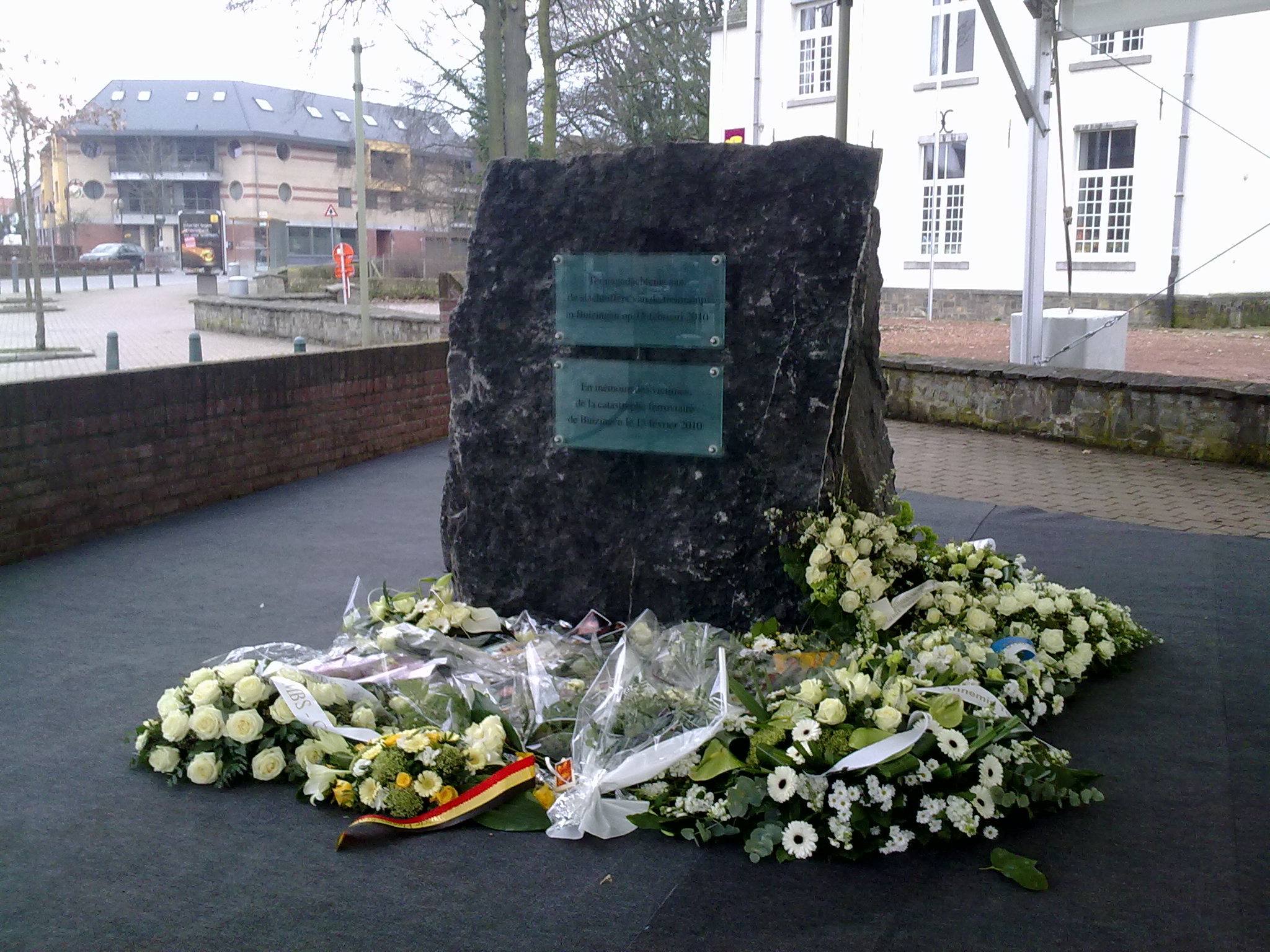
The dead were not statistics to the families who buried them. They were husbands and sisters and daughters, people who had eaten breakfast and pulled coats on and stepped out into the snow expecting an unremarkable Monday. A memorial stone was unveiled in the town square of Buizingen on 12 February 2011, a year after the crash, in two languages because Belgium is two languages — French on one side, Dutch on the other. The families came. The emergency workers came. The mayor of Halle, Dirk Pieters, came. Federal ministers came. On 15 February 2015, five years to the day, a plaque was added to the stone bearing the names of all 19. Prime Minister Yves Leterme, who had cut short a foreign trip to visit the wreckage the day of the crash, spoke of "a sense of defeat. First Liège, and now this" — meaning the gas explosion in Liège three weeks earlier that had killed 14 people. King Albert II went to the site as well. The hardest reaction was the simplest, from the families: please, this time, finally, fit the trains with brakes that can stop them automatically when a driver does not.
A Safety System That Had Waited Nine Years
The brake system the families were asking for had a name: TBL 1+. It was the Belgian version of automatic train protection, the kind of equipment that takes over when a driver passes a red signal. Belgium had known it needed something like this since the Pécrot rail crash in 2001, which had killed eight people on a single track in the same way — two trains, one driver who should not have been where he was. Nine years later, the rollout was still incomplete. The parliamentary commission that investigated Buizingen issued a 300-page report on 3 February 2011 with 109 recommendations. It found, brutally, that general railway safety in Belgium had not meaningfully improved between 1982 and 2010, despite earlier fatal crashes at Aalter and Pécrot. The money had been there. The will had not. Red signals passed had risen from 82 incidents in 2005 to 117 in 2009, a 43 percent jump, and the most common reported cause was simply distraction. After Buizingen, Belgium moved at speed. By September 2014, all national rolling stock was fitted with TBL 1+. By the end of 2015, the system was on 99.9 percent of signals at risky junctions. From December 2016, trains without it were banned from Belgian rails. Nineteen people had to die in the snow at Buizingen for the brakes to arrive.
The Slow Reckoning
Justice took longer than the safety upgrades. The judicial investigation dragged through retiring judges, language disputes (the Francophone driver's lawyers fought to have the case tried in French rather than Dutch), and the sheer volume of evidence — 46 cartons of documents in all. The driver, NMBS/SNCB, and Infrabel were finally summoned to court in June 2018, more than eight years after the collision. By the time the prosecutor delivered her final pleas on 16 September 2019, the position had hardened: a €700,000 fine for the railway operator, €650,000 for the infrastructure manager, and for the driver, eventually, no penalty at all — a finding of guilt without punishment, on the principle that the gravest failures belonged to the companies that should have made his individual mistake impossible. The waste, the long delay, the families forced to relive every detail in courtroom French — none of it brought anyone back. In late 2017, a final indignity surfaced: Netflix's *Death Note* film had used real footage of the Buizingen wreckage as set dressing. The families and the railway both condemned it. The crash was not, and is not, something to borrow.
From the Air
The collision site is at 50.745 N, 4.252 E, on the Brussels-Charleroi rail corridor near Buizingen, in the municipality of Halle, Flemish Brabant. From altitude, line up the rail line and motorway running south-southwest from Brussels along the Senne valley; Buizingen is the small town about 12 km south of central Brussels, and the memorial stone stands on the town square. Recommended viewing altitude 1,500-3,000 ft AGL in clear weather. Nearest airport: Brussels (EBBR), 18 km northeast. The site lies under Brussels TMA — coordinate with EBBR approach.