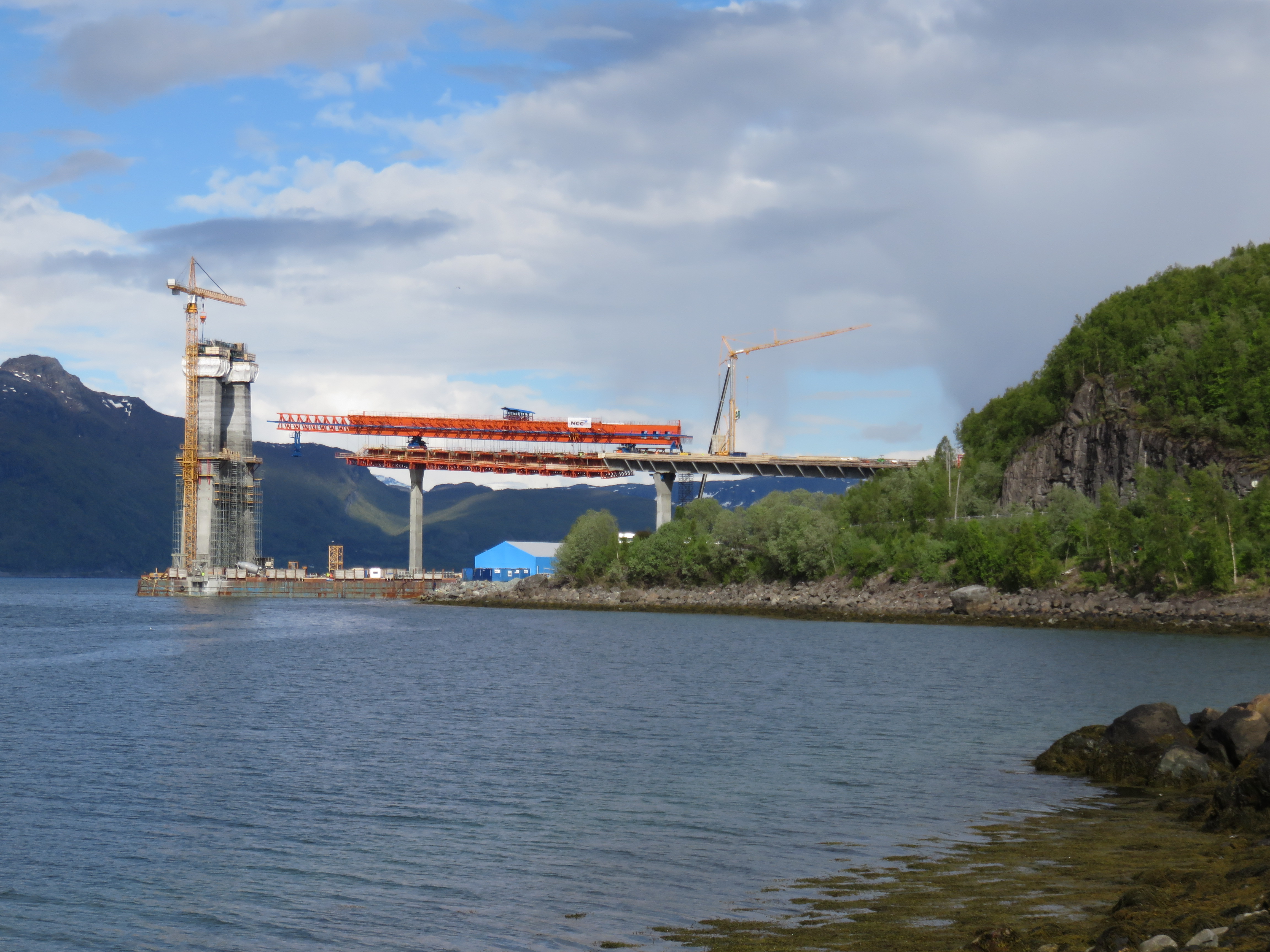
Hålogaland Bridge
To build the Hålogaland Bridge, Narvik gave up its airport. That was the bargain: close Narvik Airport, Framnes, and the savings over thirty years would help finance a 1,533-meter suspension bridge across the Rombaksfjorden, cutting the drive to Bjerkvik by seventeen kilometers and shaving twenty minutes off the route to the regional airport at Evenes. Local politicians accepted the deal in advance, staking the town's connectivity on a bridge that had not yet been built. On 9 December 2018, when traffic finally crossed the span for the first time, the gamble became concrete and cable.
Steel Above the Arctic Circle
The Hålogaland Bridge holds a distinction no other suspension bridge can claim: at the time of its completion, it was the longest of its kind anywhere above the Arctic Circle. Spanning the Rombaksfjorden at roughly 68.5 degrees north latitude, the bridge is part of European Route E6, the highway spine that connects northern and southern Norway. Another suspension bridge, the Rombak Bridge, sits further east through the same fjord, but the Hålogaland Bridge dwarfs it in scale. The project was not just a bridge, either. It included 4.9 kilometers of new road, two tunnels on the approach, and a 1.1-kilometer avalanche protection tunnel at Trældal north of Narvik. Together, these transformed an entire corridor of arctic infrastructure.
A Bridge Born from Debate
The path from concept to construction was anything but smooth. Engineers originally considered two designs: a conventional suspension bridge and a so-called symphony bridge, which would have combined suspension, cable-stayed, and cantilever elements into a single hybrid structure. The symphony bridge was dropped in 2008 when cost estimates ran too high. Even after the design was settled, financing remained contentious. In October 2009, State Secretary Erik Lahnstein publicly criticized the financial calculations underpinning the project, calling them unrealistic. It took another year before Minister of Transport Magnhild Meltveit Kleppa committed a grant of several hundred million kroner. Toll stations opened in September 2015 on the old road, years before the bridge itself was ready, to start collecting revenue for a structure still under construction.
Building in the Dark Season
Construction began on 18 February 2013, deep in the polar winter when Narvik receives barely a few hours of twilight. The Chinese firm Sichuan Road and Bridge Group won the contract, making this an unlikely collaboration between Arctic Norway and inland China. The original timeline called for completion by spring 2018, but delays pushed the opening to December. Working above the Arctic Circle imposed constraints that lower-latitude bridge projects never face: extreme cold, months of near-darkness, and weather systems that barrel in from the Norwegian Sea with little warning. When the inauguration ceremony finally took place on 9 December 2018, the bridge had been five years in the making.
The Narvik Calculus
Narvik's decision to close its local airport a full year before the bridge opened reveals something about the town's relationship with risk and reinvention. Framnes Airport shut down on 1 April 2017. For the next twenty months, residents had no local airport and no bridge shortcut either, relying on the longer route to Evenes. The Ofoten Regional Council had estimated that the savings from closing the airport would exceed the costs over three decades, but not everyone was convinced. The bridge now cuts the drive to Evenes from roughly sixty minutes to forty, a meaningful difference in a region where winter roads are slow and daylight is scarce. For Narvik, a town that has reinvented itself repeatedly since its founding as an iron ore port in 1902, the bridge represents another act of transformation, trading one kind of connection for another.
From the Air
The Hålogaland Bridge crosses the Rombaksfjorden at 68.46°N, 17.48°E near Narvik in northern Norway. Best viewed at 3,000-5,000 feet for the full span against the fjord backdrop. The bridge is part of the E6 highway. Nearest airport: Harstad/Narvik Airport, Evenes (ENEV), approximately 60 km southwest. The older Rombak Bridge is visible further east in the same fjord system. In winter, expect limited daylight and frequent low cloud.