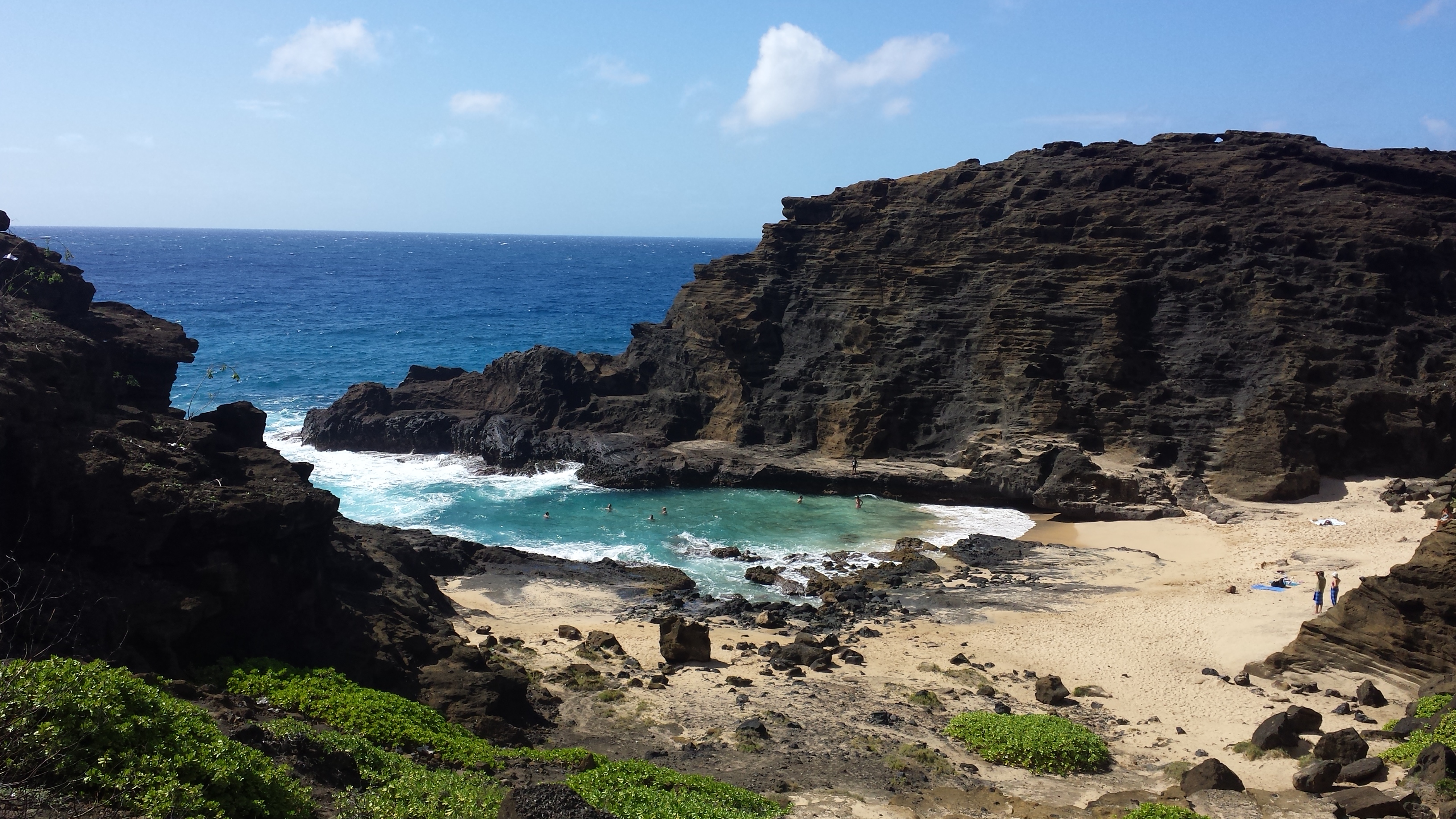
Halona Blowhole
The wave hits rock, disappears underground, and then the ocean exhales. A column of sea spray fires thirty feet into the air through a hole in the volcanic shore, hangs for a moment against the blue sky, and collapses. Seconds later, another wave arrives, and it happens again. Halona Blowhole is a geological parlor trick on Oahu's southeast coast, a lava tube from Koko Crater that channels incoming surf into a narrow opening and turns the Pacific into a geyser. In Hawaiian, halona means lookout, and the name fits the spot precisely: this is a place built for watching.
How Lava Made a Fountain
The blowhole formed thousands of years ago during the same period of volcanic activity that shaped Oahu's southeastern coastline. Lava from Koko Crater flowed into the ocean and cooled into tubes, hollow channels within the hardened rock. Over time, wave erosion opened the seaward end of one of these tubes to the surf while the landward end narrowed to a point. When a wave pushes water into the wide end of the tube, the constriction compresses the flow and forces it upward through the opening in the rock above. The effect is strongest when the tide is high and the wind is blowing onshore, driving larger swells into the tube. On calm days, the blowhole may barely whisper. On rough days, it roars.
Hollywood's Favorite Cove
Just below the blowhole lookout sits Halona Cove, a tiny pocket of sand wedged between volcanic rock that locals call Cockroach Cove. The name has not discouraged filmmakers. In 1953, Deborah Kerr and Burt Lancaster filmed the iconic beach scene from From Here to Eternity here, rolling in the surf in a moment that became one of cinema's most recognized images. Half a century later, Drew Barrymore and Adam Sandler revisited the same sand in 50 First Dates. Nicki Minaj shot the music video for Starships on the beach in 2012, and Jurassic World: Fallen Kingdom used the blowhole itself as a filming location. The cove's appeal is simple: it is photogenic, intimate, and framed by dramatic volcanic rock on three sides.
What Lives in the Reef
The waters around Halona Point are richer than the parking lot above might suggest. A wedge-shaped reef next to the cove is coated in Sinularia leather coral, and the tide pools host echinoderms, sea slugs, eels, and other marine life. In winter, the point becomes a whale-watching spot as humpback whales pass through the Ka Iwi Channel on their annual migration. Green sea turtles, the honu of Hawaiian tradition, are also regular visitors to the waters off the point. But the Ka Iwi Channel below carries some of the most dangerous currents in the world, and the blowhole itself has caused injuries to visitors who venture too close to the opening. The beauty here comes with an undertow, in every sense.
A Lookout Worth Its Name
Halona Point sits between Hanauma Bay to the west and Sandy Beach to the east, part of a stretch of coastline where Oahu's volcanic origins are most visible. The tuff cliffs, the lava tubes, the raw rock meeting open ocean, all of it speaks to the Honolulu Volcanic Series that reshaped this coast tens of thousands of years ago. The lookout above the blowhole draws tour buses and rental cars throughout the day, and on clear mornings the view extends across the channel toward Molokai. The blowhole performs on its own schedule, governed by swell direction and tidal rhythm rather than tourist demand. Some visitors wait twenty minutes and see nothing. Others arrive at the right moment and watch the ocean punch through stone. Either way, Halona delivers on its name: it is a lookout, and looking is the point.
From the Air
Halona Blowhole is at 21.28N, 157.68W on Oahu's southeast coast, between Hanauma Bay and Sandy Beach. The rocky point and small cove are visible from low altitude. Koko Crater rises immediately to the north. The Ka Iwi Channel stretches east toward Molokai. Nearest airport: PHNL (Daniel K. Inouye International Airport), approximately 13 nm west-northwest.