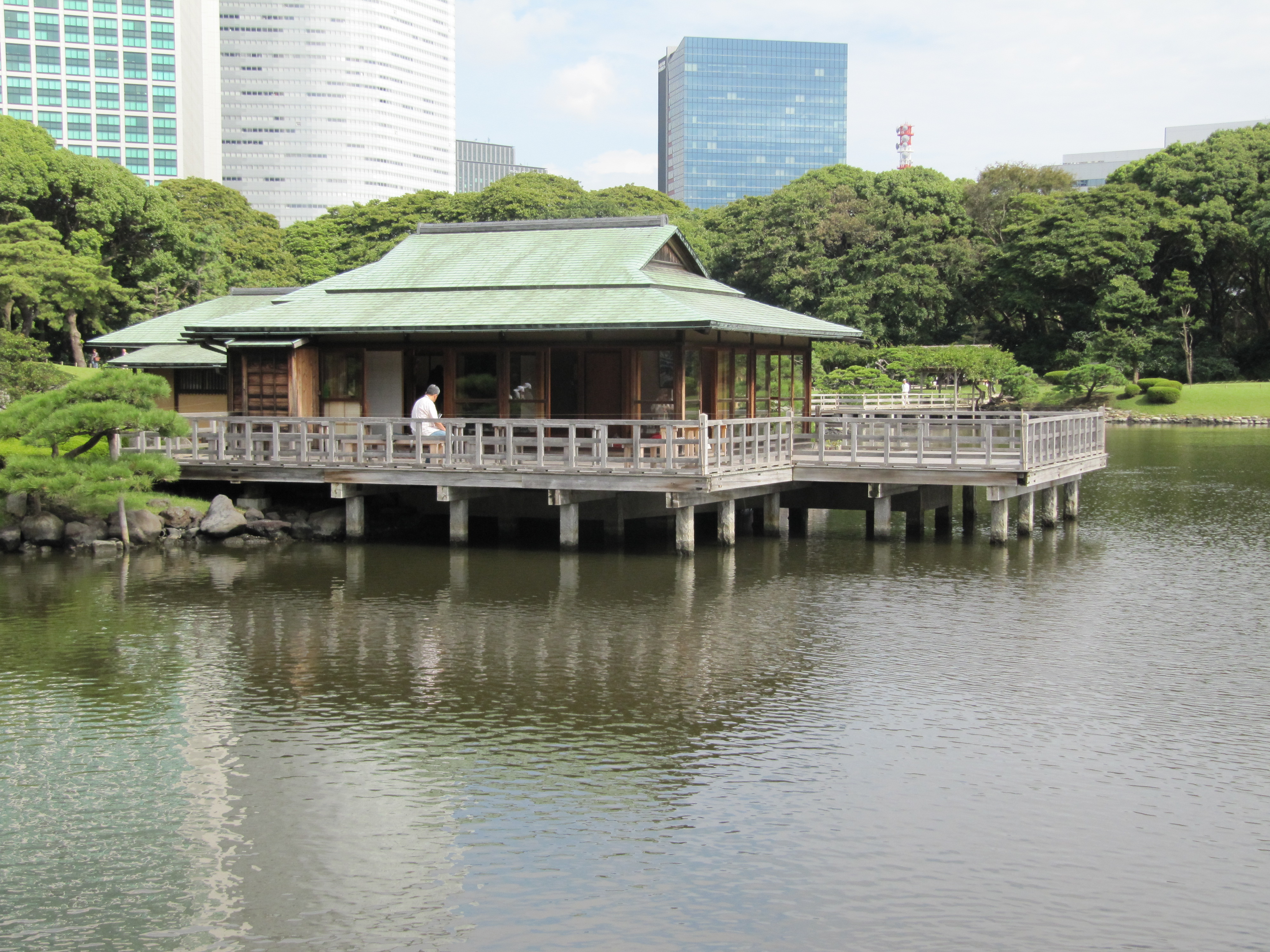
Hama-rikyu Gardens
In 1729, an elephant arrived at the gates. A gift from Vietnam to the Tokugawa shogun, the animal spent the next twelve years wandering the grounds of a waterfront estate that had already passed through three generations of Japan's most powerful family. The elephant is long gone, but the garden endures. Hama-rikyu sits at the mouth of the Sumida River in central Tokyo, a 250,216-square-meter sanctuary where seawater from Tokyo Bay still flows in and out of a tidal pond through channels first dug in the seventeenth century. Surrounded by the glass towers of Shiodome, it is the rare place in this city where the rhythm of the ocean, not the train schedule, sets the pace.
A Shogun's Private Shore
The garden began in 1654 when Tokugawa Tsunashige, the third son of Shogun Tokugawa Iemitsu and lord of Kofu Domain, received permission to reclaim land from Edo Bay. He built a villa and gardens on the newly created ground. His son, Tokugawa Ienobu, inherited the property and eventually became the sixth Tokugawa shogun, elevating the estate from a nobleman's retreat to a seat of power. Succeeding generations of shoguns used it as a secondary residence, and from the time of Tokugawa Ienari through Tokugawa Ieyoshi, the grounds served as a private falconry reserve. The main palace burned in 1724 and was never rebuilt, but the gardens kept growing, shaped by the tidal pulse of the bay. That salt water flowing through Shioiri-no-ike -- the central tidal pond -- is not an ornamental trick. It is the original design: a garden that breathes with the ocean.
Diplomats, Presidents, and Crown Princes
After the Meiji Restoration of 1868, the estate was proclaimed an imperial detached palace by Emperor Meiji and repurposed as a state guest house. The garden hosted some of the era's most consequential meetings between Japan and the West. In 1879, Emperor Meiji received Crown Prince Frederick William of Germany -- the future Kaiser Frederick III -- at Hama-rikyu. Later that same year, former United States President Ulysses Grant stayed for a full month during his extended tour of Japan. Before that, in 1867, the Tokugawa shogunate had already erected a Western-style stone building on the grounds specifically to house foreign diplomats visiting Edo. The state guest house was eventually demolished in 1889 after the Rokumeikan, Tokyo's famous ballroom of Westernization, took over its diplomatic functions.
Burned, Flooded, Reborn
Hama-rikyu has been destroyed and rebuilt more than once. The gardens burned during the catastrophic 1923 Great Kanto earthquake, which killed over 100,000 people across the Kanto region. They burned again in March 1945, during the firebombing raids that leveled much of Tokyo. In November 1945, the Imperial Household Agency transferred the grounds to the Tokyo Metropolitan Government, and the garden reopened to the public on April 1, 1946 -- less than a year after the war's end. In 1952, Hama-rikyu received dual designation as both a Special National Historic Site and a Special National Place of Scenic Beauty, one of only a handful of locations in Japan to hold both titles simultaneously. In the 2010s, several of the garden's historic teahouses were carefully reconstructed, returning the estate closer to its Edo-period appearance.
Tea on a Tidal Island
At the center of Shioiri-no-ike stands a teahouse reached by two wooden bridges. Visitors sit in the tea-ceremony style, sipping matcha and eating wagashi -- traditional Japanese sweets -- while looking out over water that rises and falls with Tokyo Bay. The garden surrounding the pond shifts with the seasons: peonies bloom in spring, plum trees flower in late winter, and fields of cosmos and rapeseed blaze yellow in their turn. Every New Year, the garden hosts demonstrations of traditional Japanese falconry and aikido, connecting the grounds back to the centuries when shoguns flew hawks from these same paths. Visitors can arrive by water bus from Asakusa, a 35-minute ride down the Sumida River that deposits passengers directly inside the garden walls -- the ticket includes admission.
From the Air
Located at 35.66N, 139.762E on the waterfront of Tokyo Bay at the mouth of the Sumida River. From the air, the garden is unmistakable: a large green rectangle bordered by the gleaming towers of Shiodome to the west and the bay waters to the east. The seawater moat surrounding the garden is visible at lower altitudes. Nearest major airport: Tokyo Haneda (RJTT) approximately 8nm south. Tokyo Narita (RJAA) is approximately 35nm east-northeast. Recommended viewing altitude: 2,000-3,000 feet for garden detail against the urban backdrop. The Rainbow Bridge across Tokyo Bay provides a useful visual reference to the south.