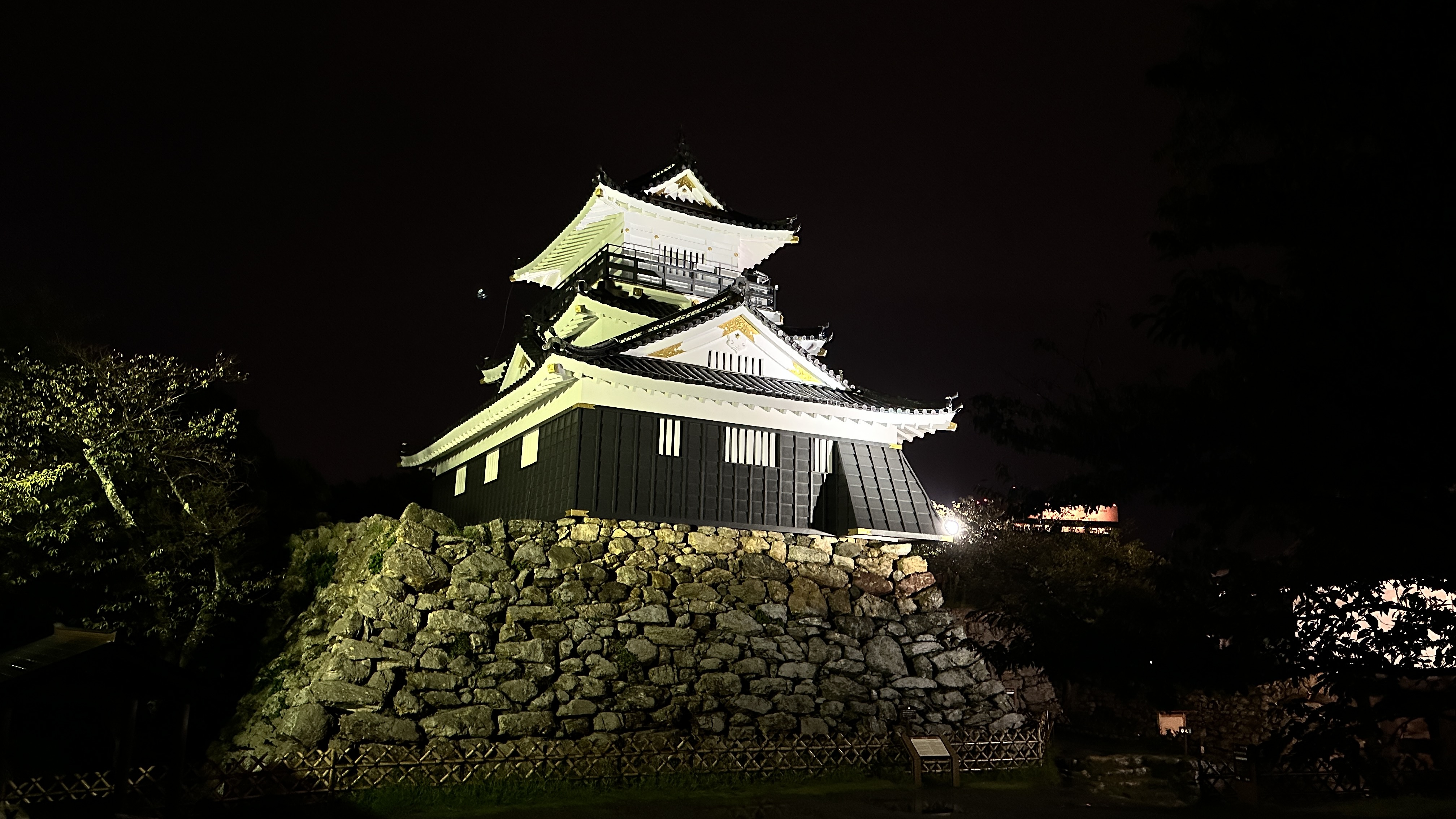
Hamamatsu Castle
They called it the Castle of Promotion, and the nickname was no exaggeration. Of the 25 feudal lords who governed from Hamamatsu Castle during the Edo period, most were transferred to higher-ranking domains within just a few years. Five became senior councillors to the shogun. Two were appointed governors of Kyoto. The castle's reputation as a career launchpad traces back to one man: Tokugawa Ieyasu, who spent 17 of his most consequential years here before unifying Japan under his rule. Today, a reconstructed tower rises above cherry trees on the Mikatagahara plateau, but the original rough-hewn stone walls beneath it still carry the weight of that history.
A Warlord's Gamble on the Plateau
Before it bore the name Hamamatsu, this hilltop fortification was called Hikuma Castle, held by retainers of the powerful Imagawa clan. When Imagawa Yoshimoto fell at the Battle of Okehazama in 1560, the clan's grip on Totomi Province crumbled. Tokugawa Ieyasu, then a rising warlord from neighboring Mikawa, saw his opportunity. He seized Hikuma Castle in 1568, and by 1570 had moved his entire headquarters here from Okazaki Castle. It was a bold gamble: positioning himself at the edge of the Mikatagahara plateau placed him on the contested frontier between his territory and the fearsome Takeda Shingen's domain. The plateau offered clear sightlines and sat along the Tokaido highway, the vital artery connecting Kyoto with eastern Japan. Ieyasu was betting that this exposed position would let him control the road and project power in both directions.
Defeat That Forged a Shogun
The gamble nearly killed him. In 1572, Takeda Shingen's forces swept across the plateau in the Battle of Mikatagahara, handing Ieyasu one of the worst defeats of his career. Retreating to Hamamatsu Castle with his surviving men, Ieyasu prepared for what he believed would be a final stand. Legend holds he ordered the castle gates left open and braziers lit along the walls, a desperate bluff suggesting a trap that made the pursuing Takeda forces hesitate. Whether the story is embellished or not, Ieyasu survived. He renamed Hikuma Castle to Hamamatsu Castle in 1577 and spent the next nine years here, fighting the Battles of Anegawa, Nagashino, and Komaki and Nagakute from this seat. By 1586, when he finally moved on to Sunpu Castle at age 45, he had forged the political alliances and military reputation that would carry him to the shogunate.
The Career Ladder in Stone
After Ieyasu's departure, Hamamatsu Castle became the most coveted posting in the feudal system. The logic was almost superstitious: because Ieyasu had used Hamamatsu as his springboard to supreme power, serving there was seen as an omen of advancement. And it delivered. Lord after lord arrived, governed briefly, and was promoted to a domain with a higher rice yield or appointed to a prestigious position in the shogunal government. The roster reads like a who's who of Edo-period administration: five senior councillors, two governors of Kyoto, two keepers of Osaka Castle, and four commissioners of temples and shrines. The castle earned its enduring nickname, Shusse-jo, the Castle of Promotion. This revolving door of ambitious lords also meant no single ruler invested heavily in grand construction. The castle never received a proper keep tower. Instead, a two-story watchtower in the second bailey served as a functional substitute throughout its 300-year history.
Rough Stones and Cherry Blossoms
The castle's most authentic surviving feature is its stone walls, built in the nozura-zumi style using uncut, unshaped natural stones fitted together without mortar. These rough ramparts date to Ieyasu's era and stand in striking contrast to the polished, precisely cut stonework found at later castles like Osaka or Himeji. The walls climb the natural slope of the plateau, with the highest point in the northwest where the original fortifications commanded views toward the Pacific Ocean. The Meiji Restoration stripped away the castle's remaining military structures, and the outer moats were filled in. But in 1958, the city built a three-story concrete reconstruction atop Ieyasu's original stone base. Inside, a small museum displays Tokugawa clan armor and a miniature model of the castle town as it appeared at the dawn of the Edo period. Outside, Hamamatsu Castle Park surrounds the ruins with hundreds of sakura trees, making it one of Shizuoka Prefecture's most popular cherry blossom viewing spots each spring. A large bronze statue of Tokugawa Ieyasu presides over the grounds, the man whose ambition turned a frontier fortress into a legend.
From the Air
Hamamatsu Castle sits at 34.71°N, 137.72°E on the Mikatagahara plateau in central Hamamatsu, Shizuoka Prefecture. The castle park is visible as a green patch amid the urban grid, roughly 1 km north of Hamamatsu Station. The Pacific Ocean coastline lies about 4 km to the south. Nearby airports include RJNS (Hamamatsu Air Base, military) and RJAF (Chubu Centrair International Airport, about 80 km west). Lake Hamana is visible to the west. Best viewed at 3,000-5,000 feet for context of the castle's plateau position relative to the coastal plain.