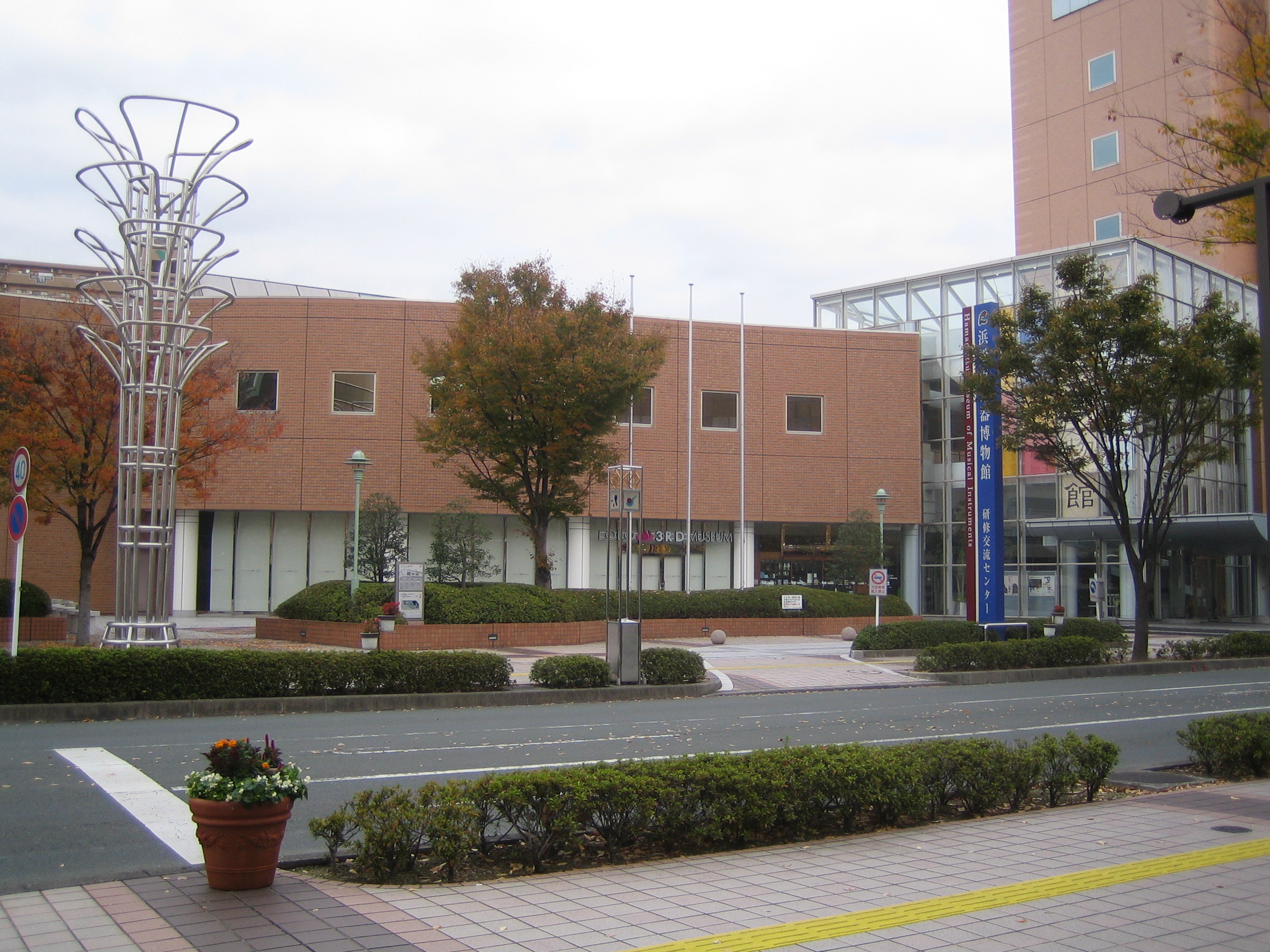
Hamamatsu Museum of Musical Instruments
In 1887, a medical equipment repairman named Torakusu Yamaha was asked to fix a broken American-made reed organ at an elementary school in Hamamatsu. He had no training in instrument building, but the mechanism fascinated him. Within two years he had built his own organ and founded the company that bears his name. That single repair call ignited an industry: Hamamatsu went on to become the birthplace of Yamaha, Kawai, and Roland, three of the world's most influential musical instrument makers. The Hamamatsu Museum of Musical Instruments, which opened in 1995 as Japan's first public museum dedicated to the subject, tells the story of how sound traveled from every corner of the globe to this coastal industrial city, and how Hamamatsu sent its own instruments back out to the world.
From Reed Organ to Global Empire
Hamamatsu's transformation into Japan's capital of instrument manufacturing unfolded in stages. After Torakusu Yamaha founded his organ workshop in 1889, the enterprise grew into Nippon Gakki, the predecessor of Yamaha Corporation. Koichi Kawai, who had apprenticed under Yamaha and contributed to developing domestic piano action mechanisms, struck out on his own in 1927 to establish the Kawai Musical Instrument Research Laboratory. By the mid-twentieth century, Hamamatsu factories were producing pianos, organs, and guitars at industrial scale. Then the electronic revolution arrived. Synthesizer and drum machine production took root here, with companies like Roland and Korg contributing to the same regional ecosystem. In 2014, UNESCO recognized what everyone in the music world already knew, designating Hamamatsu as the first city in Asia to join the Creative Cities Network in the Music category.
Fifteen Hundred Voices Under One Roof
The museum's collection of approximately 1,500 instruments spans continents, centuries, and sonic traditions. Visitors move from a gallery of 19th-century European pianos to a collection of Hsaing waing percussion ensembles from Myanmar, then to Balinese and Javanese gamelans whose layered bronze tones fill the listening stations. Two hundred exhibits are dedicated to traditional Japanese instruments, including the Taishogoto, a stringed instrument with typewriter-like keys invented during the Taisho era. One of the museum's prized objects is the Tsuru Sho organ, among the oldest confirmed instruments produced by Yamaha, dating to 1881. A Yamato organ from the Meiji era sits nearby, a tangible link to the moment when Western musical traditions began filtering into Japanese schools and homes.
The Electronic Frontier
A dedicated section of the museum traces the history of electronic music through the machines that made it possible. The collection includes synthesizers, electric guitars, rhythm machines, and organs from manufacturers that shaped the sound of popular music worldwide. A Moog synthesizer sits alongside a Roland System 700, the massive modular system that was a fixture of professional studios in the 1970s. Instruments from Yamaha, Casio, and Korg are represented as well, and the Korg M01 digital synthesizer is on permanent display. These are not static exhibits: the museum has collaborated with Yamaha on projects like the 2021 Real Sound Viewing exhibition, which used modern technology to reproduce the sound of a chikuzen biwa performance, bridging the gap between ancient acoustic traditions and digital innovation.
Where East Meets West in Sound
The museum's rotating exhibitions reveal how deeply intertwined the world's musical traditions have become. A 2015 exhibition marking the museum's 20th anniversary traced the reed organ's journey from American parlors to Japanese classrooms, showing how an imported instrument reshaped music education during the Meiji period. In 2020, the museum mounted a special exhibition for the 250th anniversary of Beethoven's birth. And in 2021, an exhibition on the history of the biwa explored how this pear-shaped lute arrived in Japan from China during the 7th and 8th centuries and evolved into distinct Japanese forms like the Heike-biwa and Satsuma-biwa. European and Arabian lutes displayed alongside their Japanese descendants made the connections visible. Since 2014, the museum has also been part of the Google Arts and Culture platform, extending its reach far beyond Hamamatsu's borders to a global audience of music enthusiasts and scholars.
From the Air
The Hamamatsu Museum of Musical Instruments is located at 34.71°N, 137.74°E in central Hamamatsu, Shizuoka Prefecture, adjacent to Hamamatsu Station on the south side. The museum building is part of the Act City Hamamatsu complex, identifiable by its distinctive tower. From the air, look for the dense urban core of Hamamatsu with the Tokaido Shinkansen line running east-west through it. The Pacific coast is about 3 km south. Nearby airports include RJNS (Hamamatsu Air Base) and RJAF (Chubu Centrair, approximately 80 km west). Best viewed at 2,000-4,000 feet to appreciate the museum's urban context.