Hamburg Massacre
Simon Coker had one last request. The Black state legislator from Barnwell, South Carolina, standing before a circle of armed white men at two o'clock in the morning on July 9, 1876, asked that someone deliver instructions to his wife about the cotton ginning and that month's rent. Then the men of the Sweetwater Sabre Company, led by Benjamin Tillman, shot him dead mid-prayer. Coker was the fifth Black man executed that night in the small Savannah River town of Hamburg, South Carolina. The killings marked the opening act of a calculated campaign of racial terror designed to destroy Black political power in the state -- and it worked.
A Town Built by Free People
Hamburg sat on the South Carolina bank of the Savannah River, directly across from Augusta, Georgia. The town had been a market hub before the Civil War, but the expansion of the South Carolina Railroad into Augusta had made it commercially obsolete. After the war, freedmen repopulated the defunct town, building their own community and establishing self-governance during Reconstruction. Black Americans in the postwar period were drawn from the violence of rural areas to the relative safety of towns where they could find strength in numbers. By 1876, Hamburg was a majority-Black community in the majority-Black Edgefield District, with its own militia company and elected officials. It was precisely the kind of Black self-determination that white supremacists in South Carolina intended to destroy.
Independence Day, 1876
The centennial Fourth of July should have been a celebration. Instead, it became a provocation. As the Hamburg Company militia -- entirely Black, mostly freedmen -- drilled on the town's wide Market Street under Captain D. L. "Doc" Adams, two white planters drove their carriage directly into the formation. Whether they deliberately forced a confrontation or simply demanded passage remains disputed. Words were exchanged, and the militia parted to let the carriage through. That should have been the end of it. Instead, the Red Shirts -- a white supremacist paramilitary group operating under Confederate veteran General Martin W. Gary's "Plan of the Campaign of 1876," also known as the Edgefield Plan -- used the incident to haul the militia before Trial Justice Prince Rivers on charges of obstructing a public road. The hearing was set for July 8. More than 100 armed white men from Edgefield and Aiken counties arrived at the courthouse carrying shotguns, revolvers, hoes, axes, and pitchforks.
The Dead Ring
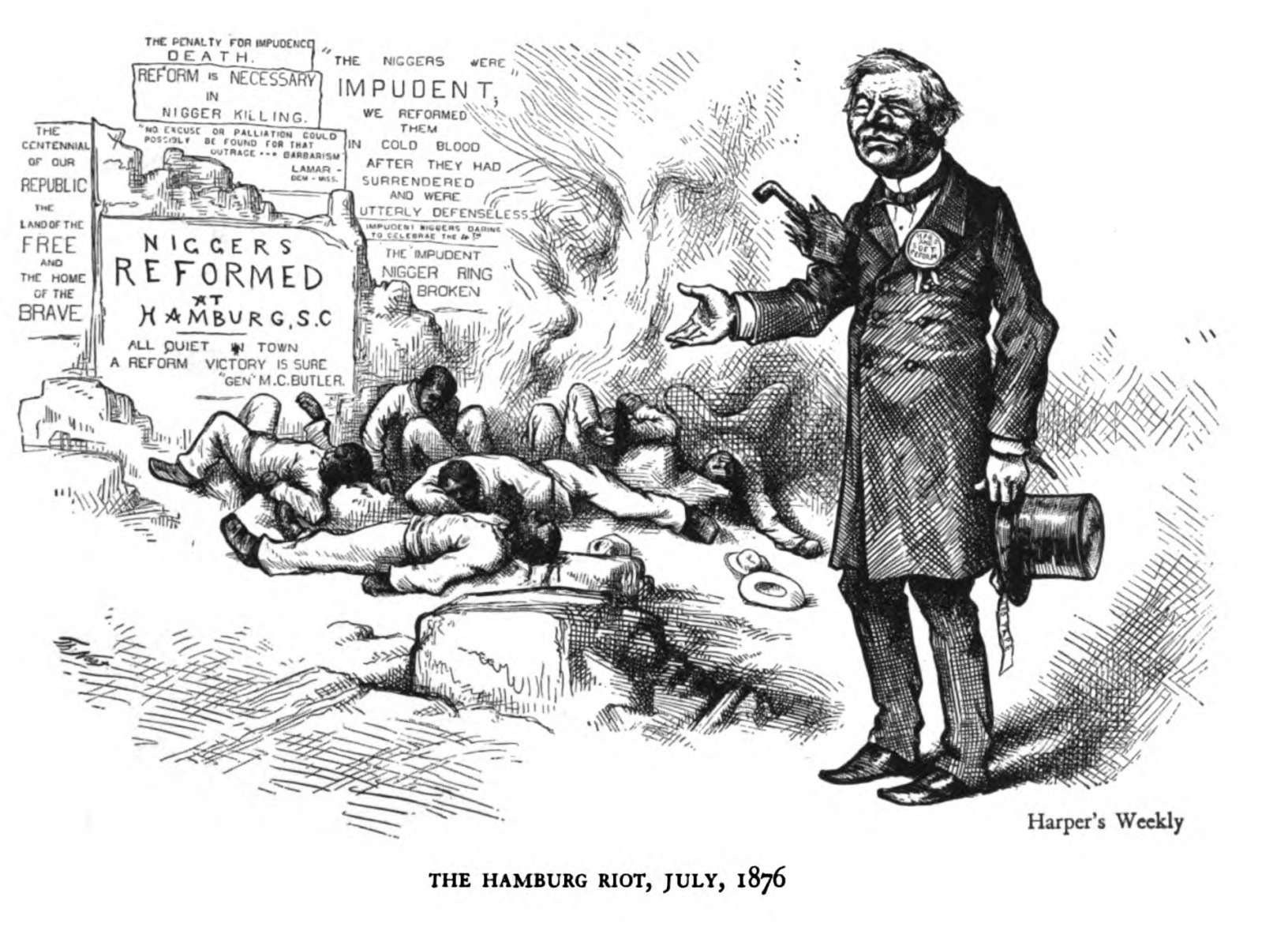
After seizing around two dozen Black citizens, the white paramilitaries marched them to a spot near the South Carolina Railroad bridge at roughly two in the morning. There they formed what became known as the "Dead Ring" -- a circle of armed men who debated, one by one, the fate of their captives. They selected five men for execution: Allan Attaway, David Phillips, Hampton Stephens, Albert Myniart, and Simon Coker. The first four were taken around the ring and shot individually. Coker, the state legislator, was executed last. According to the State Attorney General's report, freedman Moses Parks was also killed, and several others were wounded fleeing or in a general fusillade as the ring broke up. None of the perpetrators were ever prosecuted. The killings attracted nationwide attention, including coverage in Harper's Weekly and The New York Times, and the U.S. Senate called for an investigation that gathered testimony in Columbia and published its findings in 1877.
A Legacy Worn as a Badge of Honor
The Hamburg massacre was not an isolated outburst but the first blow in a systematic campaign. Larger massacres followed in Ellenton in September and Cainhoy in October. White Democrats suppressed Black voting through intimidation and violence, gained control of the South Carolina legislature, and narrowly won the governor's office. Over the next two decades they imposed Jim Crow segregation and, in 1895, adopted a new state constitution that effectively disenfranchised Black citizens. Benjamin Tillman, who led the Sweetwater Sabre Company at Hamburg, parlayed his role in the massacre into a 24-year career in the U.S. Senate. He boasted of it on the Senate floor: "We took the government away from them in 1876. We did take it." In the 1894 Democratic primary, Tillman and M. C. Butler actually competed over who had participated more in the massacre -- in South Carolina politics, involvement was a point of pride. The state erected a statue honoring Tillman on the capitol grounds in 1940 and renamed Clemson University's main hall for him in 1946. Only after the 2015 murder of nine Black churchgoers in Charleston did Clemson vote to distance itself from Tillman's legacy. Today no visible remains of Hamburg exist. The town where free people built a community is largely covered by a golf course.
From the Air
Located at 33.48N, 81.95W on the South Carolina bank of the Savannah River, directly across from Augusta, Georgia. The former town of Hamburg has been completely obliterated; the site is now largely covered by a golf course and modern development in North Augusta, South Carolina. The Savannah River and the 13th Street Bridge connecting North Augusta to Augusta provide visual reference points. Nearest airports: Augusta Regional Airport (KAGS) approximately 7nm south, Daniel Field (KDNL) approximately 4nm east. Best viewed at 2,000-3,000 feet AGL. The site is near the confluence of Horse Creek and the Savannah River.