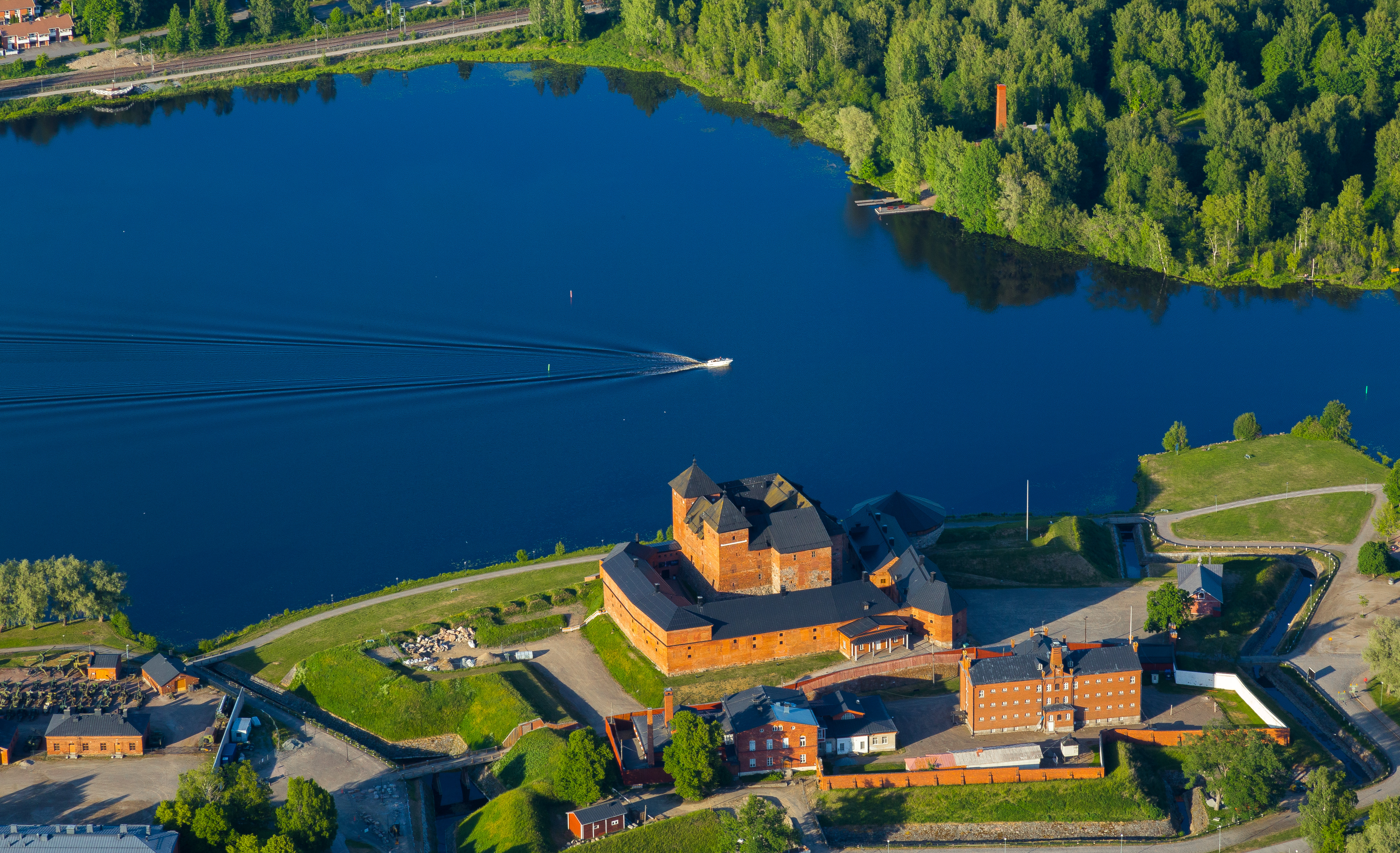
Häme Castle
When the Russian Novgorod First Chronicle records the plundering of Hame in 1311, it mentions only one castle in the region. When a Swedish royal document from 1308 lists the strongholds of Tavastia, it also mentions only one castle: Tauestahus. Yet two medieval fortresses sit just twenty kilometers apart in Finnish Tavastia. The older one, on a steep rock above Lake Kernaala, is now called Hakoinen. The newer one, on what was once an island in Lake Vanajavesi, is what everyone today calls Häme Castle. Whether Häme Castle inherited its name and its function from its older sister, or whether it stood quietly alongside it for several decades before becoming the dominant fortress of the region, is a question Finnish historians have argued about for over a century. What is clear is that by the 1320s Häme Castle was here, and that for the next 700 years it never really left.
The Crusade and the Question of When
Tradition holds that the castle was built in the mid-13th century, connected to Birger Jarl's Second Swedish Crusade of around 1249, the campaign by which the Swedish crown claimed Tavastia for Catholic Christendom and the Swedish kingdom. There is no firm archaeological evidence for any construction at the site earlier than the 1320s, and the older fortification 20 kilometers away at Hakoinen complicates the question further. What seems likely is that Häme Castle was built or substantially expanded during the early 14th century to serve as the new regional command of the Swedish administration in Tavastia, replacing or eclipsing the older fortress. The lower tiers of the keep and curtain wall are masoned granite. The upper tiers are red brick. That brick, distinctive in Finnish medieval architecture, gives the castle its dark warm color even on cloudy days.
Three Royal Castles
Medieval Sweden held Finland through three great royal castles: Turku Castle on the southwest coast at the mouth of the Aurajoki, Vyborg Castle far to the east on the Karelian Isthmus, and Häme Castle in the heartland of Tavastia. Each anchored a region of Swedish administration. Each held a bailiff, a garrison, a treasury, and the apparatus of a medieval state. Häme's job was to project Swedish power inland, into the lake country, away from the coastal trade routes. The keep, originally with five turrets (only two are visible today), the curtain wall with its octagonal brick corner turret and round gun turret, the moat, and the gatehouse all express that function. So does the location: an island in Vanajavesi, accessible only by a single causeway, defensible from any direction.
Centuries of Decline, Decades as a Prison
After the medieval centuries the castle entered a long quiet decline. Some restoration was done in the early 1600s, and in 1639 the small settlement around the walls was granted city status as Hämeenlinna, the Castle of Hame. But Sweden's strategic interests had moved south to the Baltic, and Häme Castle was largely neglected through the 17th and 18th centuries. During the Great Northern War it was briefly ceded to the Russian army. After the Finnish War of 1808-1809, when Finland was taken from Sweden and became the Grand Duchy of Finland under Russian rule, the castle was repurposed as a prison. It served in that capacity for nearly a century and a half, until 1953. Generations of prisoners walked the medieval halls, slept in cells carved out of the great spaces, and looked through the narrow windows at the lake.
The Restoration
When the prison closed in 1953, the work of bringing the castle back began. It was a massive undertaking: stripping out the prison fittings, restoring the medieval brickwork, conserving what remained of the painted decoration, opening the King's Hall and the bastion to public view. The Finnish National Board of Antiquities took over operation, and in 1979 the castle reopened as a public museum. Today it is one of the principal tourist attractions of southern Finland, the centerpiece of Hämeenlinna and a venue for everything from Renaissance fairs to concerts and weddings. The castle has lived under Swedish kings, under Russian tsars, under independent Finland; it has held knights, bailiffs, soldiers, and convicts; and it now welcomes families with children who run between the curtain walls trying to spot the missing turrets.
Sibelius and the City
Hämeenlinna gave the castle its name and the castle returned the favor: the city's identity is inseparable from the brick walls on the lake. The composer Jean Sibelius was born here in 1865 and grew up walking the same lakeshore where his city's medieval centerpiece had been quietly aging for six hundred years. The Sibelius Birthplace Museum stands a short walk from the castle gate. From the air, the castle's red walls are unmistakable against the dark water of Vanajavesi, and from inside the moat, the walls feel exactly as they were meant to feel: solid, patient, and unhurried about whatever century happens to be current outside.
From the Air
61.00 degrees North, 24.46 degrees East. Hame Castle sits on the eastern shore of Lake Vanajavesi in Hameenlinna, between Helsinki and Tampere on the main inland route. From the air, look for the dark red brick walls and the octagonal brick corner turret on a small projecting bay of the lake. Helsinki Vantaa (EFHK) lies ~95 km south. Tampere-Pirkkala Airport (EFTP) is ~75 km northwest. Lake Vanajavesi is part of the great chain of southern Finnish lakes, a navigable inland waterway visible across the entire region.