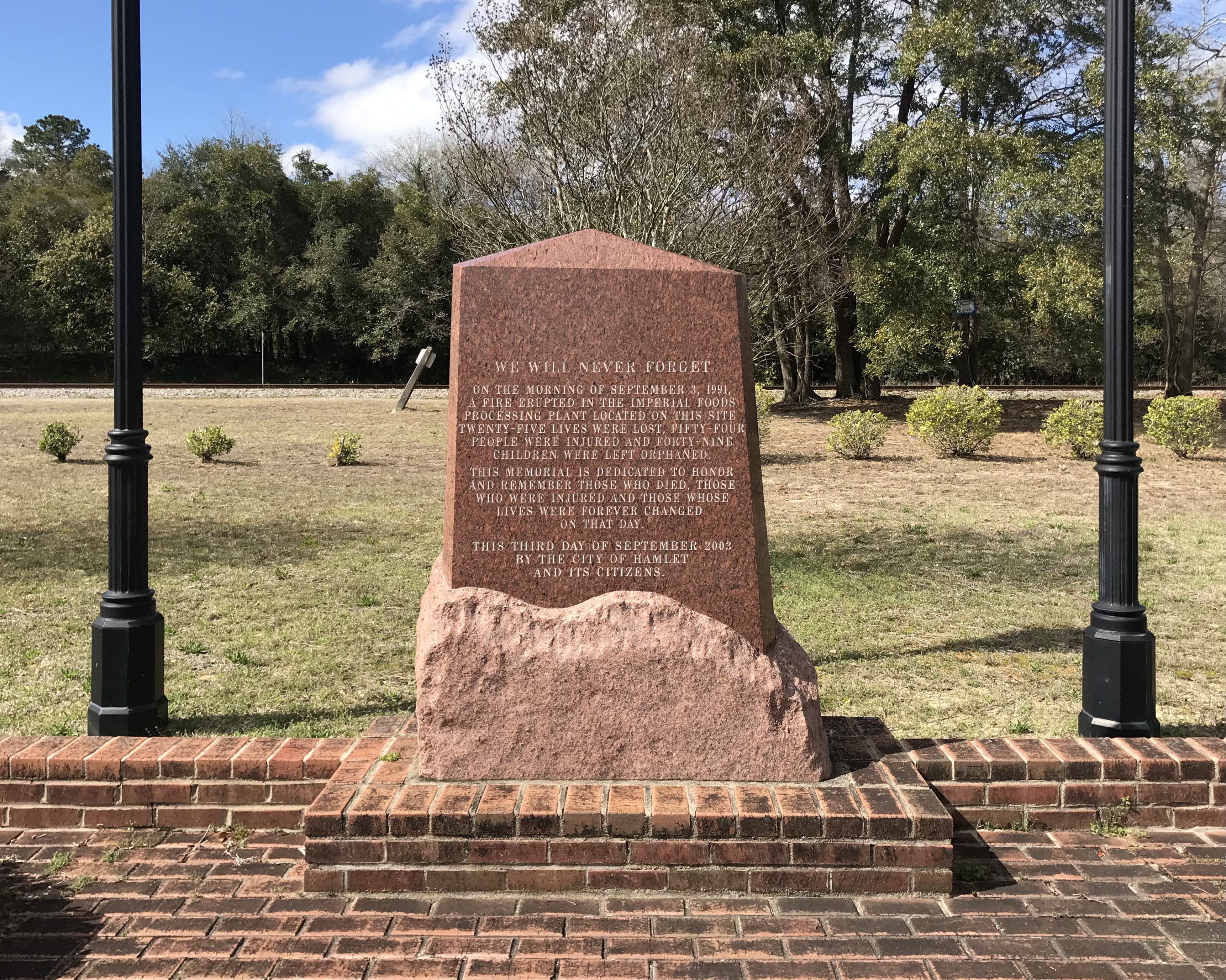
Hamlet Chicken Processing Plant Fire
Seven of the nine doors were locked from the outside. That single fact defines everything about what happened at the Imperial Food Products chicken processing plant in Hamlet, North Carolina, on September 3, 1991. When a jury-rigged hydraulic line ruptured at 8:15 that morning and sprayed fluid into the flame of an industrial fryer, the fire that erupted engulfed the building in under two minutes. Ninety workers were inside. Some reached the unlocked front door. Others ran through smoke so thick it could incapacitate a person in a few breaths, searching for exits that would not open. Twenty-five people died, nearly all from smoke inhalation. Investigators later found dent marks on at least one locked door, left by someone trying to kick their way out. In eleven years of operation, the plant had never received a single safety inspection.
A Plant Nobody Checked
Emmett Roe founded Imperial Food Products in Moosic, Pennsylvania, in the 1970s. He moved production to Hamlet in 1980, drawn by cheap labor and proximity to poultry suppliers. The facility -- a former ice cream plant on Bridges Street dating to the early twentieth century -- was renovated without the seven required building permits. The plant had no fire alarm, no fire sprinkler system, no evacuation plan, and workers never underwent a fire drill. There was one fire extinguisher near the fryer. OSHA inspectors had already flagged Roe's Pennsylvania plant for 33 health and safety violations, including blocked emergency exits; one inspector wrote that Roe displayed "utter contempt for OSHA." The inspector noted the existence of the Hamlet plant and suggested checking it. Nothing was done. In 1991, North Carolina law required local governments to appoint fire inspectors, but the statute came with no funding, and Hamlet could not afford to hire one.
Doors Locked Against Theft
In the summer of 1991, Roe ordered several exterior doors padlocked. One bore a sign reading "Fire Exit Do Not Block." The ostensible reason was to prevent workers from stealing chicken, though supervisors later downplayed this explanation. USDA food inspectors visited the plant daily to check the poultry, but when one worker raised safety concerns, the inspector told him it was outside his purview. A line worker considered reporting the locked doors to management, but her coworkers convinced her not to, fearing she would lose her job. Most employees did not know that federal law protected them from retaliation for reporting safety violations. Only a handful of maintenance workers even knew the doors were locked. The Hamlet Fire Department had no contingency plan for the plant and, despite later claims from an Imperial supervisor, did not possess a key to the padlocks.
Eight Minutes of Fire
Over Labor Day weekend, maintenance workers tried to fix a leaking hydraulic line on the chicken fryer's conveyor belt. Head mechanic John Gagnon asked Brad Roe -- Emmett's son and the plant's operations manager -- for money to buy the correct replacement parts. The request was denied as too expensive, and the crew improvised with a spare line and a hacksaw. The fryer manual called for shutting down the heat before handling flammable liquids nearby, but the crew feared the two-hour reheat delay would anger management. Seconds after they turned the conveyor on that Tuesday morning, the improvised connector blew apart under pressure. Hydraulic fluid sprayed onto the fryer's heating lines, vaporized instantly, and ignited. Chicken grease coating the walls and floor fed the blaze. A gas line in the ceiling ruptured. The plant split in two -- workers near the front escaped through the one unlocked door, while those in the processing and trim rooms were driven back toward the locked exits, the loading dock, and the breakroom. Firefighters reached the scene at 8:27 and brought the fire under control by 10:00 a.m. Of the 25 dead, 18 were women. One victim was a vending machine deliveryman who was recognized at the scene by his own son, a responding firefighter.
Justice Delayed and Diminished
North Carolina's Department of Labor imposed an $808,150 fine on Imperial for 83 OSHA violations -- a state record -- but the company declared bankruptcy and never paid. Emmett Roe pled guilty to 25 counts of involuntary manslaughter and was sentenced to nearly 20 years in prison. He served about four years before his release. Over 100 lawsuits followed. Insurers initially refused to pay, arguing that plant conditions were so unsafe the losses fell outside coverage. A $16.1 million settlement was eventually reached. A second suit against 41 companies, including the fryer manufacturer Stein and ceiling tile producer Kemlite, yielded $24 million. Roe's defense attorney later recounted that the local prosecutor privately referred to the deceased workers as "a bunch of low-down black folks" -- twelve of the plant workers who died were African American and twelve were white. Survivors suffered lasting respiratory ailments, muscular injuries, and cognitive impairments. By September 1992, only about 20 of them had found new jobs.
The Fire Nobody Remembers
The North Carolina General Assembly passed 14 new worker safety laws in response, including whistleblower protections. The state inspector corps nearly doubled, from 60 to 114 personnel. OSHA dispatched 14 of its own inspectors to North Carolina -- an unprecedented intervention. The Secretary of Labor gave the state 90 days to improve enforcement or face a federal takeover. But unlike the 1911 Triangle Shirtwaist Factory fire, which transformed American labor law and remains seared into public memory, the Hamlet fire faded quickly from the national conversation. Historian Bryant Simon wrote that the disaster "didn't fundamentally change the conversation in the state or the nation. It didn't make us see the world in a different way. It did not really bring the people who do the dirty work into view." The Imperial plant was permanently closed. The site was cleared in 2002. Today, Hamlet is a small railroad town in the Carolina Sandhills, population around 6,000, where the ruins of the plant's foundations are the only physical trace of a catastrophe that should never have happened.
From the Air
Located at 34.88N, 79.70W in Hamlet, North Carolina, a small town in the Carolina Sandhills region of Richmond County. The former plant site is along Bridges Street in a residential area. Hamlet is a historic railroad junction town with a distinctive Amtrak station. Nearest airport: Richmond County Airport (KRCZ) approximately 4 nm northwest. Best viewed at 2,000-4,000 ft AGL. Flat terrain with pine forests and sandy soil typical of the Sandhills.