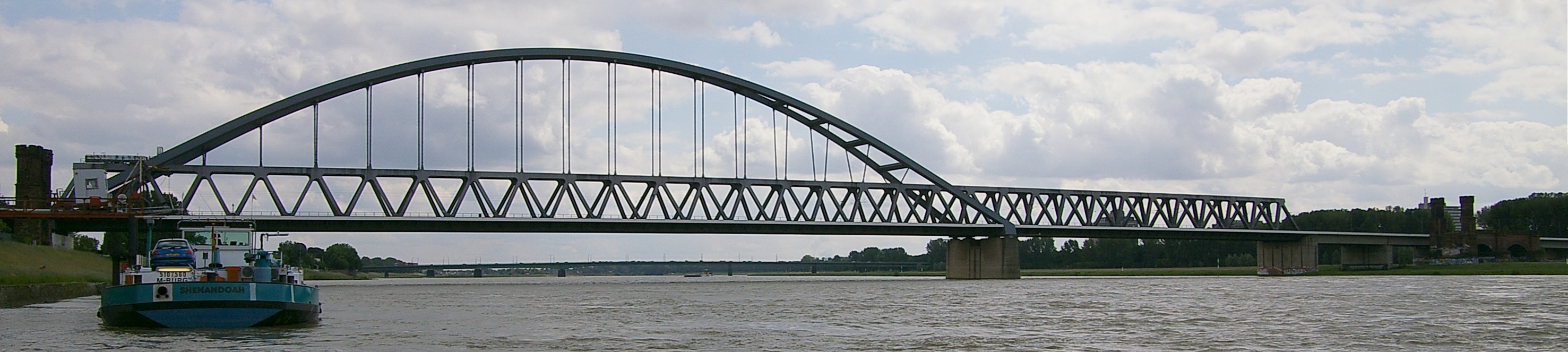
Hamm Railway Bridge
On March 3, 1945, with American troops two days into the conquest of Neuss across the river, the German Wehrmacht detonated every Rhine bridge in Düsseldorf. The Hamm Railway Bridge — the city's first solid Rhine crossing, opened in 1870 — collapsed into the water with the rest. Within four months, engineers were already back on the wreckage, salvaging arches from the still-standing southern twin to splice into the more damaged northern bridge. Trains were running again by July 31, 1946. The Rhine had taken Hamm down before. It would not be the last time it had to be put back up.
King William's Iron Arch
The original Hamm Railway Bridge opened on July 24, 1870, the first solid bridge across the Rhine at Düsseldorf. It was named the König-Wilhelm-Brücke after the Prussian king William I, built by the Bergisch-Märkische Railway Company to plans drawn by an engineer named Pichier at the Harkort works in Duisburg. The structure was a wrought-iron arch supporting a three-span truss, but the two heavy stone towers on each bank were doing more than decoration. They were fortifications. Bridges over the Rhine were strategic targets in any war anyone could imagine in 1870, and the towers — together with an outer fort that stood beside the bridge until 1885 — were meant to make Hamm defensible.
Two Bridges, Side by Side
Traffic outgrew Pichier's bridge faster than anyone expected. Between 1909 and 1911, the railway built a second, parallel double-track span just upstream, on identical pier spacing but with a heavier and more modern superstructure. Its bridge towers were bigger and stronger. With the new span carrying the load, engineers immediately rebuilt the original 1870 bridge to match — replacing its half-parabolic beams with new superstructure identical to the second bridge. By November 1912, two near-twin bridges sat side by side across the Rhine. Only the towers gave the older one away.
The Demolition
On March 1, 1945, the U.S. Army took Neuss on the west bank. Two days later, retreating German troops blew up every Rhine bridge in Düsseldorf to slow the Allied crossing. The Hamm Railway Bridge went with them. Recovery began almost immediately. The two destroyed central arches of the less-damaged northern bridge were spanned with a temporary structure built from standardized "Schaper-Krupp-Reichsbahn" parts, and trains crossed the Rhine here again on July 31, 1946 — sixteen months after the demolition. The permanent fix came in November 1947, when the least-damaged arches of the ruined southern twin were salvaged and substituted for the temporary spans. The northern bridge was whole again. The southern bridge was not rebuilt. Its iron went to scrap. Its piers and towers were left standing in the river — ruins of a structure not quite a century old.
A Record-Breaking Replacement
The third Hamm bridge came in 1987. The east-west S-Bahn line S 8, opened in 1984, demanded four tracks across the Rhine again, so a new bridge — built just south of the original alignment — was floated in for the equivalent of €61.4 million. The main river span is a tied arch attached to a Warren-truss through span, deliberately echoing the historic profile. The whole 9,000-tonne structure is fully welded; pieces up to 100 tonnes were assembled on the Düsseldorf bank and slid into place. When it opened, its main span was the longest of any railway bridge in Germany, a record it held until the 250-metre span of the Grümpentalbrücke on the Nuremberg–Erfurt high-speed line eventually overtook it.
The Towers That Remain
Once the new bridge was carrying trains, the old north bridge — the 1912 rebuild of Pichier's 1870 structure — was demolished. But the stone towers were left standing on both banks. They were the last visible piece of the original König-Wilhelm-Brücke, and someone made the decision that 150 years of history were worth keeping even when the bridge between them was gone. The Bergische Lehnsritter, a local club, now uses the towers as its headquarters. The ruins of the security fort on the east bank are still visible too, lower down by the water. Three bridges, one alignment, and the same stubborn idea: trains need to cross the Rhine here. Whatever it costs.
From the Air
Coordinates 51.21°N, 6.73°E. The bridge crosses the Rhine between the Düsseldorf suburb of Hamm and the Neuss district of Rheinparkcenter. Düsseldorf International (EDDL) is about 8 km north. From altitude, look for the tied-arch span with its characteristic curved profile, set just upstream of the older stone tower ruins on both banks. Best viewing 2,000–4,000 ft to pick out the bridge towers as ghost-monuments to the 1870 original. The Rhine here runs roughly north–south; the railway crosses east–west.