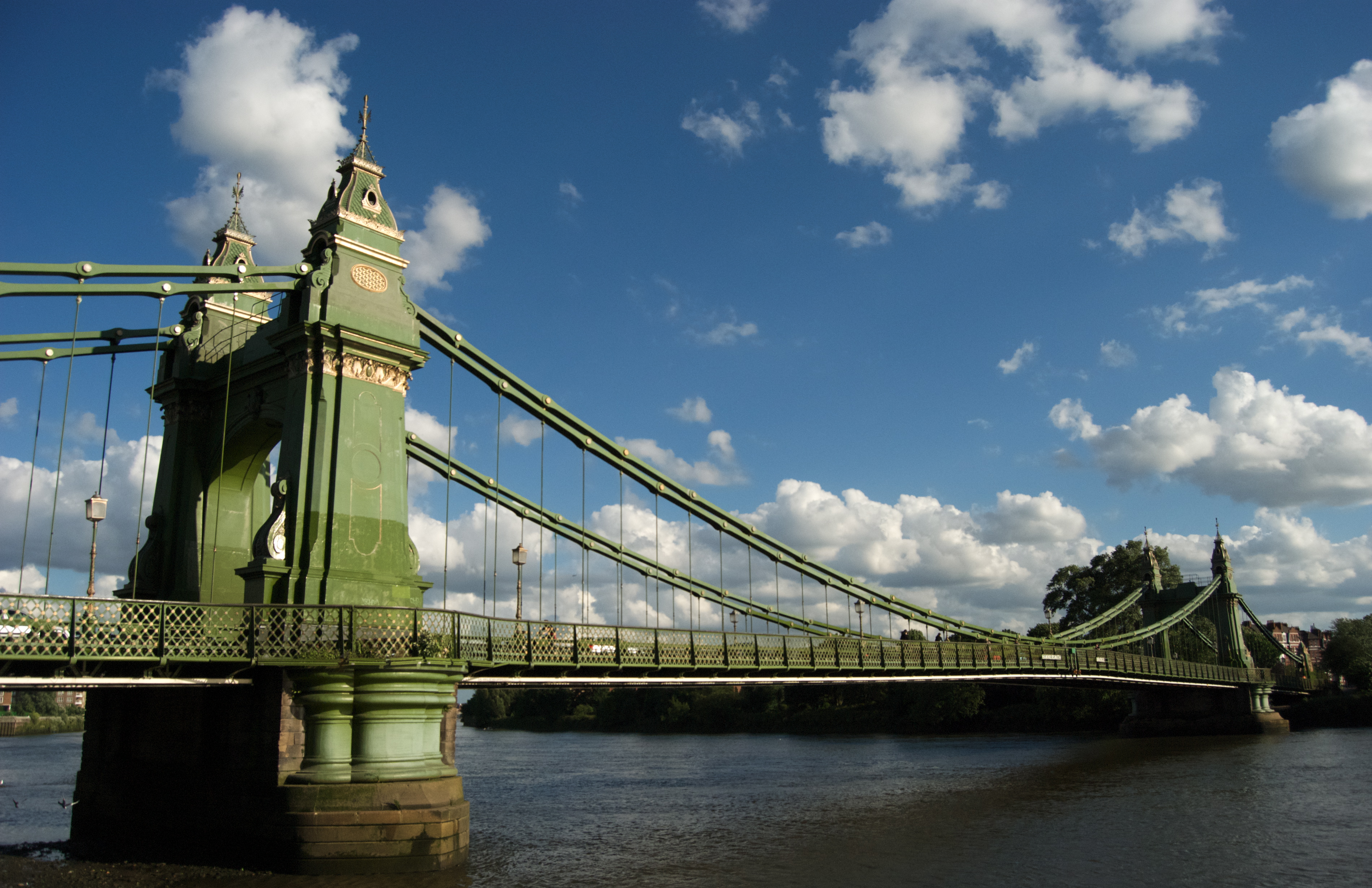
Hammersmith Bridge: Bombed, Broken, and Still Beautiful
At one o'clock in the morning in 1939, a hairdresser named Maurice Childs from nearby Chiswick was crossing Hammersmith Bridge when he noticed a smouldering suitcase on the walkway. He threw it into the Thames. The resulting explosion sent a column of water high into the air, blew a hole in the bridge deck, and damaged the suspension chains. It was the IRA's first attack on the bridge. They would try twice more -- in 1996 with the largest Semtex bomb ever found in Britain, and again in 2000. The bridge survived all three attacks. What has proved harder to survive is simple age.
London's First Suspension Bridge
The original Hammersmith Bridge, designed by William Tierney Clark and opened on 6 October 1827, was the first suspension bridge over the Thames. Local residents had grown tired of detouring to Kew Bridge or Putney Bridge to cross the river, and an Act of Parliament in 1824 authorized a private company to build the crossing. The original bridge had stone suspension towers designed as archways of the Tuscan order, with octagonal toll-houses at each approach. The company even built a floating steamboat pier to boost revenue. But by the 1880s the bridge could not handle modern traffic, and a replacement was commissioned.
Bazalgette's Masterwork
The current bridge was designed by Sir Joseph Bazalgette -- the same engineer who built London's sewer system -- and opened by the Duke of Clarence on 11 June 1887. Built of wrought iron, it stretches 700 feet across the river and is 43 feet wide, decorated with ornamental ironwork and heraldic shields. At both ends, seven coats of arms are displayed: Queen Victoria's royal arms at center, surrounded by the arms of Surrey, Westminster, Essex, Middlesex, the City of London, and Kent. The bridge is Grade II* listed and widely considered one of London's most beautiful river crossings. It is also, by a considerable margin, one of its most fragile.
A Bridge Too Expensive to Fix
Hammersmith Bridge has been in some state of structural crisis for decades. It was closed to most traffic in 1997 for repairs. In April 2019, cracks were discovered in the pedestals and the bridge was closed indefinitely to all motor vehicles. During a heatwave in August 2020, the structural problems worsened and the bridge was shut entirely -- no cars, no cyclists, no pedestrians. Estimates for full repair reached 141 million pounds. Neither the local council nor Transport for London had the money. Foster and Partners proposed a temporary double-decked steel structure inside the existing bridge. The cost eventually climbed to 250 million pounds. By January 2024, London's Mayor acknowledged that no one had the funding to restore the bridge to vehicle use.
Open Again, Sort Of
In April 2025, after years of piecemeal stabilization work costing nearly nine million pounds -- delayed at one point by the Russian invasion of Ukraine, which made steel scarce, and at another by a boat collision that damaged a repair gantry -- the bridge's resurfaced wooden roadway was reopened to pedestrians and cyclists. The deck is made of plywood boards bolted to timber supports. It remains closed to motor vehicles, with no date set for full restoration. Rowing crews still race beneath it during the annual Boat Race and the Head of the River Race. From the bridge, walkers can look east toward central London or west toward the green banks of Barnes. The heraldic shields gleam in their paint. The ironwork is as ornate as ever. Hammersmith Bridge endures, beautiful and broken, waiting for someone to find the money to make it whole.
From the Air
Hammersmith Bridge (51.49N, 0.23W) crosses the Thames in west London between Hammersmith and Barnes. The ornate suspension bridge is identifiable from altitude by its distinctive green ironwork. The Thames curves prominently here. Nearby airports: London Heathrow (EGLL) 8nm west, Northolt (EGWU) 9nm northwest. Best viewed from 1,500-2,500ft following the Thames corridor.