Hampton Court Palace: Henry's Obsession, William's Ambition
Cardinal Thomas Wolsey made a mistake that would cost him everything. In 1514, the Archbishop of York and chief minister to Henry VIII began building a palace on the Thames so magnificent that it outshone anything the king himself possessed. When Wolsey fell from favor in 1529, he tried to save his life by giving Hampton Court to Henry. The bribe delayed but did not prevent his destruction. Henry accepted the palace, enlarged it enormously, and made it one of his favorite residences -- a place where he honeymooned, feasted, hunted, and where the ghost of his fifth wife Catherine Howard is said to still walk the Haunted Gallery, screaming for mercy.
Wolsey's Vision, Henry's Appetite
Wolsey built Hampton Court to reflect his status as the most powerful man in England after the king. He chose pink brick, then fashionable, and laid out the palace around a series of courtyards designed for entertaining on a lavish scale. His household numbered nearly five hundred. When Henry took possession, he expanded the palace to accommodate his even larger retinue of courtiers. Henry added the Great Hall, the Chapel Royal, and extensive kitchens capable of feeding the court. The palace became a center of Tudor power -- a place where marriages were celebrated, alliances forged, and the fates of queens decided. It was at Hampton Court that Jane Seymour gave Henry the son he desperately wanted, and it was there that she died twelve days later.
William's Versailles
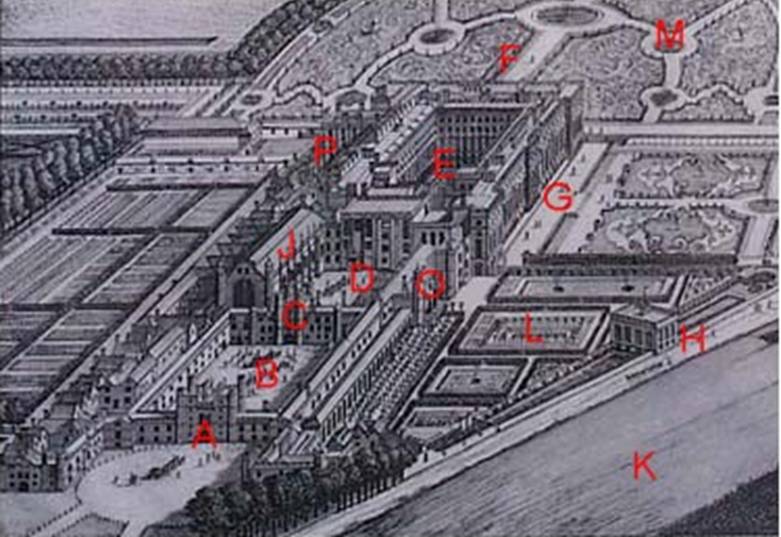
In the early 1690s, William III commissioned Sir Christopher Wren to rebuild Hampton Court on a scale that would rival the Palace of Versailles. The project was staggeringly ambitious. Wren demolished much of Henry's Tudor palace and replaced it with grand Baroque state apartments featuring painted ceilings and classical facades. But the work stopped abruptly in 1694 after Queen Mary II died of smallpox, and William lost enthusiasm for the project. The result was a palace permanently split between two architectural personalities: the surviving Tudor sections, with their warm brick, twisted chimneys, and intimate courtyards, sit alongside Wren's cool, symmetrical Baroque wings. The accident of fate gives Hampton Court a unique character -- half medieval, half classical, unified only by the pink brick both eras shared.
The Maze and the Gardens
Hampton Court's hedge maze, planted in the 1690s for William III, remains one of Britain's most famous garden features. Covering a third of an acre, it was designed to be navigated -- visitors are meant to get lost. The maze has appeared in literature from Jerome K. Jerome's Three Men in a Boat to countless children's novels. Beyond the maze, the palace gardens cover sixty acres of formal plantings, including the Great Vine, planted by Capability Brown in 1769 and still producing grapes. The Privy Garden was restored in the 1990s to its William III appearance, and the enormous Tudor kitchens have been recreated to show how meals were prepared for Henry VIII's court, which consumed two thousand sheep and over a thousand deer each year.
Ghosts and Guardians
George II was the last monarch to live at Hampton Court. Since then, the palace has served various purposes, including housing 'grace and favour' residents -- people granted apartments by the Crown. Today it is managed by the independent charity Historic Royal Palaces, which receives no government funding. The palace is one of London's most visited tourist attractions, drawing visitors to its Tudor kitchens, Baroque state apartments, and the Haunted Gallery where Catherine Howard's ghost is said to appear. The palace displays works from the Royal Collection, including Andrea Mantegna's Triumphs of Caesar paintings. From the river, the palace's long brick facade and the ornamental gardens stretching to the Thames create a scene that has changed remarkably little since Henry VIII first gazed upon it and decided it must be his.
From the Air
Hampton Court Palace (51.40N, 0.34W) is on the north bank of the Thames in the London Borough of Richmond upon Thames, 12 miles southwest of central London. The palace, its formal gardens, maze, and the Great Park are clearly visible from altitude. The Thames curves prominently around the palace grounds. Nearby airports: London Heathrow (EGLL) 7nm north, Fairoaks (EGTF) 8nm southwest. Best viewed from 2,000-3,000ft.