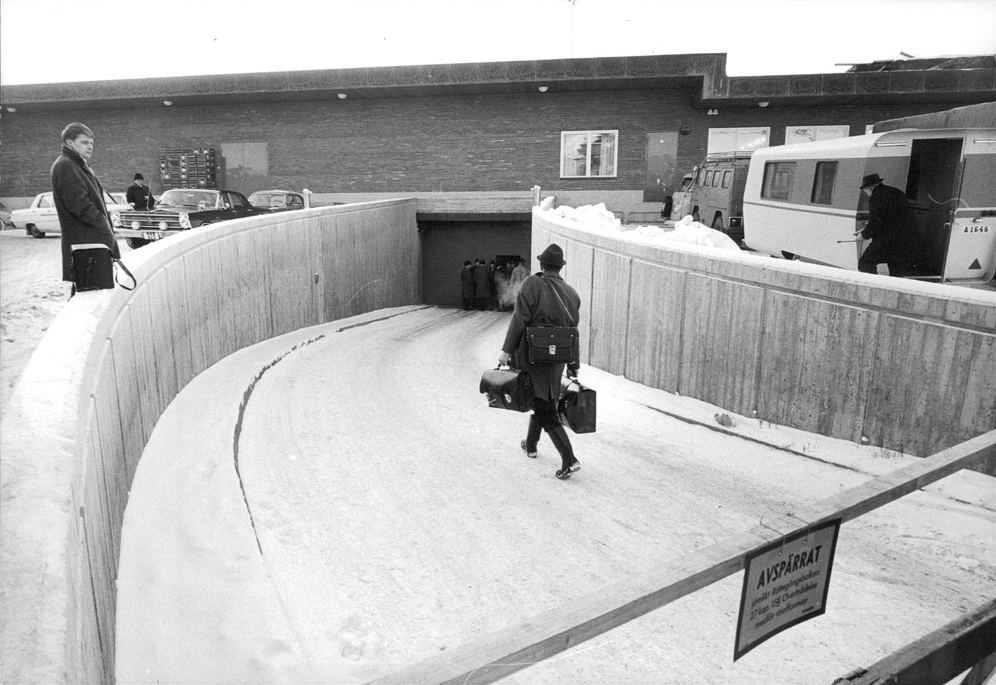
Handen Murders
Thirty-four shots shattered the winter silence of Handen Centrum on the night of January 9, 1967. Two police officers and a security guard lay dead beside a loading dock at Sweden's newest shopping mall, victims of a chance encounter with men they initially mistook for fellow security personnel. The triple murder sent shockwaves through a nation unaccustomed to such violence, exposing a criminal underworld that had been quietly arming itself with stolen military weapons.
A Routine Surveillance Gone Wrong
Police officers Uno Helderud and Lars Birger Wikander had been assigned to watch a loading bay at Handen's new business center, south of Stockholm. Intelligence suggested thieves might strike. When three men approached in the darkness, the officers grew suspicious. The men claimed to be security guards responsible for the stores, but something felt wrong. Without warning, one of them produced a submachine gun, another a pistol. The first burst killed Wikander instantly. Helderud, struck eleven times, somehow dragged himself onto the loading dock. Security guard Nils Bertil Nilsson, caught in the crossfire, was hit eleven times as well. The killer, not yet finished, fired again at Nilsson before turning the submachine gun on the wounded Helderud one final time.
The Making of a Murderer
Leif Peters was born in Gothenburg in 1938 to a troubled family with an alcoholic father. His early years were marked by convictions for theft and firearms offenses. By 1964, a routine arrest for petty theft at Stockholm's famed Operakällaren restaurant led police to discover a pistol in his home, connected to a large weapons theft on the island of Orust. Yet sentences remained light, and Peters continued down the same path. With his brother Bo, he became involved in ever-larger weapons heists. In autumn 1966, they burglarized a military depot, making off with submachine guns and ammunition. Those weapons would soon be used at Handen.
The Night Watchman Gang
Peters had worked briefly for a Stockholm security company in 1965, knowledge he would later exploit. The criminal network that emerged around him became known as the Nattvaktsligan, the Night Watchman Gang. When Peters was arrested without incident on February 11, 1967, on a quiet street in Strängnäs, investigators began unraveling a web of stolen weapons, burglaries, and accomplices. The night before his formal remand, Peters attempted suicide in his cell, tearing his jacket lining and fashioning it into a noose. Guards intervened in time. During his first interrogation at police headquarters on Kungsholmen, he confessed.
Justice and Its Limits
The main trial, known as Handenmålet, opened on June 7, 1967, with twelve defendants. Gustav Torver and Leif Wahlkvist, Peters' accomplices, received five years for aggravated theft and related charges, but the murder complicity charges were dismissed. A psychiatric evaluation found Peters mentally sound. On March 29, 1968, the court sentenced him to a minimum of twelve years' detention. He had deliberately used a submachine gun to kill three men, the court concluded, though it could not determine who fired the initial pistol shots. Peters would later be suspected in an unsolved 1960 murder case, though the statute of limitations eventually closed that investigation. He died in 2006 at sixty-eight, the Handen murders still the most notorious crime of 1960s Sweden.
From the Air
Located at 59.17°N, 18.14°E in Handen, approximately 15 kilometers south of central Stockholm. The former Handen Centrum shopping area is in a suburban setting surrounded by residential neighborhoods and light industrial zones. Nearby airports include Stockholm Bromma (ESSB, 20nm northwest) and Stockholm Arlanda (ESSA, 35nm north). The location has no distinctive aerial features but lies along the main rail corridor south from Stockholm.