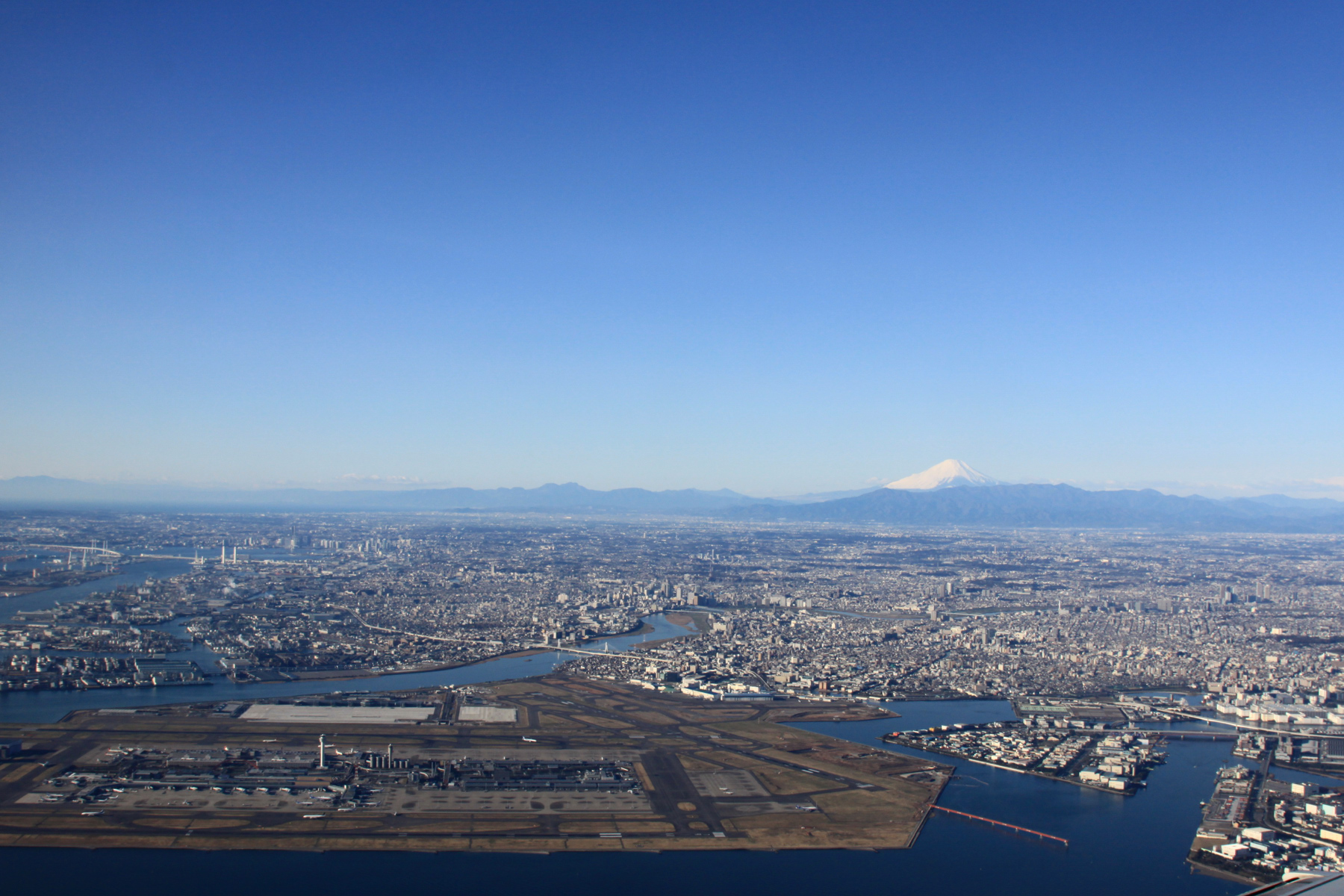
Haneda Airport
There is a photograph that aviation historians cannot forget. On March 5, 1966, a BOAC Boeing 707 taxis past the still-smoldering wreckage of a Canadian Pacific DC-8 that had crashed into the seawall less than 24 hours earlier. The BOAC jet was departing for Hong Kong. It never arrived. Near Mount Fuji, violent clear-air turbulence tore the aircraft apart, killing all 124 people aboard. Two catastrophic accidents at the same airport in two consecutive days -- and a third had already struck one month before. That dark spring of 1966 belongs to Haneda, Tokyo's original airport, a facility that has spent nearly a century being built, seized, restricted, expanded, and reinvented on a patch of reclaimed land at the edge of Tokyo Bay.
Insects, Empire, and Occupation
Haneda opened on August 25, 1931, when its first flight carried a cargo of insects to Dairen in the Kwantung Leased Territory, now part of China. The airport began as a modest affair: a single concrete runway, a small terminal, and two hangars on land the Japanese postal ministry had purchased from a private individual in 1930. Japanese newspapers built their first aviation departments here. Manchukuo National Airways launched service to the Manchurian capital Hsingking. After Japan's defeat in 1945, General Douglas MacArthur ordered Haneda handed over to occupation forces on September 12. The next day he took possession and renamed it Haneda Army Air Base. On September 21, the Anamori Inari Shrine and over 3,000 residents received orders to leave their homes within 48 hours to make room for longer runways. Many resettled across the river in the Haneda district of Ota, where their descendants still live today.
Gateway to the World, Then Not
International aviation blossomed at the base even under military control. Northwest Orient Airlines began DC-4 flights to the United States in 1947. Pan American World Airways made Haneda a stop on its famous round-the-world route that same year, with westbound service through Shanghai, Hong Kong, Kolkata, Karachi, Damascus, Istanbul, London, and New York. Air France arrived in 1952. BOAC flew de Havilland Comets to London in 1953. The Tokyo Monorail connected the airport to central Tokyo in 1964, just in time for the Summer Olympics. Then, in 1978, Narita Airport opened and absorbed virtually all international traffic. Overnight, Haneda became a domestic-only facility, its global connections severed. It would take 32 years to undo that decision.
The Black Spring of 1966
Within a single month in early 1966, three disasters struck flights connected to Haneda. On February 4, All Nippon Airways Flight 60, a Boeing 727, crashed into Tokyo Bay on approach, killing all 133 aboard. On March 4, Canadian Pacific Air Lines Flight 402, a DC-8 arriving from Hong Kong, descended below the glide path in poor visibility and struck the approach lights and a seawall. Of 72 people on board, only eight passengers survived. Less than 24 hours later, BOAC Flight 911 departed for Hong Kong and broke apart in extreme turbulence near Mount Fuji, killing all 124 aboard. An 8mm film recovered from the wreckage, shot by a passenger, confirmed the in-flight breakup. The combined death toll from Haneda's black spring was 379 people. Years later, on August 12, 1985, Japan Air Lines Flight 123 departed Haneda and crashed into a mountain after a catastrophic pressure bulkhead failure, killing 520 of 524 people aboard -- the deadliest single-aircraft accident in history.
Return to the World Stage
In 2010, Haneda reclaimed its international identity. A new terminal for overseas flights -- now called Terminal 3 -- opened alongside a fourth runway built on reclaimed land south of the existing airfield, increasing the airport's capacity from 285,000 to 407,000 aircraft movements per year. The government positioned Haneda as the "Hub of Japan" for premium business routes, while Narita became the "Hub of Asia" for leisure and low-cost carriers. By 2018, Haneda handled 87 million passengers, making it the fourth-busiest airport in the world. In 2022, it earned the title of most punctual international airport on Earth, with a 90.3 percent on-time departure rate across 373,264 flights. Today the airport covers 1,522 hectares and operates three passenger terminals with 71 jet-bridge gates, its four runways arranged in two parallel pairs that funnel traffic through circular routes over Tokyo Bay to avoid the surrounding military airspace and dense urban neighborhoods.
From the Air
Haneda Airport (RJTT) is located at 35.553N, 139.781E on the western shore of Tokyo Bay. ICAO code RJTT, IATA code HND. Four runways: 16L/34R, 16R/34L, 04/22, and 05/23 (D Runway, built on reclaimed land). During north wind operations (60% of the time), arrivals come from the south on 34L and 34R; during south wind operations, a high-angle approach over central Tokyo is used on 16L/16R between 15:00-18:00. Most traffic routes over Tokyo Bay due to proximity of Yokota Air Base and NAF Atsugi to the west. The airport is clearly visible from altitude -- look for the distinctive D Runway extending into the bay on its platform of reclaimed land. Narita International Airport (RJAA) lies approximately 37nm to the east.